2026 Q2 Report (SPP2 Q4)
Summary
This is the final report of Year 1 of our SPP2 scope of work, covering Apr–Jun 2026. In Calldata & Proposal Review, we answered every tagged proposal on time, all four quarters. Anticapture delivered the treasury and token market visibility KPI that had been delayed since Q3. The Delegation Incentives System was built, and the campaign opened in July. We implemented Governor Nexus, the governor upgrade we proposed as an RFC, and published the code and the implementation report in August. ENSIP-20 remains blocked on ENS Labs and ENSv2.
On Security Council Renewal, we built the new SecurityCouncil contract, had it audited by Nethermind (NM-0945), and submitted EP 6.45, which passed on Snapshot. The onchain executable, EP 6.48, was defeated. The DAO has since enacted a council running the same audited contract code (details in the Security Council Renewal section).
Outside the funded scope, we also over-delivered. We continued the end-to-end build of the Governance Interface, authored governance posts beyond our funded workstreams, and built a Copeland visualizer the DAO used to follow ranked-choice votes in real time.
Year 1 results
| Workstream | Where Year 1 ended | Status |
|---|---|---|
| Calldata & Proposal Review | We reviewed all 24 executable proposals of Year 1 on time |  Done |
| Anticapture | All four quarterly KPIs were met. The delayed Q3 treasury and token market KPI was delivered this quarter | Done |
| Notification System | The system is live with Telegram, Slack and offchain vote support | Done |
| Delegation Incentives | The campaign opened in July. The KPI is met at +71.2% (see the disclosure below) | Done |
| Governor Nexus | The implementation is done and the code went public in August. Feedback window open, external audit next |  In progress |
| Security Council Renewal | Our renewal was defeated onchain. In July the DAO adopted the same audited contract code |  Defeated → Adopted |
| ENSIP-20 | The work is waiting on a formal document from ENS Labs for ENSv2 | Blocked |
Calldata & Proposal Review
We reviewed all 24 executable proposals submitted onchain during Year 1 within the committed response time. That closes the year at 100% across all four quarters. The reviews are public in blockful/dao-proposals. We also improved the review tooling with test helpers, pre-state assertions, and CI formatting checks.
| EP | Description | Review published |
|---|---|---|
| EP 6.39 | Treasury Flow Automation | 2026-04-08 |
| EP 6.40 | Update DNSSEC Algorithm 7 | 2026-04-20 |
| EP 6.41 | Endowment permissions to KPK - Update #9 | 2026-05-01 (draft review), 2026-05-09 (live proposal) |
| EP 6.47 | Delegation Incentives Program (funding transfer) | 2026-07-01 |
| EP 6.48 | Renewal of the Security Council (our own proposal) | 2026-07-01 |
 Over-delivery: We started building
calldata-registry-protocol, which turns our proposal reviews into onchain records. It publishes each review as an EAS attestation, routes URLs by executor nonce with an indexer that needs no RPC calls, and includes a review app that maps how proposals depend on each other.
| Quarter | KPI | Status |
|---|---|---|
| Q1–Q4 | 100% response to tagged proposals within SLA | Done, all four quarters |
| — | calldata-registry-protocol review infrastructure |
Over-delivery |
ENSIP-20
The workstream is blocked on alignment with ENS Labs and the ENSv2 work rather than implementation effort. We did no ENSIP-20 dev work this quarter. As previously reported, PR #226 to ensdomains/ensjs remains open and unmerged, with no review activity since July 2025.
That pause is deliberate. Building the integration while the ENSv2 resolution model is still being finalized could mean building the wrong thing, so we are waiting for a formal document from ENS Labs describing what needs to change in the standard.
Getting that document from Labs has been difficult. In Year 2 we will keep pressing them for that answer, and we are ready to rebuild the standard if ENSv2 requires it. We identified this problem and took responsibility for solving it, but we cannot take it to production without Labs.
| Quarter | KPI | Status |
|---|---|---|
| Q1 | ENSIP specification + initial ENSjs integration | Done (PR #226 submitted, awaiting review since Jul 2025) |
| Q2 | Complete ENSjs implementation + integrate into frontend for usability testing | Blocked |
| Q3 | Integration with 2+ major subdomain providers + developer documentation | Blocked |
| Q4 | Full ENS Manager App + ENSv2 integration and 3+ production implementations | Blocked |
Anticapture
We delivered the treasury and token market visibility KPI that was delayed from Q3. The token markets side was already live through the token distribution and attack profitability pages. The treasury side was missing, and we closed it with the new revenue page, which breaks ENS revenue down by quarter. The methodology and data are open in ens-revenue-analysis.
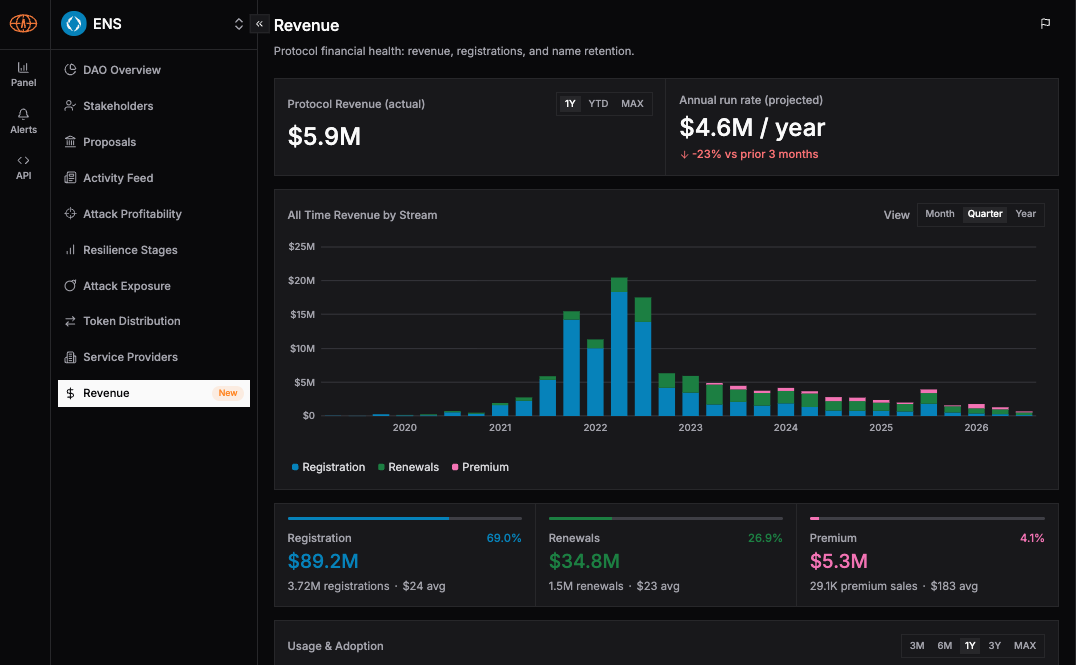
The KPI was waiting on the backend rework we reported last quarter, and we finished that rework this quarter. The dashboard now also shows votes, choices and non-voters for Snapshot proposals, including Copeland ranked-choice votes.
Over-delivery: We shipped an Anticapture MCP server, giving AI agents access to the same governance and security data the dashboard shows.
| Quarter | KPI | Status |
|---|---|---|
| Q1 | ENS DAO prototype with core governance risk metrics | Done |
| Q2 | Final DAO Security Staging Framework in ENS dashboard | Done |
| Q3 | Treasury and token market visibility | Done |
| Q4 | Risk-relevant transactions monitoring | Done (ahead of schedule) |
| Q4 | Offchain voting data integration | Done (ahead of schedule) |
| — | Anticapture MCP server | Over-delivery |
Governor Upgrade (Governor Nexus)
We spent the quarter implementing Governor Nexus, the modular governor with three interchangeable rulesets (Standard, Optimistic, Bond) that we had proposed to the DAO as an RFC.
The code is complete and public at blockful/nexus. In August, after the quarter closed, we posted the implementation report to the DAO, which opens a two-week feedback window before the external audit. The next steps are the audit and then deployment.
| Quarter | KPI | Status |
|---|---|---|
| Q1 | Governor change recommendations report | Done |
| Q2 | Community consensus on proposed changes | Done |
| Q3 | Governor ready for audit | In progress (code public in August, feedback window before the audit) |
| Q4 | Onchain deployment | Pending |
Delegation Incentives System
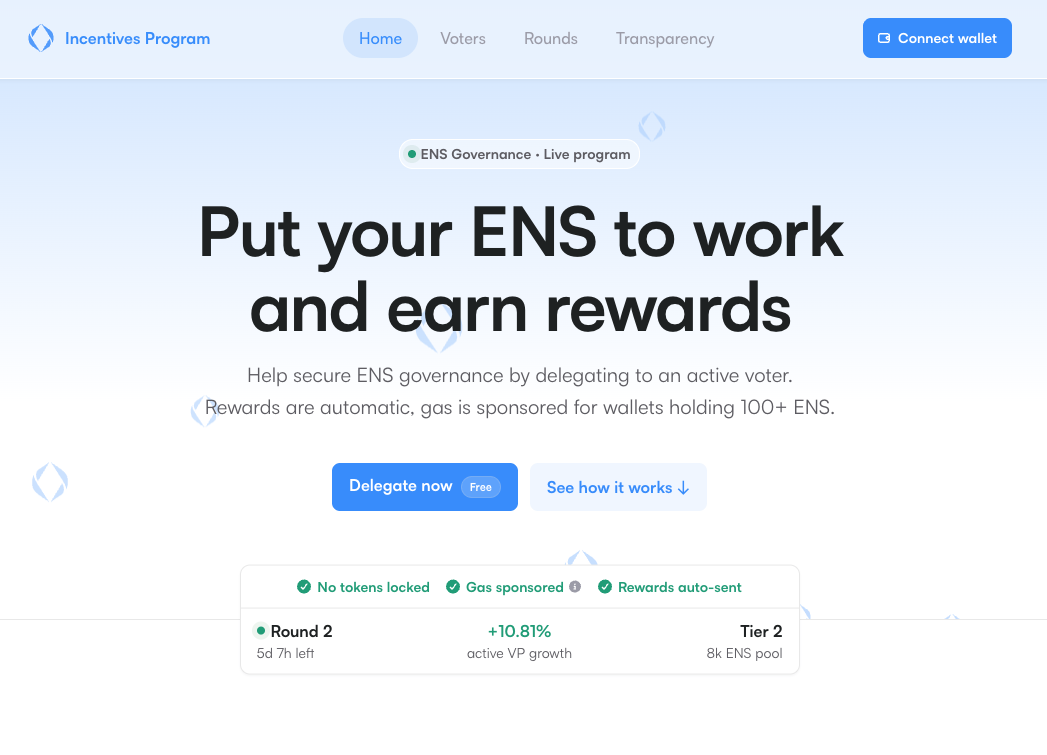
We finished building the Delegation Incentives System this quarter and made it ready to launch. Since last quarter, when it was feature-complete and under test, we added matchmaking between delegates and delegators, referral and sharing features, a rewards engine that records where each wallet’s rewards come from, gasless delegation through a relayer, and the public launch pages.
The campaign opened in July and runs through September 2026 at incentives.ens.blockful.io. The Q4 KPI is met. Delegated supply grew from ≈4.14M ENS to ≈7.09M ENS over the SPP2 year, measured as delegated voting power on 28 Jul 2025 and 29 Jun 2026 using Anticapture. That is +71.2% against the 30% target.
A single delegation accounts for the whole increase. nick.eth’s delegated voting power went from ≈155.6k to ≈3.26M ENS, a rise of 3.11M ENS, which is 105% of the DAO’s 2.95M net increase. Excluding that address, delegated supply fell from ≈3.99M to ≈3.83M ENS, a 3.9% decrease.
| Measure | 28 Jul 2025 | 29 Jun 2026 | Change | vs. 30% target |
|---|---|---|---|---|
| Total delegated supply (the KPI) | ≈4.14M ENS | ≈7.09M ENS | +71.2% | Met |
| Excluding nick.eth’s delegation | ≈3.99M ENS | ≈3.83M ENS | −3.9% | Below target |
We report the KPI as met because it is met as written. We do not attribute the increase to our work. The campaign was not running at any point in the window this KPI measures, so the −3.9% reflects a year with no incentives program in place.
Engaging the community around the campaign has been harder than expected. Delegates offered strong support for spreading the word early on, but after the discussions and enactment of the ENS Foundation proposal, that support faded and fewer tokenholders heard about the program.
| Quarter | KPI | Status |
|---|---|---|
| Q1 | Research report on effective delegation models | Done |
| Q2 | Community iteration and scope definition | Done |
| Q3 | Scope delivery | Done (system built and ready to launch) |
| Q4 | 30% increase in delegated supply (excluding veto council) | Met at +71.2% (see the disclosure above) |
Notification System
This quarter’s Notification System work went into reliability. We rebuilt the Snapshot reminders, improved their delivery consistency and monitoring, and restored the offchain and security-thread notifications after the Anticapture backend rework, using the public @anticapture/client package. Our uptime monitoring showed no downtime during the quarter.
| Quarter | KPI | Status |
|---|---|---|
| Q1 | Telegram integration (voting reminders, delegate inactivity) | Done |
| Q2 | Slack integration | Done |
| Q2 | Email, Discord integration |  De-prioritized (no delegate demand, ready to enable on request) |
| Q3 | Offchain vote support | Done |
| Q3 | 99% uptime | Done |
| Q4 | Anticapture security thread notifications | Done (restored after the Anticapture backend rework) |
| Q4 | 99% uptime (sustained) | Done (no downtime this quarter) |
Security Council Renewal
The DAO’s Security Council was set to expire, so we took on renewing it. We built a new contract where only the DAO timelock can extend the expiration and the council multisig owns it from day one. We had it audited by Nethermind, deployed it to mainnet on 20 June 2026, and submitted EP 6.45.
EP 6.45 passed on Snapshot. The onchain executable that would have enacted it, EP 6.48, Renewal of the Security Council (Term 2), was defeated with 1,137,702 ENS for and 3,859,981 ENS against, 3,260,721 of them cast by nick.eth. Our proposal kept the current council membership, and that membership, not the contract or the audit, was the objection. nick.eth wrote onchain that the current members had made clear they intended to use the veto against proposals they personally disagree with.
On 13 July 2026 nick.eth submitted Establishing a new Security Council (Executable), which passed with 4,228,716 ENS for and 94,526 ENS against and was executed. The new council runs the contract we developed and had audited, and we helped architect the proposal and its deployment. We also reviewed the calldata and verified onchain that the deployed bytecode exactly matches the code Nethermind audited. The council is now owned by the elected members’ 5-of-8 Safe and expires on 16 July 2028.
Over-deliveries
Everything in this section sits outside our funded scope. The Extended Scope ($100k) that would have covered part of it was not approved, so we delivered it at no additional cost to the DAO.
Governance Interface
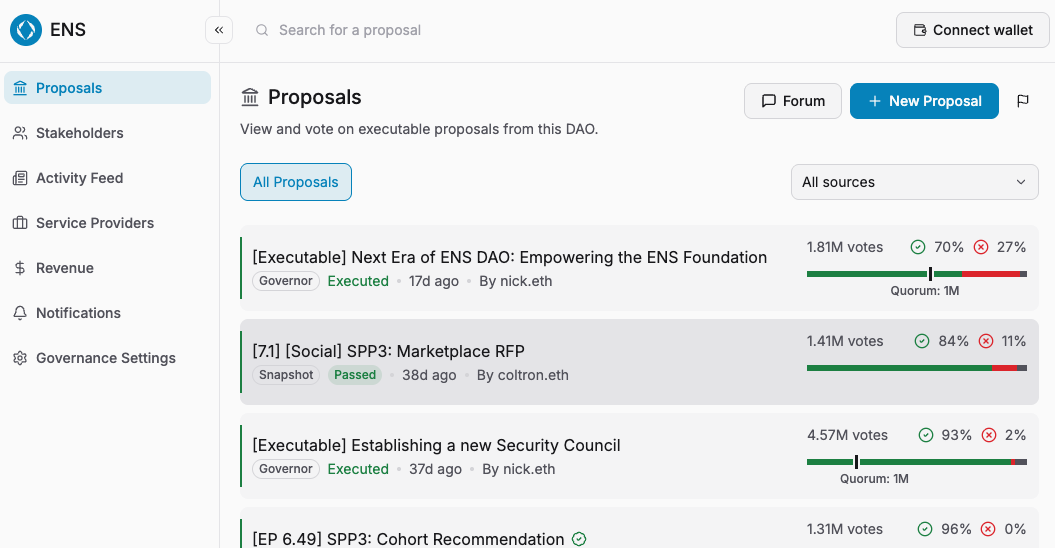
The Governance Interface is in production. With Tally sunsetting, we are building it to become the DAO’s main governance tool, under the ENS brand. We introduced it to the DAO in an RFC on 31 May. The main features deployed this quarter:
- Proposal creation, with a multi-action calldata builder and queue and execute steps
- Shareable proposal drafts, so an author can circulate and refine a proposal before submitting it onchain
- Gasless voting and delegation through a relayer
- A unified list of onchain and Snapshot proposals
- A revenue dashboard covering ENS revenue, registrations, renewals, retention and expirations
ENS governance work
We were active in ENS governance throughout the quarter, authoring proposals, temp checks and public positions, and holding a Meta-Governance Working Group steward seat. Most of that participation was already committed to the DAO, through the stewardship or through funded workstreams like the Security Council renewal. Setting those aside, two posts were still over-delivery.
Copeland visualizer
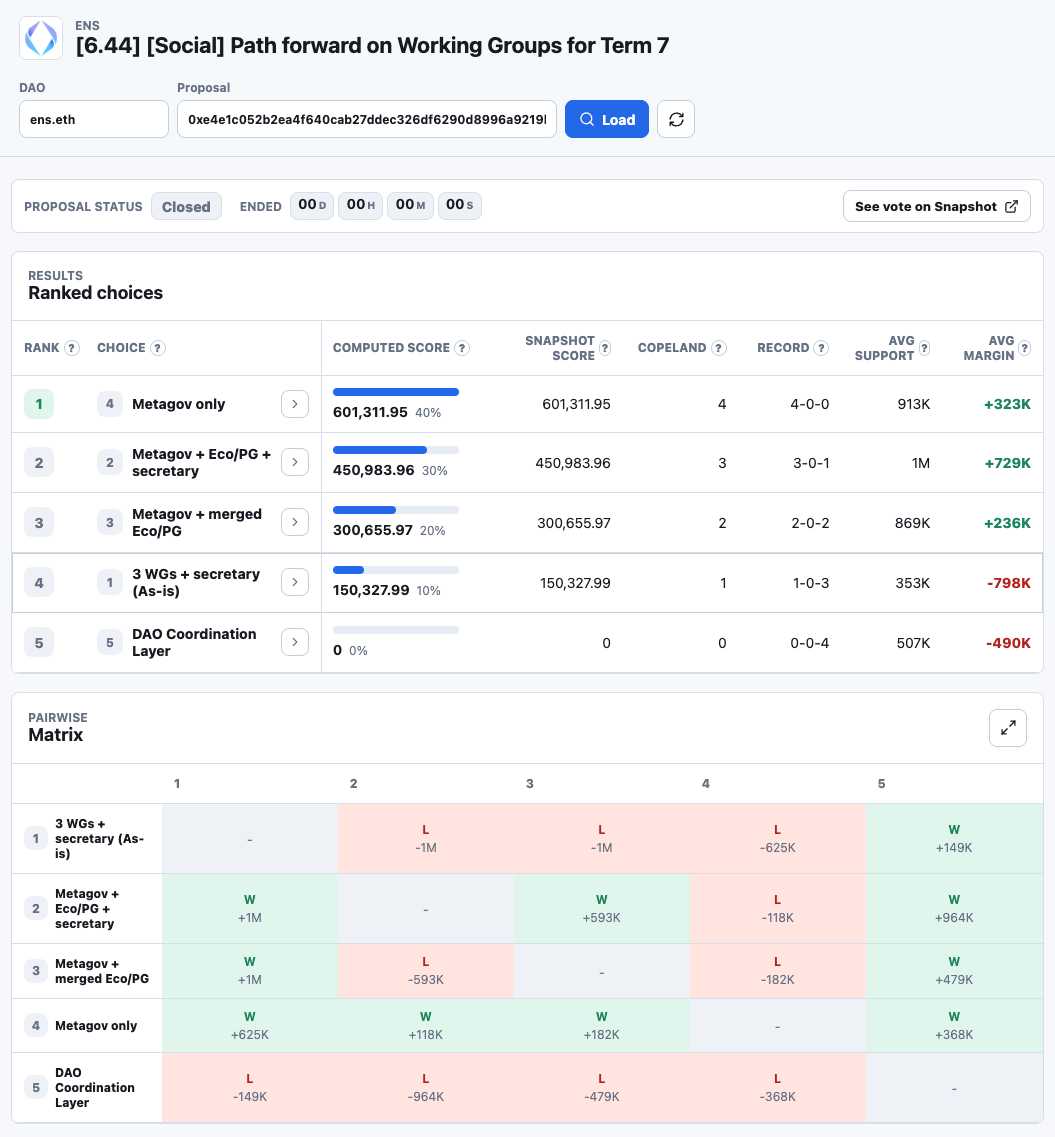
ENS ranks candidates with the Copeland method in SPP and working group votes, and the raw Snapshot results are hard to read. We built a visualizer that shows the standings in real time and shared it with the DAO during the Term 7 working groups vote. The code is open at blockful/copeland-visualizer.
Carried into Year 2
Three items carry into Year 2, none of them abandoned. The table shows where each one stopped and what it is waiting on.
| Item | Where it stopped | What it is waiting on |
|---|---|---|
| Governor Nexus | The implementation is complete and the code went public in August, in a two-week community feedback window before the audit. | The feedback window closes, then the external audit, then deployment (see the Governor Upgrade section). Two Year 1 KPIs carry over: “ready for audit” ( In progress) and “onchain deployment” ( Pending). |
| ENSIP-20 | PR #226 is open and unmerged. | A formal ENS Labs document describing what must change in the standard for ENSv2. |
| Delegation Incentives campaign | The system was built during the quarter and the campaign opened in July 2026. | Nothing blocks it. The campaign is running, and we will report its effect when we re-measure delegated supply in the Year 2 reports. |
We will post a Year 2 roadmap soon, with more detail on these items and the new scopes for the year.