Blockful SPP2 Year 2 Roadmap
TL;DR: Year 1 built the infrastructure ENS governance runs on. Year 2 keeps it running and makes it more robust and reliable, with measurable guarantees. It takes Governor Nexus through external audit to a deployment proposal, starts two new work-streams on the registrar (a protocol-paid referral program and 1-2 character .eth names), and carries ENSIP-20 as blocked until ENS Labs takes an official position on it. We’re publishing the plan up front so you can check each quarterly report against it, and there’s an open questions section at the end for delegate input.
Context
Our 2026 Q2 report closed Year 1 of the two-year SPP2 stream the DAO approved. The infrastructure we committed to build is now live. Anticapture and the Governance Interface at ens.gov.blockful.io, the notification system, the calldata review SLA, the Delegation incentives campaign, and the Security Council contract now running until 2028 are all in production. We spend Year 2 operating that stack and tightening its guarantees rather than expanding it, with two exceptions.
The scope conversations with NameHash Labs added two items, a protocol-paid referral program and 1-2 character names. We’ll do the design work on both in Year 2 and bring each to the DAO as a proposal.
Year 2 scope
What we will strengthen
Most of this plan is continuity. These six services are already live, and Year 2 puts each of them under a guarantee you can measure us against.
Anticapture: The ENS dashboards and data stay in production with two operational guarantees. On-chain data freshness stays under 10 minutes. Prometheus measures uptime and we publish the number each quarter.
Governance Interface (ens.gov.blockful.io): We keep maintaining and improving proposal viewing, creation and voting. Each quarter we’ll report how the interface is being used, starting with the number of votes submitted through it. The analytics are anonymous and collect nothing that identifies who voted.
Notification system: The service keeps running with uptime measured the same way, and every governance event covered by a subscription produces its own notification. Telegram and Slack are the live channels, and whether email and Discord stay in scope is question 2 at the end.
Calldata review: The SLA continues. 100% of tagged proposals reviewed before they go on-chain, and we publish every review’s turnaround each quarter.
Delegation incentives: The campaign has been live since July, still aimed at the application’s +30% goal, and its funded rounds close in September. We’ll report what it attributed. Whether delegation work continues after the campaign closes is a decision for the DAO, and question 1 at the end asks it.
Security Council: The council the DAO seated in July runs until 2028 on our contract, audited by Nethermind (NM-0945). We provide operational support for that council through the term.
What we will finish
One work-stream has a single job in Year 2, to ship.
Governor Nexus: The implementation report’s two-week feedback window has closed. We’re folding the feedback in, finalizing the audit scope, and collecting quotes from audit firms. We’ll bring those options to the community so the choice of firm is discussed in the open, then post the audit proposal for the DAO’s approval. When the audit runs, we address everything it finds. Then a deployment proposal takes the contracts on-chain. Every step is a public forum post, so at any moment you can tell which stage we’re in.
What we will start
Two work-streams are new, and both live on the registrar.
ENS Referral Program: ENS pays no referral fees today. The current controller records a bytes32 referrer on every registration and renewal, but the parameter is only emitted in events, nothing on-chain pays out, and providers pay any referral rewards off-chain from their own budget. We proposed the first referral implementation to ens-contracts in September 2022 (PR #128), including a DAO-settable fee split. A referrer parameter shipped with the new controller in 2025, without a fee split. We’ll continue from what NameHash Labs proposed and learned in their experiments, and bring the DAO a policy that takes referral payments into production and grows ENS registrations.
1-2 character .eth names: Short names have been a standing community ask since 2023 and nobody has ever owned the work. The entire restriction is one function in the current controller, valid(), which requires three characters or more and has no admin switch. Releasing them would be one transaction, the DAO authorizing an additional controller on the registrar it owns, with no migration and nothing to unwind. The live price oracle also carries zero prices for 1 and 2 character names today, so pricing needs a decision of its own. Year 2 is the pricing research and coordination work.
What is blocked
One Year 1 work-stream is blocked.
ENSIP-20: It is the wildcard writing standard we authored in SPP1, so any ENS client can register and update names whose records live off-chain or on an L2. The spec is published, the reference implementation is open source, and the ENSjs integration has been open and unmerged since March 2025. Taking it to production depends on ENS Labs adopting it in the manager app and ENSv2, and they haven’t taken a position. In Year 2 the spec and implementation stay published, we keep asking ENS Labs for a formal position, and the moment it’s unblocked we pick it back up, in this form or a revised one.
Timeline
Five services run on standing guarantees that hold every quarter:
| Service | Standing guarantee |
|---|---|
| Anticapture | Data freshness under 10 minutes, uptime reported quarterly |
| Governance Interface | Usage reported quarterly, starting with votes submitted through the interface |
| Notification system | Uptime measured, every covered event produces a notification |
| Calldata review | 100% of tagged proposals reviewed, every review’s turnaround published quarterly |
| Security Council | Operational support through the 2028 term |
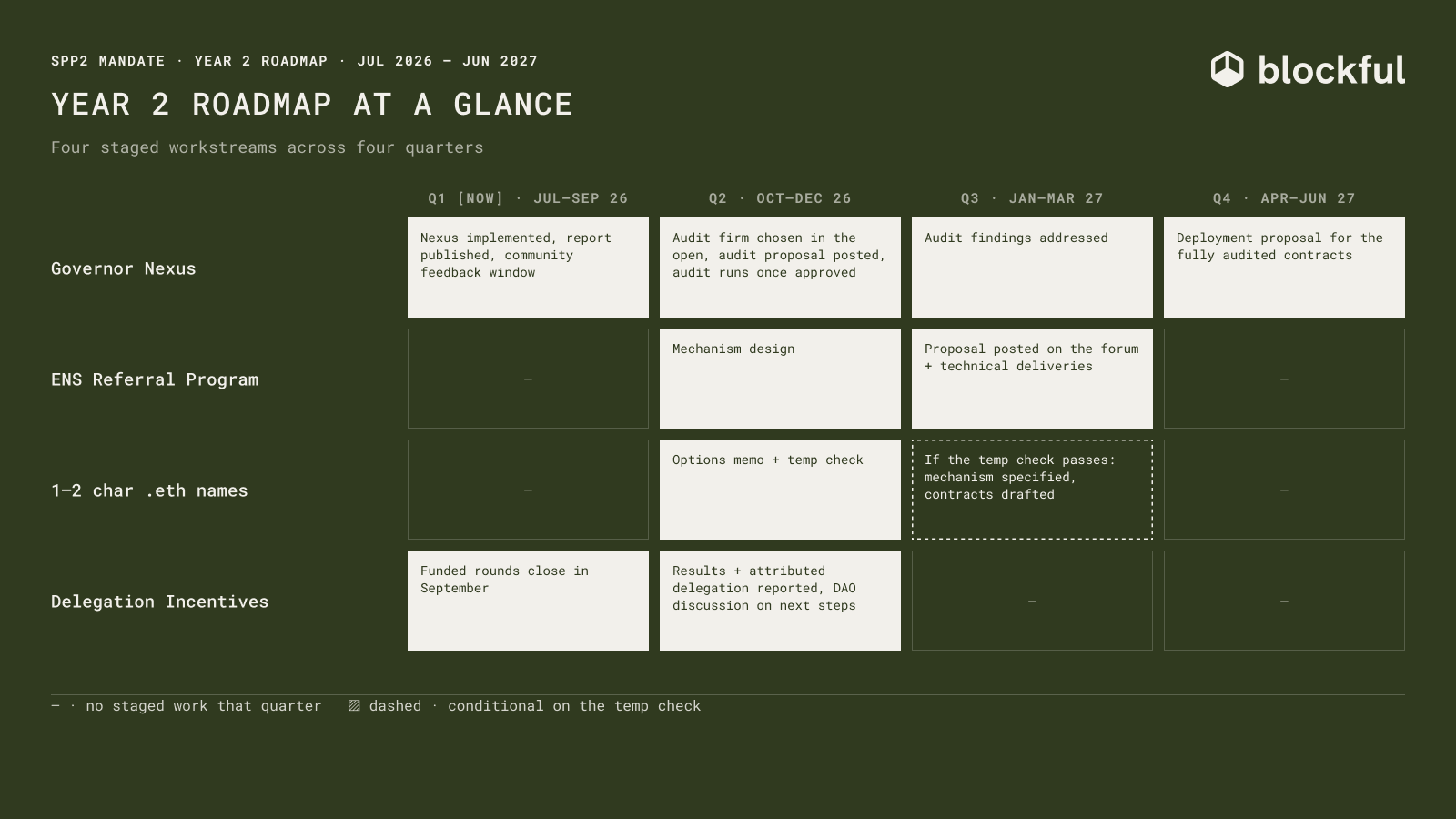
The staged work moves like this:
Open questions
Everything above is what we’ll do in Year 2. Two points along the way are open, either because they need a DAO decision or because we want to hear how you see them before we commit. We’ve written our recommendation under each one.
-
Delegation target. Year 1 carried a +30% active delegation target and we built the incentives campaign to chase it. This roadmap carries no delegation target for Year 2. Should it? Our recommendation: not yet. The campaign closes in September and its results, with attribution separated from market movement, reach the forum next quarter. That’s the first real data on what moves delegation in ENS, and we’d rather propose the next step from it than commit a number before seeing it. That next step can be a second round, a different mechanism, or no further delegation work at all, if the campaign shows incentives don’t move the number.
-
Notification channels. The notification system delivers on Telegram and Slack. Email and Discord were in the Year 1 plan, and we de-prioritized them in our last report because no delegate had asked for them. Since then the subscriber base has held flat and no request for either channel has come in. Should email and Discord stay in Year 2 scope in case demand appears, or come off the roadmap so the effort goes to the commitments above? Our recommendation: take them off. A new channel is one more adapter on the same pipeline. If a delegate asks, we add it then. A channel nobody asked for is cost without users.
Point out what you’d reshape. Happy to keep contributing to ENS in Year 2.