I wanted to put some numbers on the proposal.
Past Delegates
I downloaded all 48 DAO proposals of the last 2 years (33 Snapshot + 15 onchain, Jul 2024–Jul 2026). For each voter, average voting power used = sum of voting power actually cast ÷ 48 (missed votes count as zero). Factor = √(that average). Eligibility requires voting in ≥24 of 48 proposals. The pool is distributed proportionally to the factor among the 51 eligible delegates. I excluded the largest delegate and myself to avoid looking like self-dealing (it would be an opt in proposal anyway). I can share the CSV details if anyone wants. I ran two scenarios, delegating a total of 1M or 2M ENS.
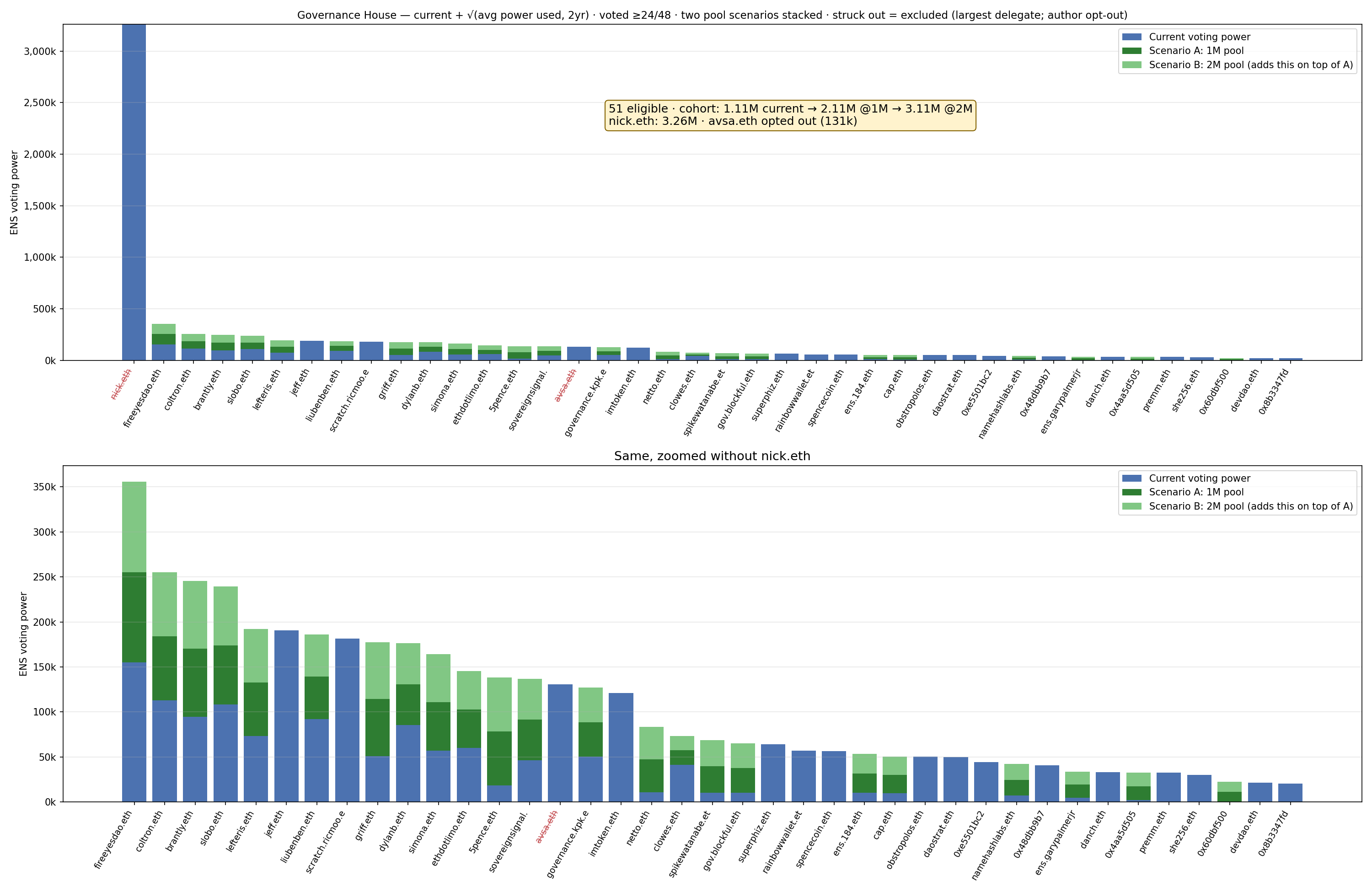
| Delegate | Current power | Factor √(avg used) | +1M pool | +2M pool | Notes |
|---|---|---|---|---|---|
| 3,260,165 | 408.0 | — | — | Excluded: largest delegate | |
| jeff.eth | 190,668 | 117.3 | — | — | Below participation cutoff (15/48) |
| scratch.ricmoo.eth | 181,229 | 225.5 | — | — | Below participation cutoff (14/48) |
| fireeyesdao.eth | 154,854 | 436.3 | 100,435 | 200,869 |  45/48 — highest factor 45/48 — highest factor |
| 130,653 | 326.4 | — | — | Voluntarily opted out (proposal author) | |
| imtoken.eth | 121,058 | 72.6 | — | — | Below participation cutoff (2/48) |
| coltron.eth | 112,918 | 309.2 | 71,171 | 142,342 | 45/48 |
| slobo.eth | 108,494 | 284.2 | 65,419 | 130,837 | 47/48 |
| brantly.eth | 94,536 | 328.5 | 75,616 | 151,233 | 47/48 |
| liubenben.eth | 92,231 | 203.9 | 46,944 | 93,888 | 35/48 |
| dylanb.eth | 85,200 | 198.5 | 45,688 | 91,377 | 42/48 |
| lefteris.eth | 73,021 | 259.2 | 59,661 | 119,322 | 26/48 |
| superphiz.eth | 63,998 | 149.3 | — | — | Below participation cutoff (14/48) |
| ethdotlimo.eth | 60,000 | 185.4 | 42,681 | 85,361 | 30/48 |
| simona.eth | 57,069 | 232.5 | 53,522 | 107,043 | 39/48 |
| rainbowwallet.eth | 56,876 | 37.4 | — | — | Below participation cutoff (1/48) |
| spencecoin.eth | 56,573 | 34.3 | — | — | Below participation cutoff (1/48) |
| griff.eth | 50,864 | 275.1 | 63,334 | 126,667 | 44/48 |
| governance.kpk.eth | 50,299 | 166.2 | 38,265 | 76,531 | 28/48 |
| obstropolos.eth | 50,098 | 64.6 | — | — | Below participation cutoff (4/48) |
| daostrat.eth | 50,000 | 140.7 | — | — | Below participation cutoff (19/48) — near miss |
| sovereignsignal.eth | 46,351 | 196.5 | 45,243 | 90,486 | 40/48 |
| 0xe5501bc2 | 44,244 | 32.7 | — | — | Below participation cutoff (1/48) |
| clowes.eth | 41,300 | 69.3 | 15,956 | 31,912 | 34/48 |
| 0x48dbb9b7 | 40,794 | 44.7 | — | — | Below participation cutoff (2/48) |
| danch.eth | 33,210 | 71.2 | — | — | Below participation cutoff (17/48) |
| premm.eth | 32,398 | 73.7 | — | — | Below participation cutoff (10/48) |
| she256.eth | 30,118 | 88.8 | — | — | Below participation cutoff (11/48) |
| devdao.eth | 21,434 | 43.2 | — | — | Below participation cutoff (3/48) |
| 0x8b3347fd | 20,106 | 46.5 | — | — | Below participation cutoff (4/48) |
| 5pence.eth | 18,438 | 260.2 | 59,898 | 119,796 | 38/48 — largest relative gain (7.5×) |
| luc.eth | 17,500 | 38.2 | — | — | Below participation cutoff (4/48) |
| netto.eth | 10,458 | 158.9 | 36,574 | 73,149 | 45/48 |
| matzo.eth | 10,161 | 20.5 | — | — | Below participation cutoff (2/48) |
| spikewatanabe.eth | 10,159 | 127.2 | 29,282 | 58,564 | 34/48 |
| gov.blockful.eth | 10,152 | 119.2 | 27,437 | 54,874 | 37/48 |
| 0x1d921dff | 10,000 | 64.5 | — | — | Below participation cutoff (20/48) — closest miss |
| ens.184.eth | 9,960 | 94.0 | 21,644 | 43,287 | 46/48 |
| mihal.eth | 9,925 | 33.3 | — | — | Below participation cutoff (5/48) |
| cap.eth | 9,523 | 88.6 | 20,386 | 40,773 | 40/48 |
| namehashlabs.eth | 7,053 | 76.0 | 17,490 | 34,980 | 35/48 |
At 1M votes, we are talking about giving less than 100k for the largest delegate. At 2M the total sum of their voting power would now be just enough to equal the top delegate. So it’s, in my opinion, an improvement without significantly shaking everything up.
Top level domain owners
I think we want to encourage other companies to add and manage their domains via ENS and I believe that any organization that commits to being value-aligned (including of course article I of the ENS constitution, Name Ownership shall not be infringed) should get a slice of the votes. The issue is there aren’t many organizations like this and the few that exist show sparse results..
| TLD | On-chain ENS registrations (L1) | Status |
|---|---|---|
| .box | ~3,800 (100% onchain, on Optimism) | every .box name is a 3DNS token by design — 0 on mainnet, all L2 |
| .art | 856 unique names on main net | steady claims 2020 → April 2026 |
| .locker | 27 | started mid-2025, active |
| .hiphop | 8 | stalled since Dec 2023 |
| .kred | 60, all pre-2020 | PeopleBrowsr — re-claimed its TLD at the ENS root in Feb 2026, no new names yet |
| .luxe | 1,845, all pre-2020 | GoDaddy (ex-MMX). Once the largest TLD integration on ENS; dormant since the acquisition |
| .club | 1 | GoDaddy (ex-.CLUB Domains). Effectively never used |
| Side note: .art has ~380k DNS registrations of which only 856 ever claimed their ENS integration, while .box has ~3,800 names that are all onchain by construction. |
I would advocate for delegating 1M to this pool. Of course, this would mean that they would want to participate and opt in. The less companies want to join, the more delegated power one would have.
Infrastructure Development
EthLabs (the offshoot from former EF members), has come forward interested in helping ENS governance. I think we should extend this invitation for other Ethereum-native companies that have a stake in ENS working: Ethereum Foundation, Gnosis (via Safe), L2 orgs, etc. I would also advocate another 1M delegated in total for these.
I would also like to extend something similar to a Builder’s House — companies in the Service Provider Program, authors of ENSIPs, and maintainers of widely used ENS libraries — and another for sites and wallet apps with a significant number of active ENS names. These are harder to put clear numbers on, so I’ll leave them for a follow-up.