Prepared for the ENS DAO community
Executive Summary
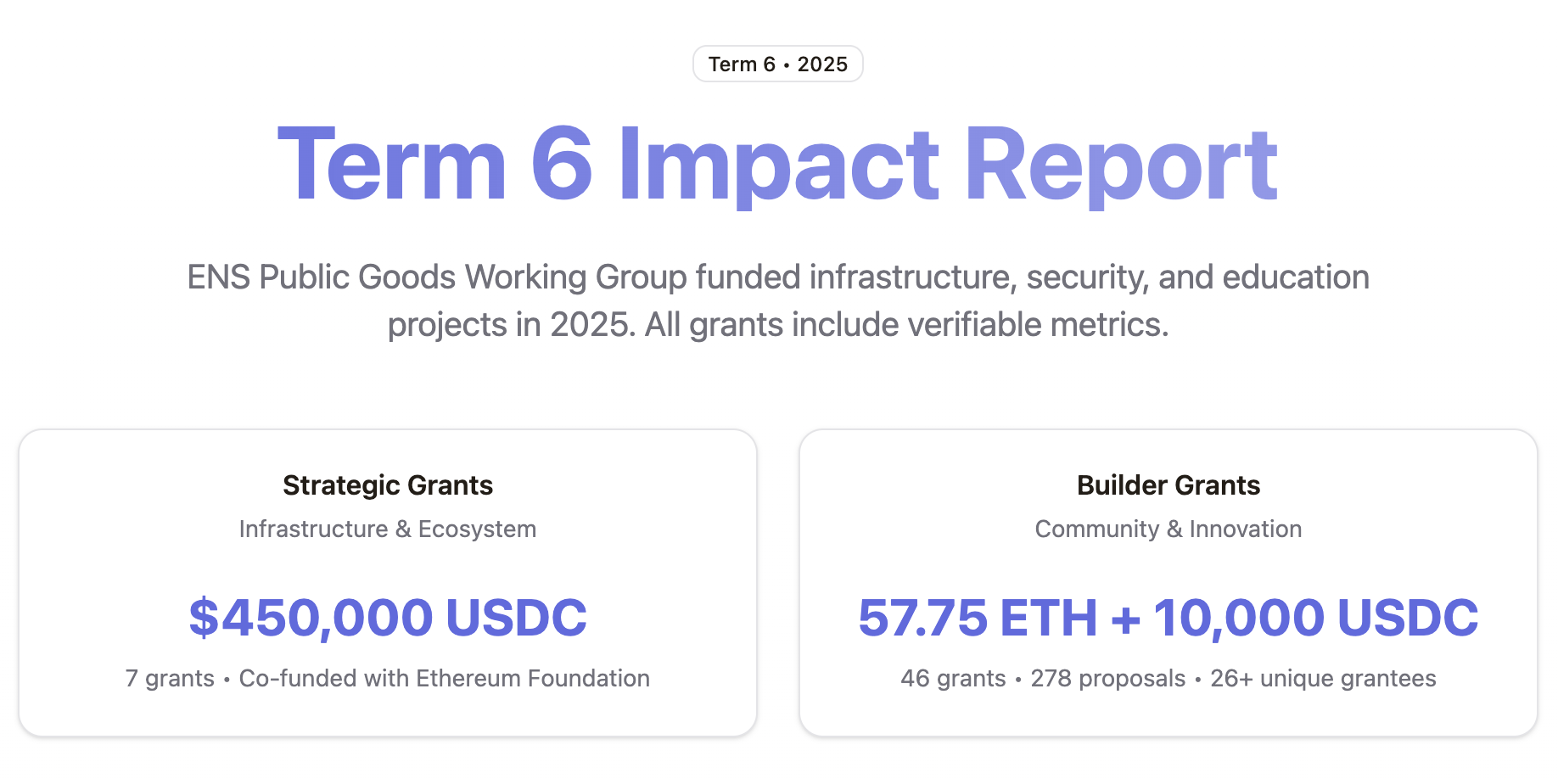
Term 6 (2025) marked the most productive and strategically aligned term for the Public Goods Working Group (PGWG). We successfully combined Builder Grants, Strategic Grants, and Advocacy initiatives into a cohesive funding framework, partially co-funded by the Ethereum Foundation (EF) and aligned with broader ecosystem needs. The synergy among the three Public Goods stewards led to accelerated decision-making, greater accountability, and transparent reporting.
We have developed an interactive dashboard that can be found at the link below, where you can see all of the stats and details from this report:
Strategic Grants (Core Infrastructure & Advocacy)
Strategic Grants were awarded to a range of essential ecosystem teams building the technical, advocacy and research infrastructure for the broader Ethereum ecosystem (including ENS). Most of the grants were structured with co-funding compatibility and milestone accountability in mind.
| Date (2025) | Recipient | Description | Amount | Notes |
|---|---|---|---|---|
| Mar 6 | Decentralization Research Center (DRC) | A research & advocacy body focused on ensuring decentralization is understood and protected in policymaking, uniting technologists, academics, and regulators. | $150,000 USDC | External matching planned (~$300k total) |
| May 29 | Remix Labs | The team behind Remix IDE (widely used in Ethereum dev) is transitioning out of direct EF support and into an independent public goods entity. | $50,000 USDC | Supports continuity and stability through spin-out |
| May 29 | Fabric | Focuses on standards and infrastructure for based rollups, validator coordination, and pre-confirmation tooling across multiple teams. | $50,000 USDC | ~20+ ecosystem participants |
| Aug 7 | Vyper | The alternate smart contract language/compiler for Ethereum, emphasizing auditability, simplicity, and diversity in tooling. | $50,000 USDC | Matched by EF funding |
| Sep 18 | Argot | An independent home for Solidity and related tools (Fe, Sourcify, Act, etc.), focusing on verification, testing, and long-term stewarding. | $75,000 USDC (initial) + $25,000 earmarked | Tranche-based funding for accountability |
| Sep 25 | ICANN Engagement (Emily Murray) | Expert representation in ICANN naming policy processes, especially in the 2026 gTLD Applicant Guidebook consultations and stakeholder forums. | Up to $25,000 USDC | Supports global naming coordination |
Strategic Grant Summary (Term 6 Totals)
- Total committed: $375,000 USDC (confirmed)
- Additional earmarks: $50,000 USDC (Argot + ICANN)
- External matching leveraged: ~$400,000 USDC+ (EF and ecosystem co-funders)
- Focus areas: Developer tooling, compiler diversity, rollup standards, decentralization policy, and naming governance.
Builder Grants (Rolling, On-Chain Grants)
The Builder Grants program, managed via builder.ensgrants.xyz, continued to empower individual developers and small teams to deliver measurable ecosystem improvements. Builder grants operate in ETH and USDC, milestone-based, and fully transparent via the Dune analytics dashboard.
Builder Grant Statistics (as of October 2025)
| Metric | Value | Currency / Notes |
|---|---|---|
| Total amount granted | 57.75 ETH + 10,000 USDC | Small + Large grants combined |
| Small Grants awarded | 43 | Micro-funding for individual builders |
| Large Grants awarded | 3 | Typically >1 ETH / >1,000 USDC each |
| Total proposals submitted | 244 | Across all categories |
| Large-grant proposals submitted | 34 | Reviewed by PG Stewards |
| Dashboard build grant | 0.25 ETH | For transparency and reporting improvements |
Builder Grant Summary
- Builder funding budgeted at $150,000 USDC for Term 6.
- Grants typically range 0.25 ETH – 2 ETH, milestone-based via on-chain streaming.
- New USDC grant flow introduced this term to complement the smaller ETH streams—enabling full coverage of the builder journey, from early experimentation to larger-scale project stabilization.
- Public Dune Dashboard (funded by PG WG) tracks approvals, withdrawals, unique grantees, and daily flow metrics.
- Transparency and accountability: All disbursements auditable on-chain.
Builder Grant Verticals and Example Grantees
| Vertical | Focus | Example Grantees & Descriptions |
|---|---|---|
| Developer Tooling & Infrastructure | Tools, SDKs, resolver libraries, chain utilities, and execution clients. | • Revoke.cash – public-good tool for managing and revoking token approvals across EVM chains. • EVM Tools – suite of dev utilities (22+ tools) supporting decoding, EIP playgrounds, and data analysis. • Rust Ethereum Execution Client (REEC) – modular execution client in Rust for network diversity. |
| Education, Onboarding & Community | Education, mentoring, and community onboarding programs for builders and new web3 users. | • Women in DeFi (WID) Skill-Up Training – educational workshops and mentorship programs for women in DeFi. • Dev3pack Fellowship – bootcamp fellowship bridging Web2→Web3 for global student and women developers. • SheFi Summit Africa – major African web3 event to empower women in blockchain. |
| Hackathons, Events & Civic Experiments | In-person or virtual hackathons, local community programs, and civic-tech experiments. | • Hackatsuon – two-week residency and hackathon in Kesennuma, Japan exploring ENS for local governance. • ETHAccra – flagship African Ethereum hackathon featuring ENS integration and workshops. • Aleph Hackathon – Latin American builder event supporting subdomain integrations and identity tooling. |
Outcomes
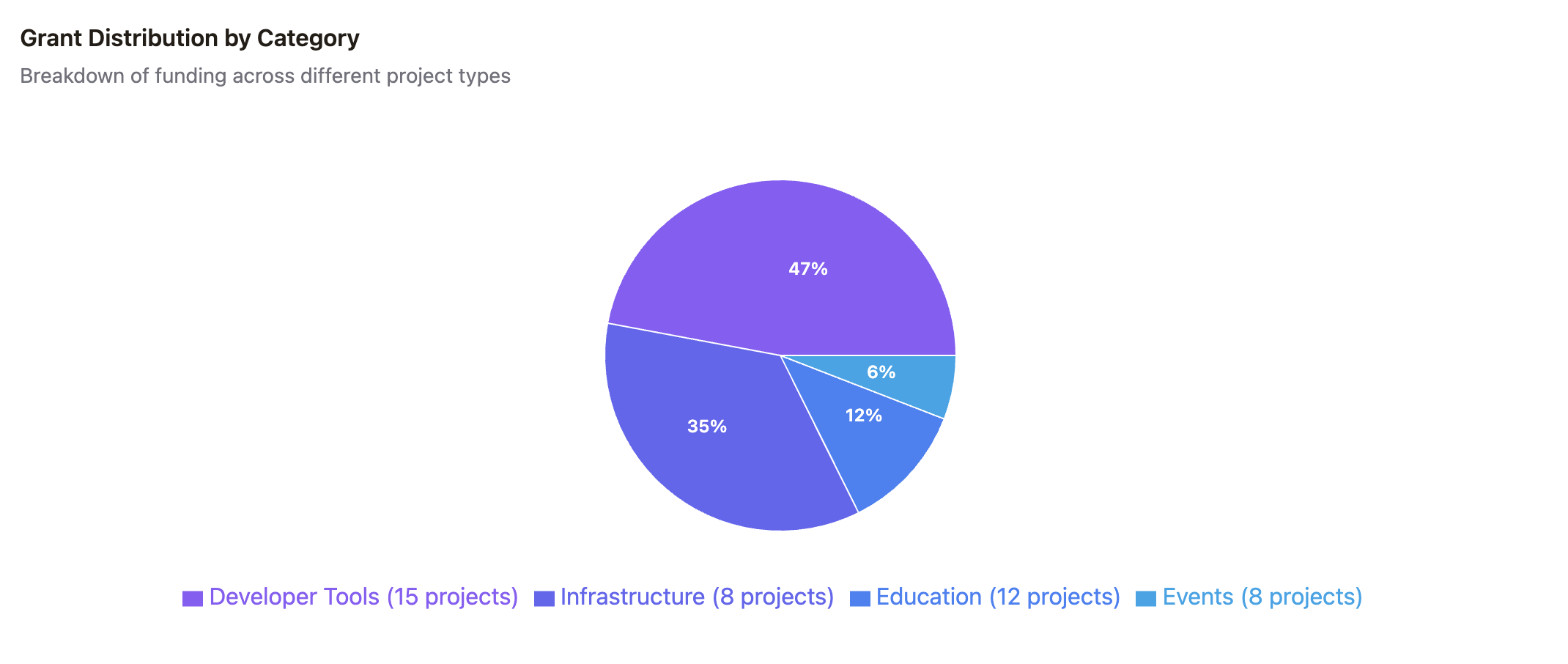
- Broader coverage of project types, from dev tooling to civic and educational initiatives.
- More than 200 proposals demonstrate growing grassroots interest.
- Micro-grants continue to seed experimentation, while larger grants stabilize more mature projects.
- Events like ETHAccra and Hackatsuon expanded global presence, bringing ENS visibility to new communities.
Alignment with Ethereum Foundation (EF) — A Key Term 6 Initiative
A defining achievement of Term 6 was the alignment with the Ethereum Foundation (EF) Funding Coordination team. This collaboration ensured ENS Public Goods resources were strategically directed toward shared ecosystem priorities, reducing duplication while amplifying resource allocation impact.
Key Aspects of the Alignment
-
Creation of the Strategic Grant Category:
ENS PG formalized the “Strategic Grants” lane (>$50k USDC) specifically designed for EF co-funding and multi-party coordination on foundational public goods. -
Jointly Funded Projects:
- Vyper – $50,000 USDC (EF matched funding with additional support from Lido, Yearn, and Optimism). "Vyper secures 7,959 contracts with over $2.3 billion in Total Value Locked across 23 chains, including Curve Finance and Yearn Finance. This grant supports continued compiler releases and security updates.
- Argot Collective - $100,000 USDC (EF transition alignment). Argot maintains Solidity, Sourcify, and other critical tools for the wider Ethereum Ecosystem. Argot consists of 25 former Ethereum Foundation employees with a long-term commitment to maintain these tools. Additionally, ENS smart contracts are developed in Solidity and verified with Sourcify.
- Remix Labs – $50,000 USDC (EF transition alignment). Remix has deployed over 12 million smart contracts through its browser-based IDE. This grant supported Remix’s transition from Ethereum Foundation stewardship to independent sustainability, ensuring continued maintenance of the primary onboarding tool for Ethereum developers
- Fabric – $50,000 USDC (coordinated with ecosystem and validator partners). Fabric develops neutral standards for rollup infrastructure with support from Optimism, Namechain, Arbitrum, and Scroll. This work enables L2-to-L2 bridging and supports Namechain’s proof of concept, aiming for a 99% cost reduction in ENS domain operations.
- Decentralization Research Center – $150,000 USDC (aligned with EF’s advocacy framework). The organization coordinated 50+ industry stakeholders in joint letters to Congressional leadership in support of blockchain legislation, including the CLARITY Act. DRC hosted policy events at Harvard Kennedy School and Stanford Center for Blockchain Research
This alignment reduced duplicate reviews, extended project runways through pooled resources, and established shared transparency standards. The model strengthened ecosystem signaling for supported teams and created evaluation pipelines that can extend to future terms.
Program Metrics Snapshot (Term 6)
- Strategic allocations committed: $450k USDC
- Builder Grants distributed: 57.75 ETH + 10,000 USDC
- Unique builder participants: ~40+
- Co-funding ratio (ENS PG : EF + other funders): ~1 : 1.2
- Policy / naming engagements: 4 major submissions
- Transparency goals met: Dune dashboard live; open weekly reporting
Steward Statement — Reflection on Term 6
“This term felt like a step-change. We found a working rhythm that’s both fast and thoughtful: quick paths for builders; deeper coordination for core infrastructure; and clear, public accountability. Most importantly, we operated as one team - sharing context, exploring better ways of allocating meaningful funding and keeping the bar high. That combination translated into the most successful and productive term we’ve had so far. We’re grateful to the ENS PG community, our co-funders, and - above all - the teams doing the work.”
— The ENS Public Goods Stewards (Term 6, 2025)
Appendix – Reference Links
- DRC strategic grant announcement (Mar 6 2025)
- Remix & Fabric grants (May 29 2025)
- Vyper grant (Aug 7 2025)
- EF alignment memo (Aug 21 2025)
- Argot grant (Sep 18 2025)
- ICANN engagement grant (Sep 25 2025)
- Builder Grants platform & Dune dashboard
- Small Grants (community-voted rounds)
Note: This report was prepared and intended to be published as a wrap-up of term 6 for informative, accountability and transparency purposes, before any of the current conversations around working group changes, retros and any other modifications to existing structures.
