2025 Q3 / Q4 Report
Summary
Following our scope of work as a Service Provider for ENS DAO, Q3 and Q4 focused security:
- Continuous calldata review across all governance proposals, preventing 2 proposals from executing incorrectly.
- Risk assessment report and governor upgrade research, to be published next week, after months of research.
- Delivery and iteration of the Delegation Incentives System proposal, currently the most material lever to increase active voting power and reduce long-term capture risk.
- Incremental expansion of Anticapture as a governance risk observability layer. Progress from v0.6.0 to v1.5.5. More reliable data, infrastructure and features to detect uncommon behavior and threats.
- Deployment of a fully functional governance frontend as an over delivery (outside of initial scope), with an experiece focused on security, better understanding of sudden voting power changes.
- Improvement on notification system reliability, relevant information and slack integration.
ENSIP
With the objective of maintaining operational transparency, we note that ENSIP-related deliverables are delayed relative to the original roadmap.
This delay reflects an explicit prioritization: governance-layer risk reduction (delegation dynamics, governor upgrades, and Calldata reviews) as higher urgency for ENS DAO than application-layer integrations.
Entering Q1 2026, blockful’s internal metrics explicitly target:
- Completion of ENSIP-related deliverables
- Fulfillment of ENSIP KPIs as outlined in the Service Provider proposal, under a revised and realistic timeline
ENSIP — KPI Status
| Quarter | KPIs | Status |
|---|---|---|
| Q2* | Complete implementation with ENSjs + integrate ENSjs into our frontend for usability testing |  Delayed Delayed |
| Q3* | Integration with at least 2 major subdomain providers (e.g. base.eth, uni.eth) + developer documentation | Delayed |
| Q4* | Full integration with ENS Manager App and ENSv2 + 3+ production implementations | Delayed |
Calldata Review
Continuing our calldata review mandate, which ensures alignment between proposal intent, onchain execution, and governance security, blockful reviewed all proposals submitted during Q3 and Q4.
All reviews were completed within the expected SLA.
Calldata reviews from Q1 and Q2 can be found in the previous report:
blockful - service provider reports - #6 by blockful
Reviewed Proposals (Q3 / Q4)
Calldata Review — KPI Status
| Quarter | KPIs | Status |
|---|---|---|
| Q3 | Response to 100% of tagged proposals within SLA |  Done Done |
| Q4 | Response to 100% of tagged proposals within SLA | Done |
Anticapture
Product Updates — Data & UX
During Q3 and Q4, we focused on strengthening how governance data is surfaced, navigated, and interpreted. They are designed to quickly identify threats and uncommon behaviors.
Holders and Delegates
- Increased flexibility on filters
- Filterable tables and interactive charts to explore token holders, delegates, and voting power.
- Detailed drawer views for individual actors, enabling deep inspection without leaving context.
- Balance history charts and tables to track token holder balance changes over time.
- Delegation history tracking with voting power variation graphs.
- Voting power analytics to visualize distribution and temporal changes.
- Top Interactions view highlighting frequent delegation relationships.
- ENS name and avatar resolution using Viem to replace raw addresses.
Impact:
Delegates and token holders can better assess concentration, participation patterns, and coordination behavior, reducing information asymmetry and improving the quality of governance decisions.
Panel v2
Panel v2, expanding the DAO panel table to include additional governance-relevant context and a more structured presentation of DAO-level data.
Impact:
Users can more easily extract meaningful differences across DAOs instead of relying on incomplete or non-standardized views.
Custom Charts
Users now can select and visualize the metrics most relevant to their analysis, rather than relying on a fixed, one-size-fits-all set of charts.
Impact:
This prevents important signals (e.g., lending supply) from being visually or numerically drowned out by larger unrelated metrics (e.g., CEX supply). It also enables users to explore relationships between metrics over time such as trends between lending supply and governance proposal activity—supporting more explanatory analysis and better-informed discussion.
Cost Comparison Currency Switcher
We added a currency switcher for cost comparisons.
Impact:
This makes costs easier to contextualize and compare without requiring external conversion. As a result, users can evaluate proposal spend and treasury-related figures with reduced ambiguity and less manual overhead.
Export as CSV
Users can extract structured datasets directly from the interface.
Impact:
This enables downstream analysis, reporting, and integration into existing workflows. It also improves reproducibility and auditability by allowing users to work from the same underlying data outside the UI.
Overview Redesign
We redesigned the DAO detail overview to reduce information density by reorganizing content into clearer sections and separating content into dedicated pages where appropriate.
Impact:
This reduces user overwhelm and improves readability, making it faster to locate relevant information and interpret governance data.
| Quarter | KPIs | Status |
|---|---|---|
| Q3 | Increased visibility into treasury movements and token markets for security metrics | Done |
| Q4 | Surface risk-relevant transactions and integrate offchain voting data | Partially Delayed (offchain vote integration is currently under development. Risk relevant transaction visualization is under review, and soon to be released) |
Governor Upgrade
After months if iteration from the research squad a Governor Upgrade proposal will be posted this week, outlining:
- Explicit mitigation of known governance vulnerabilities
- A redesigned governor architecture
Governor Upgrade — KPI Status
| Quarter | KPIs | Status |
|---|---|---|
| Q3 | Report on recommendations for governor changes | Done |
| Q4 | Reach community consensus on changes | In Progress |
Delegation Incentives System
This is the highlight as a delivery outlined in this report.
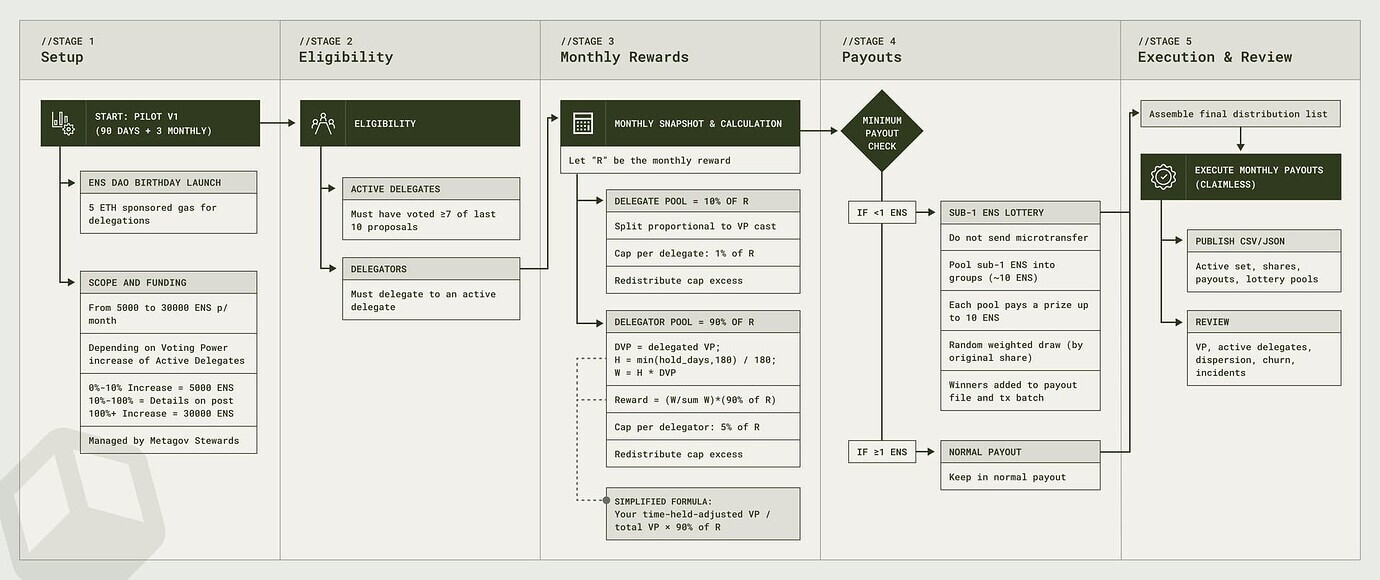
We propose a 90-day pilot that distributes incentives to:
- Active delegates
- Their delegators
Guardrails
- Time-held factor for delegators (capped at 180 days) to reduce sybil risk
- 1 ENS minimum payout per address to avoid inefficient micro-transfers
- Per-delegate and per-delegator payout caps to prevent concentration and increase long-term capture cost
Reward Split
[!IMPORTANT]
The discussion is ongoing here
Community participation is critical for the future of ENS DAO governance.
Delegation Incentives — KPI Status
| Quarter | KPIs | Status |
|---|---|---|
| Q3* | Community iteration and scope definition | Done |
| Q4* | Deliver scoped system | In Progress |
Notification System
Following delivery of a functional risk and governance notification system, we now provide a dedicated, shareable access point: HERE
Updates:
- Slack integration
- Message improvements to add more insight
- Message with links to see more details, transaction
- Bug fixes and tests
| Quarter | KPIs | Status |
|---|---|---|
| Q3 | Integrate email, Discord, and Slack notifications | Done (email pending/ongoing; Discord integration is under development as an out-of-scope enhancement not originally included in the proposal.) |
| Q4 | Support offchain votes, 99% uptime | Delayed |
| Q1 | Notify governance security threads via Anticapture, 99% uptime | Already done (instant notifications) |
Governance Frontend
We also shipped the governance section as a over-delivery. Client diversity is important for security, and besides that, each detail is designed to be useful in adversial scenarios (eg.: like being able to easily see voting power variation and understand if there was sudden moviments to manipulate a vote).
Key current featurea:
- View all proposals, states, and calldata
- Voting
- Access security data one click away, enabling more data-driven decision-making. By clicking on delegates or votes.
For the roadmap we have planned a deeper integration with our calldata process, UX and security improvements.
Feedback
Please let us know any feedback you have, we’re here to make sure ENS is secure and has the best data better for decision-making.
Here is a short anonymous feedback form. Please fill it, makes a huge difference.