Expanding the Endowment Mandate: Onchain Options

Expanding the Endowment Mandate: Onchain Options

Summary

This post follows the June 2026 Investment Policy Update, which made no significant expansion of available strategies. This post is deliberately separate: it proposes amending the IPS itself.

Delegates have raised a number of questions about the Endowment’s mandate. One was whether it should write options against assets it already holds. KPK recommends the DAO amend the IPS to permit covered options writing: covered calls and cash-secured puts against existing holdings. This post makes the case and includes a proposed first trade, a cash-secured put, analysed quantitatively against the current IPS. The amendment authorises the strategy; it does not commit the DAO to any single trade.

The Endowment is conservative by design: ETH, staked ETH, and a few major stablecoins, deployed only via over-collateralised lending, liquidity provision, staking, and cash-and-carry on Ethereum mainnet, with no protocol above 30%, a three-year stablecoin runway floor, a strict 60/40 ETH-to-stable split, and no speculative trading. Any expansion has to be measured against that baseline.

Background: What Options Are

Options are derivatives giving the holder the right, not the obligation, to buy or sell an asset at a set price by a set date. Calls are the right to buy; puts are the right to sell. Every contract has a strike price, an expiration date, and a premium paid upfront to the seller.

Moneyness describes the strike relative to spot: ITM (in the money, has intrinsic value), ATM (at the money, strike = spot), OTM (out of the money, no intrinsic value).

For a treasury, selling options rather than buying is the relevant move: it generates upfront premium income and lets the Endowment take a position at price levels it already finds acceptable, without transacting the underlying outright.

The Two Strategies

Covered Calls

Written against an asset already held. Hold the asset, sell a call above spot, collect the premium. If price stays below strike, keep the asset and the premium. If price rises through strike, the asset sells at strike, premium still kept.

Example: 100 ETH at $3,000; sell a 30-day $3,300 call for $200/ETH ($20,000 total). Below $3,300, keep ETH plus $20,000. Above $3,300, sell at $3,300, still keep $20,000.

  • Upside: income on inventory already earmarked for sale.
  • Downside: capped upside on a hard rally, and an obligation to deliver if exercised.

Cash-Secured Puts

Funded from the stablecoin side. Hold stablecoin collateral, sell a put below spot, collect the premium. If price stays above strike, keep the stables and the premium. If price falls below strike, buy the asset at strike using the collateral, premium still kept.

Example: $500K in stablecoins; sell a 30-day put at a strike 10% below spot, collect a $13,700 premium. Above strike, keep the $500K plus premium. Below strike, buy at the strike using the collateral, premium still kept.

  • Upside: yield on otherwise-idle stablecoins, plus accumulation at a pre-approved discount.
  • Downside: collateral is locked until expiry, and an obligation to buy if ETH falls through the strike.

(The two examples above use round numbers to illustrate the mechanics. The proposed first trade further down uses live ETH pricing near $1,600.)

Why Start With Puts

ETH trades near $1,600, well off its 2025 high above $4,900, after a sustained drawdown. Realised volatility sits around 55% annualised, elevated but short of crisis levels. That keeps put premiums meaningful, while a deep, out-of-the-money strike keeps assignment risk low even in a falling market. The only adverse outcome, assignment, is buying ETH at a price the DAO already wanted. Puts also sit on the stablecoin side, so they don’t compete with the Endowment’s existing ETH yield and rebalancing flows. Calls only earn their place later, against a narrow sleeve of ETH already scheduled for sale.

The volatility backdrop matters because premium scales with it. Over the trailing year, ETH’s annualised realised volatility ranged from roughly 35% in the calmest month (May 2026) to 79% in the most turbulent (February 2026, the year’s sharpest drawdown). The full monthly breakdown, and the methodology behind it, is in the quantitative analysis below.

For a put seller, this is the right regime: volatility high enough that premiums are worth collecting, without the panic conditions that would make even a deep strike likely to be assigned. It is also why the recommended trade sits far out of the money, capturing premium while keeping the buy level well below current spot.

Quantitative analysis that led to this decision

Asset: ETH
Notional: $1,000,000 (622 ETH)
Expiry: 30D
Decision: Sell 1150 Put

1. Methodology: why Garman-Klass

We estimated ETH volatility using the Garman-Klass estimator, which incorporates the full daily high/low range and open/close move rather than relying on close-to-close returns alone. This is roughly more efficient than a simple close-to-close calculation, which matters especially for monthly estimates where the sample size is small (20–31 trading days).

gk_i = 0.5 · (ln H/L)² − (2·ln2 − 1) · (ln C/O)²

Where, for each day i:

H = highest price of the day
L = lowest price of the day
C = close price of the day
O = open price of the day
ln = natural logarithm

(2·ln2 − 1) ≈ 0.3863, a constant that corrects for the drift/directional component, so the estimator stays unbiased
gk_i = the Garman-Klass variance estimate for day i (the first term captures intraday range, the second corrects for the open-to-close move)

2. ETH Price Context
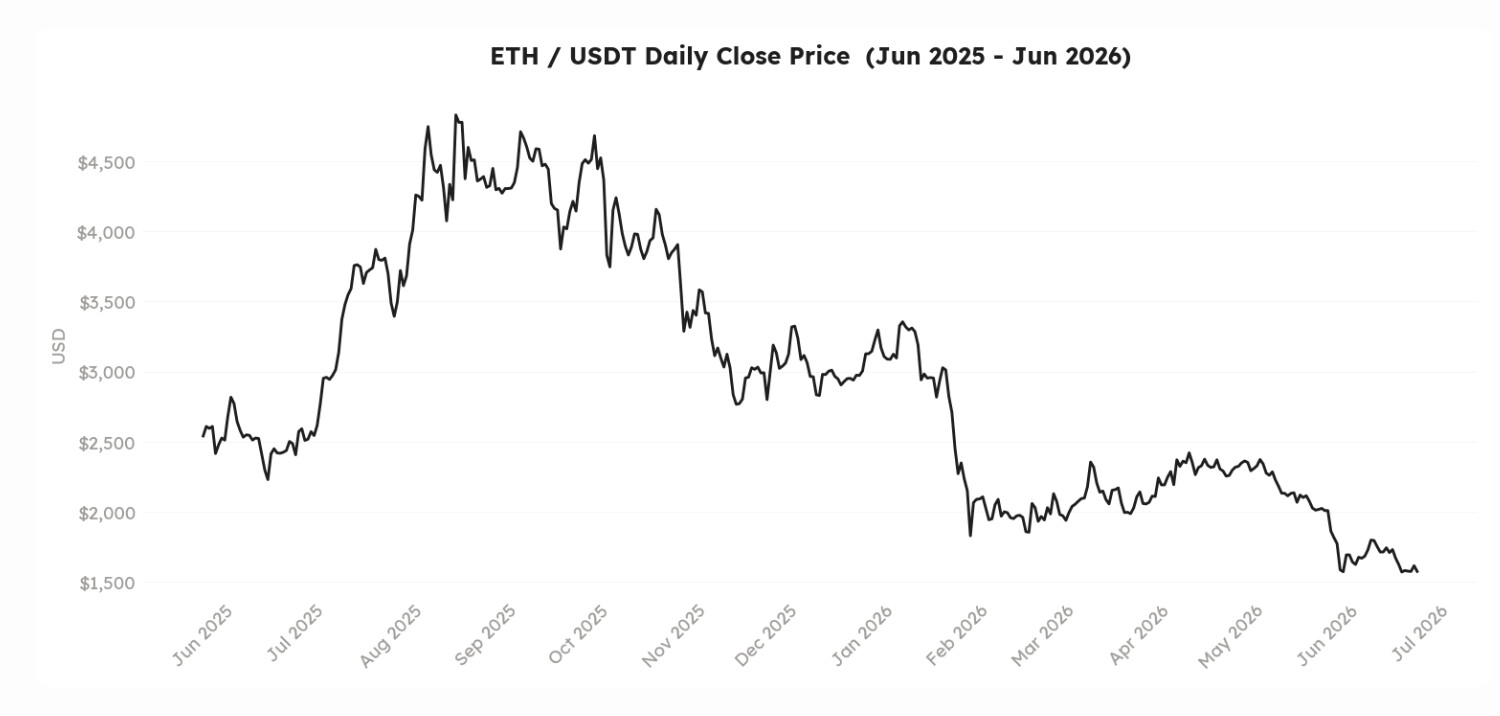
Raw ETH price over the period, used as a reference for the vol charts below, sharp moves or choppy ranges here should line up with vol spikes. Calm trending periods (e.g. the Sep 2025 plateau) produced low vol; sharp reversals (e.g. the Feb 2026 drawdown) produced high vol.

3. Daily Rolling Volatility

Daily rolling vol (30-day window) currently sits at ~0.0356, right around the 12-month mean of 0.0355, but importantly, it’s trending upward off a May 2026 low rather than sitting in a calm, complacent regime.
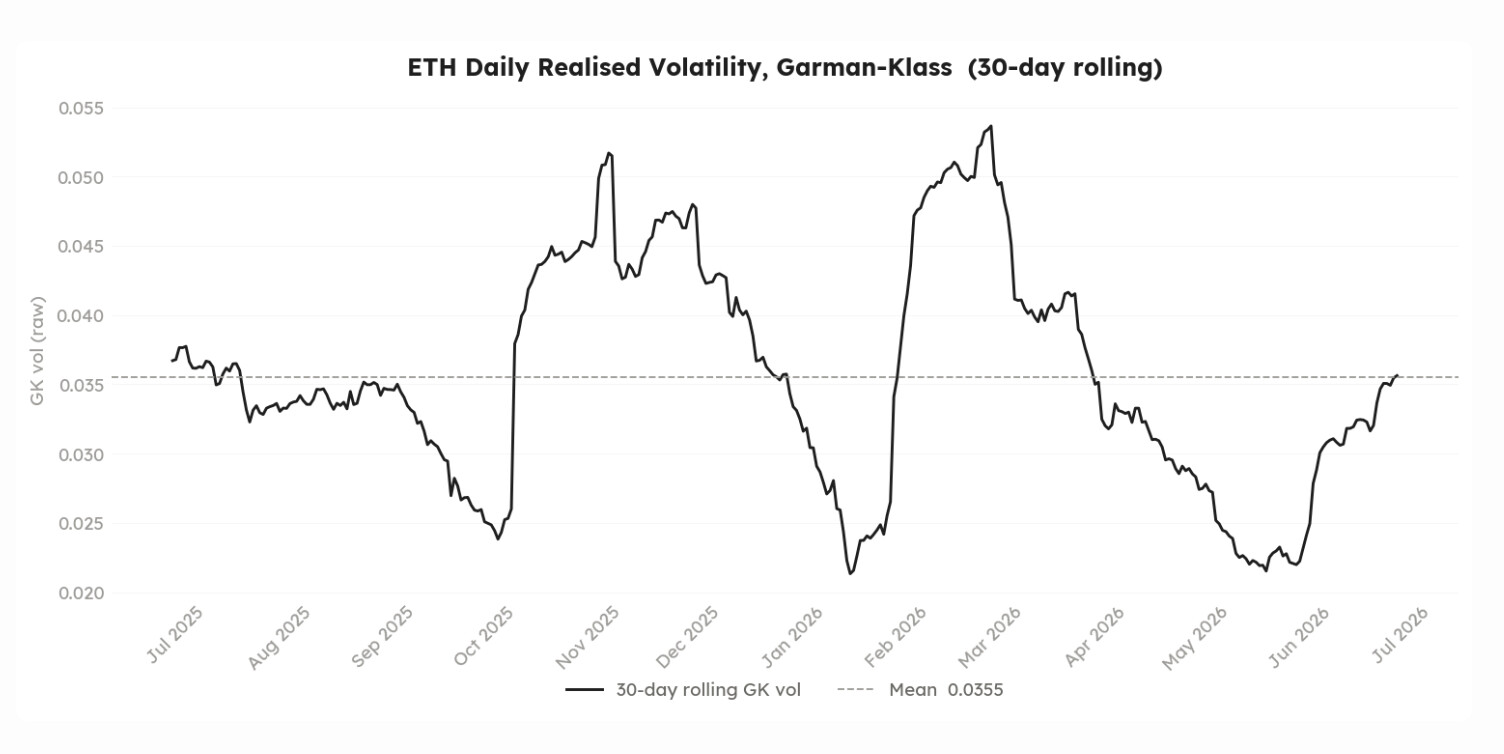
Each point is GK vol computed over the trailing 30 days, smoothing single-day noise while staying responsive to regime shifts. The dashed line marks the period mean. Rising line = market becoming more volatile; falling line = market calming down. We’re currently on the rising side of a recent trough, which argues for caution rather than reaching for yield.

4. Monthly volatility

Monthly GK vol has ranged from 0.0219 (May 2026, calmest) to 0.0499 (Feb 2026, most volatile) over the trailing 12 months, with the largest spikes clustering around sharp down-months (Oct–Nov 2025, Feb–Mar 2026).
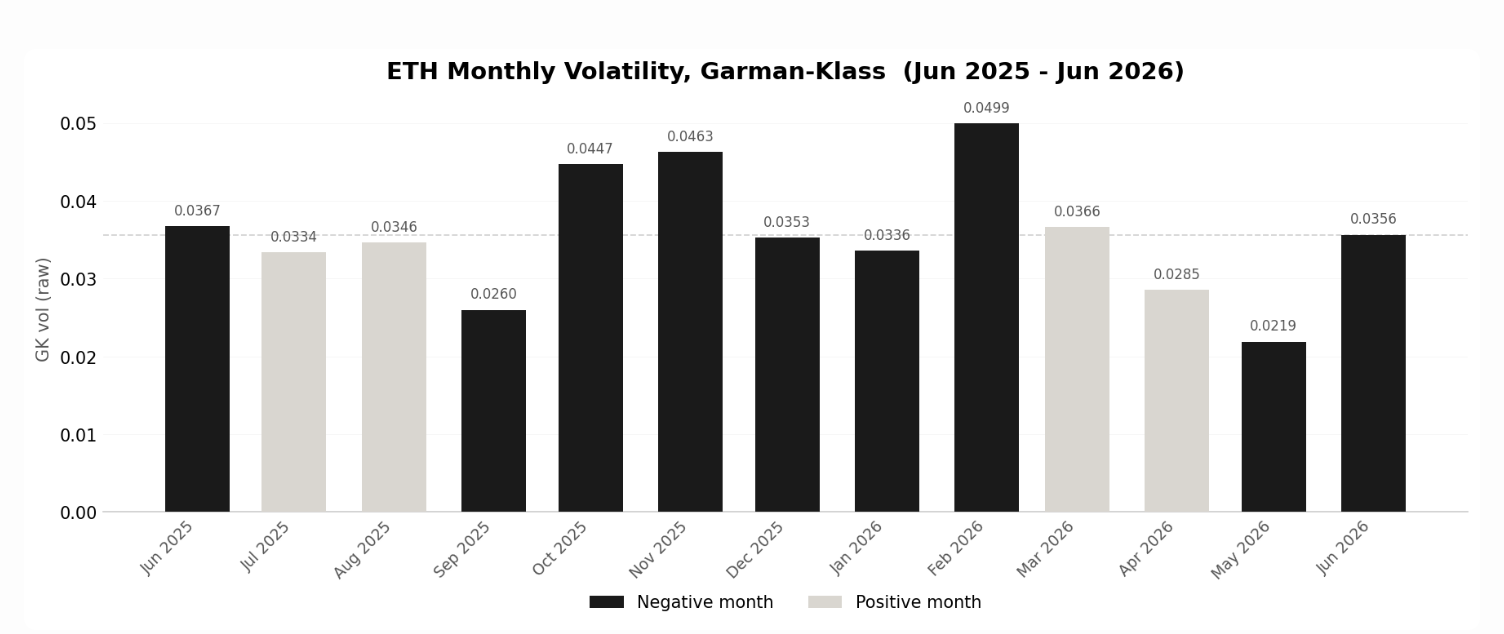
One vol number per calendar month. Dark bars = negative-return months, light bars = positive-return months. High + dark = volatile down move (e.g. Feb 2026’s crash). Low bars = tight, rangebound months (e.g. May 2026). This confirms the pattern seen in the rolling chart: volatility spikes have historically coincided with drawdowns, not rallies.

5. From vol to strike selection

Scaling current daily vol to the option’s 30-day horizon gives an expected move of roughly ±19.5%, which we used to estimate each strike’s probability of finishing in-the-money.

These are rough estimates from a normal-distribution model; real assignment odds on downside strikes run somewhat higher because options price in a volatility skew.

Strike Strike/Spot Premium (APR) Est. Assignment Probability
1550 96.4% 55.4% ~42%
1450 90.2% 32.3% ~30%
1300 80.8% 14.8% ~14%
1150 71.5% 7% ~4%

The 1550 and 1450 strikes carry near-coinflip-to-1-in-3 assignment odds, the premium there compensates for real, live risk, not “safe” yield. 1300 and 1150 meaningfully reduce that exposure.

6. Decision

Given the goal of preserving capital, and with realised vol trending upward rather than calm, we selected the 1150 strike: the best match between our volatility data and an acceptable risk threshold, while still locking in a ~7% APR.

Execution Venue

Both strategies can execute on-chain with custom strikes and expiries, keeping settlement transparent.

  • MYSO Finance settles on Ethereum mainnet, built for treasuries, bespoke P2P quotes against institutional trading firms, ~$100k minimum notional, custom strike/tenor.
  • Rysk Finance offers the same primitive via vault plus RFQ auction, over $1B notional volume since launch. Currently runs on Hyperliquid’s HyperEVM, with mainnet roll-out impending, and has no top-tier audit as of mid-2026.

Either is a viable venue for the trade below, especially consdering the Rysks mainnet roll-out. Headline premium and APY figures at both are point-in-time, not durable yields.

Sizing and strike selection matter more than any quoted number.

Proposed First Trade: Cash-Secured Put

When the Endowment sells a put, it selects a strike: a price below the current ETH price at which it is prepared to buy. The lower the strike relative to spot, the lower the probability of assignment, and the lower the premium. The table below maps that trade-off across four strikes at recent (July 1st 2026) pricing, ETH near $1,600, on a $1M (~622 ETH) notional at one-month tenor:

Strike (vs. spot) Premium (1M) Annualised* Assignment risk Interpretation
~3–4% below ~4.5% ~55% High Maximum premium, but assignment is near-certain. Economically close to buying ETH outright today.
~10% below ~2.65% ~32% Moderate Meaningful premium against a modest chance of acquiring ETH at a 10% discount.
~20% below ~1.2% ~15% Low Reduced premium; assignment only on a sharp drawdown.
~30% below ~0.57% ~7% Minimal Modest, dependable premium with assignment only on a severe drawdown. The conservative choice, and the recommended trade.

*Annualised figures compound a single month’s premium across twelve months and assume premiums hold at current levels. They will not; premiums move with volatility. The figures are illustrative, not a forward yield.

Recommended trade: the ~30%-below strike. This sits deliberately at the conservative end of the curve: a low, dependable premium in exchange for minimal assignment risk, with ETH acquired only if the market falls sharply.

Concrete terms at an ETH spot near $1,608:

Parameter Term
Instrument ETH cash-secured put, Endowment as seller
Spot at quote ~$1,608
Strike ~$1,150 (~71% of spot)
Tenor ~30 days
Notional $1,000,000 (~622 ETH)
Premium ~0.57%, ~$5,700 collected upfront
Annualised ~7%
Collateral ~$715,000 stablecoins, locked to expiry
Outcome if ETH ≥ $1,150 Retain collateral and premium; position expires
Outcome if ETH < $1,150 Acquire ETH at $1,150 (~30% discount), retain premium

The decision is where to set the acquisition price, and the Endowment sets it 30% below spot. It earns a steady ~7% annualised premium, and assignment happens only on a severe drawdown, precisely the level at which the Endowment wants to be buying ETH.

The IPS Tension

Options aren’t in the IPS’s allowed-strategies list, and a strict reading of the speculative-trading prohibition would exclude them.

The counterargument: a fully covered position is an overlay on existing inventory, not a directional bet, backed by stablecoins set aside for the purpose, with a strike reflecting a pre-approved transaction price rather than a reach for premium.

The DAO would need to draw that line explicitly: permit covered writing against existing inventory, cap the committed share, keep the speculative-trading prohibition intact for everything else.

Recommendation

KPK recommends the DAO amend the IPS to permit covered options writing (covered calls and cash-secured puts) against assets the Endowment already holds, subject to explicit sizing caps and the constraint that every position be fully covered by inventory or set-aside collateral. These strategies can be codified to remain confined to a small percentage of the portfolio only. The speculative-trading prohibition would remain intact for everything else.

If delegates support this direction, KPK will bring formal amendment language, with the sizing caps and execution constraints, to a Snapshot vote.

The cash-secured put detailed above is the first trade KPK would execute under that mandate; it is shown here as a worked example of how the strategy would be applied, not as a separate item for approval.

We welcome feedback on the proposed direction, the sizing and risk constraints, and the analysis above.

3 Likes

Dan from Rysk here.

Thanks for putting this together. We appreciate KPK opening the discussion around onchain options as part of the Endowment mandate. The framing of covered calls and cash-secured puts as fully covered treasury overlays is the right way to evaluate the strategy.

A few updates and clarifications on Rysk.

Rysk is now live on Ethereum mainnet. Main contract here: https://etherscan.io/address/0x684404f2aebad87a6803f13741b1d638bfe2c671. The roll-out referenced in the post has shipped, so the infrastructure is now available on mainnet with custom strikes and tenors, settled fully onchain.

On track record: Rysk has processed ~$1B in notional volume through our current Rysk V12 product in roughly one year, with every position fully collateralized and settled onchain. The protocol has operated across meaningfully different volatility regimes, through live settlement cycles in exactly the conditions that matter for a put seller.

On liquidity and execution: Rysk is supported by an integrated market maker network that provides pricing through RFQ. That network has continued to expand. A recent example is the STS integration, with more makers currently in the integration pipeline. This is what allowed Rysk to process over $1B in notional while supporting custom strikes, tenors, and assets. ROSF, the Rysk Options Support Fund, was also introduced. It is a mechanism where protocol fees are reinvested back into RFQ flow to improve execution quality over time.

On security, some context the post may not have had visibility into. Rysk’s settlement layer is built on Opyn Gamma, which has been live in production since 2021 and was also the infrastructure behind structured products like Ribbon. I was an active contributor to Opyn at the time.

The original protocol codebase was audited by firms including Trail of Bits, OpenZeppelin, Akira, Certora. Since then, Rysk-specific modifications and improvements have been reviewed by Akira, Dedaub, TrustSec. Public bug bounty coverage was also available through Immunefi, with no findings.

TrustSec has been our primary security partner for Rysk-specific changes, given their deep working context on the protocol and the know-how on derivatives protocols. For DeFi derivatives specifically, we consider them a top-tier security partner.

Internally, security also runs through the team. Jib, Rysk’s co-founder, came through yAcademy and has been closely involved in the protocol architecture from the start. Our most recent engineering hire, Blackie, was also a professional auditor before joining Rysk.

If there is a specific due diligence framework behind the audit assessment in the post, we would genuinely like to engage with it. That would be useful input for us either way.

On institutional readiness: HyperionDeFi, a publicly listed treasury, has been live on Rysk Premium since March 2026, with over $2M deployed in a permissioned vault that went through their operational and compliance requirements before launch. Happy to share how that structure worked, since it maps closely to what an Endowment deployment would need.

None of this removes the need for DAO-specific due diligence. Any deployment should still review venue risk, contract scope, settlement mechanics, liquidity, operational process, and sizing. We would welcome that process and are happy to go deeper on contracts, audits, architecture, settlement flows, liquidity, or the Hyperion deployment if useful.

Thanks again for starting the discussion. We believe fully collateralized options strategies can become a useful treasury management tool for DAOs when implemented with the right constraints, collateralization, and risk controls. We appreciate Rysk being considered as part of this framework.

Supportive of this in principle, personally.

I also think the DAO should consider relaxing some other criteria. Rather than a fixed duration stablecoin runway, we should be acting to move, long-term, off ETH at attractive prices, and into less volatile assets, while maintaining enough liquidity that immediate capital needs won’t require selling assets at disadvantageous prices. Investment criteria should be widened to accept low-to-moderate risk assets such as tokenised index funds that don’t guarantee parity with stablecoins but offer better returns at acceptable risk levels.

5 Likes

Selling cash-secured puts is a reasonable way to earn yield on stablecoins we’re holding anyway, and I’ve no problem adding it to kpk’s toolset. But it’s worth being clear that, directionally, it leans the wrong way for us: getting assigned means buying more ETH into a decline, increasing our exposure to the volatile asset I think we should be reducing, while our reward is capped at the premium. Covered calls have the mirror problem — they cap our upside while leaving our existing ETH downside fully intact.

Since we are talking about updating the IPS itself, I’d like to highlight these paragraphs:

  • Medium-term (0–5 years): capital growth and optimised deployment toward institutional-grade onchain strategies that enhance yield without compromising capital preservation, liquidity, or ENS’s values.

  • Long-term (5+ years): capital preservation as the dominant objective, with risk appetite shifting downward as the Endowment matures toward self-sustainability.

The return objective is to outperform a 60/40 (ETH/USD) weighted average of onchain reference rates:

The DAO’s risk tolerance is moderate-to-low.

I don’t think a 60% ETH, 40% Stables split should be considered a “moderate to low” risk profile, and I think we should mature the Endowment to focus less on medium term capital growth and more long term capital preservation. We should directionally start moving towards a more conservative Endowment that limits its exposure to volatile assets and focus on more reliable returns similar to the composition of a university endowment or a pension fund.

1 Like

Hi all, Luca from Enzyme here.

For context, Myso has been part of the Enzyme’s product suite for a while.

Thanks for putting this together. We appreciate KPK opening the discussion around onchain options as part of the ENS Endowment mandate, and we are directionally supportive of the initiative.

A few updates / notes on Myso.

On adoption: Enzyme Myso v3 has seen meaningful usage, with about $100m in notional volume and $4m in premiums distributed, mostly concentrated in covered calls so far.

On product scope: Enzyme Myso supports fully collateralized onchain options, including covered calls and cash-secured puts, with customizable strikes, expiries and RFQ-style execution. Settlement takes place onchain.

Additional Notes on Potential Setup

  • Cash-Secured Puts:
    Upon execution, the transaction is processed atomically through the following steps:

    1. The stablecoin collateral is locked within the escrow contract.

    2. The escrow contract issues the corresponding option token, which is transferred to the buyer.

    3. The buyer transfers the premium to the seller.

  • Liquidity:
    Enzyme/Myso can facilitate access to an existing network of buyers, while also allowing distribution to your owner network. Commercial terms and negotiations are conducted off-chain, with Myso providing the infrastructure to execute and validate transactions on-chain.

On security: Enzyme Myso v3 has undergone external review, including an audit conducted by Omniscia.

From our side, we are supportive of the initiative as long as ENS delegates consider it makes sense for the Endowment’s mandate and risk profile.

We appreciate Enzyme Myso being considered as part of this framework and are remain available to answer product questions where useful.

1 Like

We agree overall with reducing the Endowment’s structural ETH weight over time, and relying less on a fixed-duration runway as the sole liquidity backstop. Reviewed once a year at the delegate level, the IPS has arguably been too blunt an instrument to manage that shift, or to adapt to volatility at all. A target that moves on a volatility rule, rather than on an annual vote, is something we’re supportive of.

On widening the asset set, the current IPS already carries a Real-World Asset framework, tokenised money-market funds and government bonds, capped at 5% of the Endowment. Tokenised index funds would extend that sleeve into assets that do not hold a dollar peg.

This is only a small step beyond the current scope, and one we would be happy to bring into the fold.

Agreed. At June’s close the target and the binding constraint already disagree: on ~$68.4M AUM, the ~$49.3M runway floor, being unconditional and senior to the 60/40 target, forces stablecoins to roughly 72% of the book and caps ETH near 28%. In our view the 60/40 split is structurally impractical and deteriorates performance.

We would consider replacing the fixed 60/40 target with a volatility-responsive band that defaults conservative:

  • Normal: 55% stablecoin / 45% ETH, the baseline, inverting today’s majority-ETH stance.
  • Calm / risk-on: ETH up to a 60% ceiling. Today’s target becomes the most aggressive setting, not the resting one.
  • Stressed / risk-off: ETH down to 30%.

These would be ceilings on ETH exposure, not targets. In a drawdown the ETH weight falls on its own as prices drop, so the band de-risks mainly by not adding rather than by selling, and any trimming is tranched and funded from stablecoin income before ETH is sold. Strict adherence never means liquidating ETH into a weak market at a disadvantageous prices.

The bands would key off the Garman-Klass realized-volatility measure from the options post, so the split shifts on a rule rather than a judgment call, with exact thresholds set in the amendment text. The runway floor stays senior throughout (the more conservative of floor and band binds) so the floor governs at today’s size and the band’s ceiling takes over only as the book grows back above ~$90M. The 60/40 return benchmark would be re-weighted to match the active band.

Fair test, so we would bind the overlay to the band. Cash-secured puts may only be written to move the book toward, never beyond, the ETH target for the regime, so in the risk-off band they do not accumulate past the 30% ceiling: assignment adds ETH only when policy already wants it, at a discount. Covered calls become the trimming tool toward the lower weight. Both sit inside the existing 10% moderate-risk sleeve, capping the overlay independently of the band.

I still think this is too aggressive for the long term for an endowment intended to last for the long run. Also, “in a drawdown the ETH weight falls on its own as prices drop” is a way of saying we absorb 100% of the losses from ETH dropping, no?

Disclosure first: I’m part of the team behind Sentralis, a crypto portfolio risk and scenario analysis tool. Nobody at ENS asked or paid for this, none of it is advice, and it takes no position on any of the governance questions currently being debated.

To get a fresh persepctive on the assignment risk mentioned above, we ran the endowment through our engines: the seven open positions from the recent June report, priced as of July 13, about $73.7M in total. Three results, based on the proposal’s own example ($1M cash-secured put, $1,150 strike):

- $1,150 is a 35% drop from the current (July 13) ETH price. If that happens, the book will be down about $16.5M (22%), and it’s the stablecoins that keep the damage that small. Getting assigned at that point turns reserve stablecoins into more ETH exposure at $1,150: roughly $1M of extra exposure near the bottom for every $1M of notional, in exchange for roughly $70k of premium per year (using the ~7% from the proposal). This scales linearly with program size. Whether that trade is worth it is a risk-appetite call for the DAO.

- Some context on what the puts would be written against: we ran two deliberately different Monte Carlo models (25,000 paths each, same seed). The simulated 1-in-20 bad year lands anywhere between −34% and −50% depending on which model you believe, and the chance of ending the year below the new IPS’s $49.34M liquidity floor comes out at 6% in one model and 37% in the other. That gap is pure model risk, and a good argument against sizing anything off a single number.

- On liquidity: assuming a crisis (5% of daily volume, order books only, staking exit delays), about $12.4M converts to cash within a week, and all of it is USDC. The DAI position needs about 11 days. Two caveats that work in the treasury’s favor: we don’t model redemption mechanisms (Sky redemptions, staking withdrawal queues), which would improve these numbers considerably, and the Stader ETHx position (~$18M) has no usable volume data in our source, so it’s not in the liquidity numbers at all.

Some caveat: all of this is model output under stated assumptions, not fact or prediction.. A full write-up with methods and limitations is going up in the Treasury Management category this week, and I’m happy to re-run any of it against the exact mandate parameters once they’re set.