New Pricing Policy: Research

it definitely won’t :joy: just opened for 30 seconds and closed.

I understand your reasoning but I don’t think most users who wait for gas to go down are impatiently waiting to register as soon as gas drops. I think the effect is smoothed out over a longer timeframe. Maybe the 98% was exaggerated but I still believe temporary high gas fees periods only minimally affect the ultimate total number of registrations.

There is no way for us to know if it is a refusal to register or a delayed registration. I would say it the vast majority is a temporary refusal.

It depends on how the sample should look like. What are the different populations needed?
ENS users and speculators are very active on twitter. I think we could have a high answer rate if the survey only takes a few minutes. We could also contact ENS users who are not on twitter if they set social records on their profile. It is more complicated for ethereum users without an ENS name. Are blockscan chat and coinbase wallet messages good ways to contact them?

I completely agree with this. And the more I think about it the more I think it doesn’t only affect users from poor countries but also poor people in rich countries. I remember when the french government proposed to lower a housing subsidy (APL) by 5 euros, people started posting how much food they buy for 5 euros. An ENS name is a human right. It should stay affordable.

I did some additional research to explore splitting the 5L+ category into two subgroups with different prices to keep them affordable. I studied how user behavior differs within this broad 5L+ group and found a rationale for dividing it into 5–7L and 8L+ subcategories, which I will describe below.


Price Sensitivity

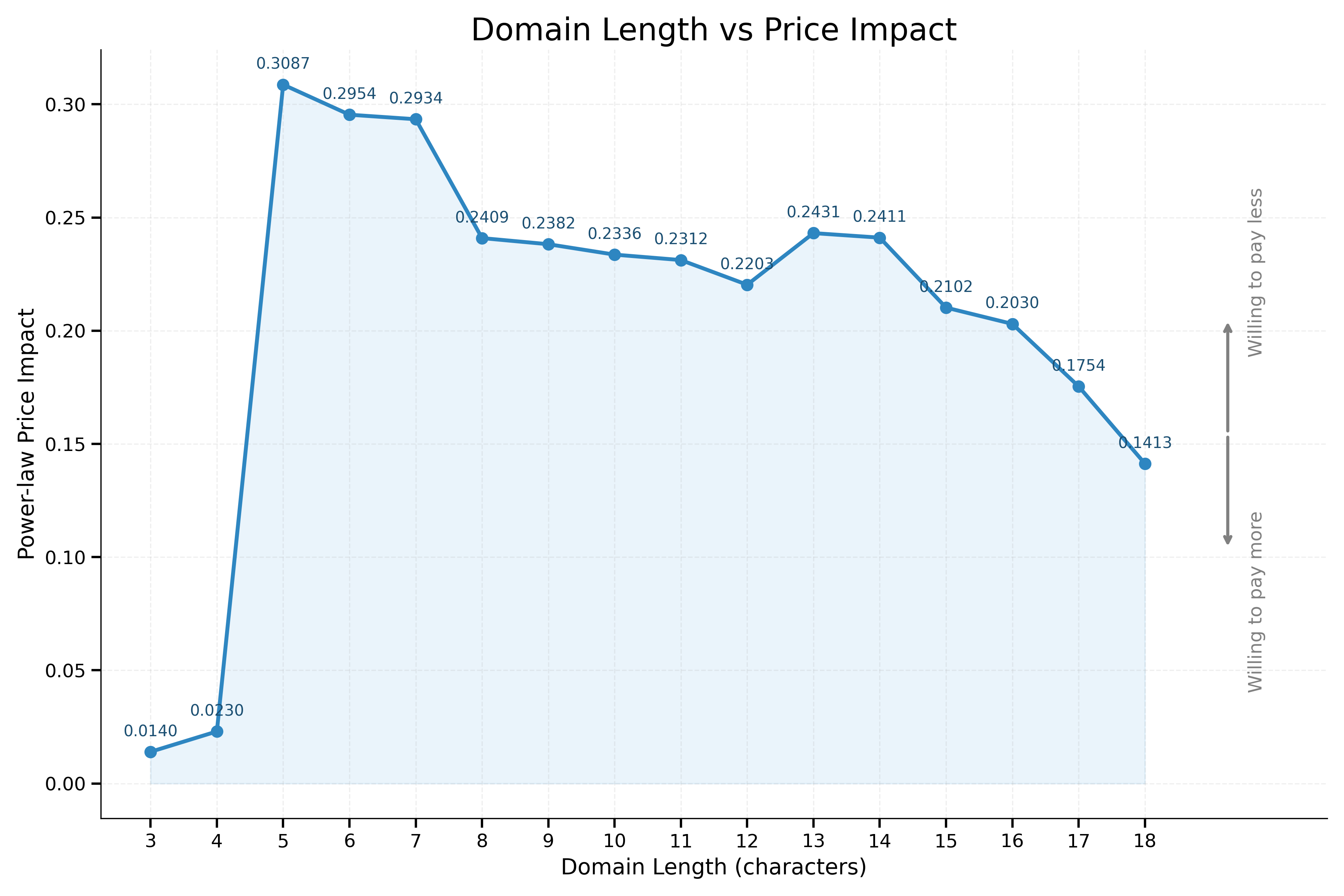
On the price impact graph for domains of different lengths, you can see a rather unexpected econometric picture. Price sensitivity almost continuously decreases with increasing number of characters. It would be expected the opposite, because 5L have a much more limited supply than, for example, 18L.

5-7L domains are essentially the most sensitive and vulnerable to high gas (and to the final price, respectively). That is, seeing high gas, a user is more likely to abandon the idea of registering a domain “danch.eth” than “alexnetto.eth”.

Does this mean that 5-7L domains should cost less than 8L+? From a purely economic point of view, yes. However, firstly, this does not correspond to the established pricing logic of “shorter – more expensive”. Secondly, one more anomaly can be noticed: in the 8-12L section there is a certain pit, which tells us that in such a large 5L+ category there is a certain complex structure with its own patterns.


Registration Duration

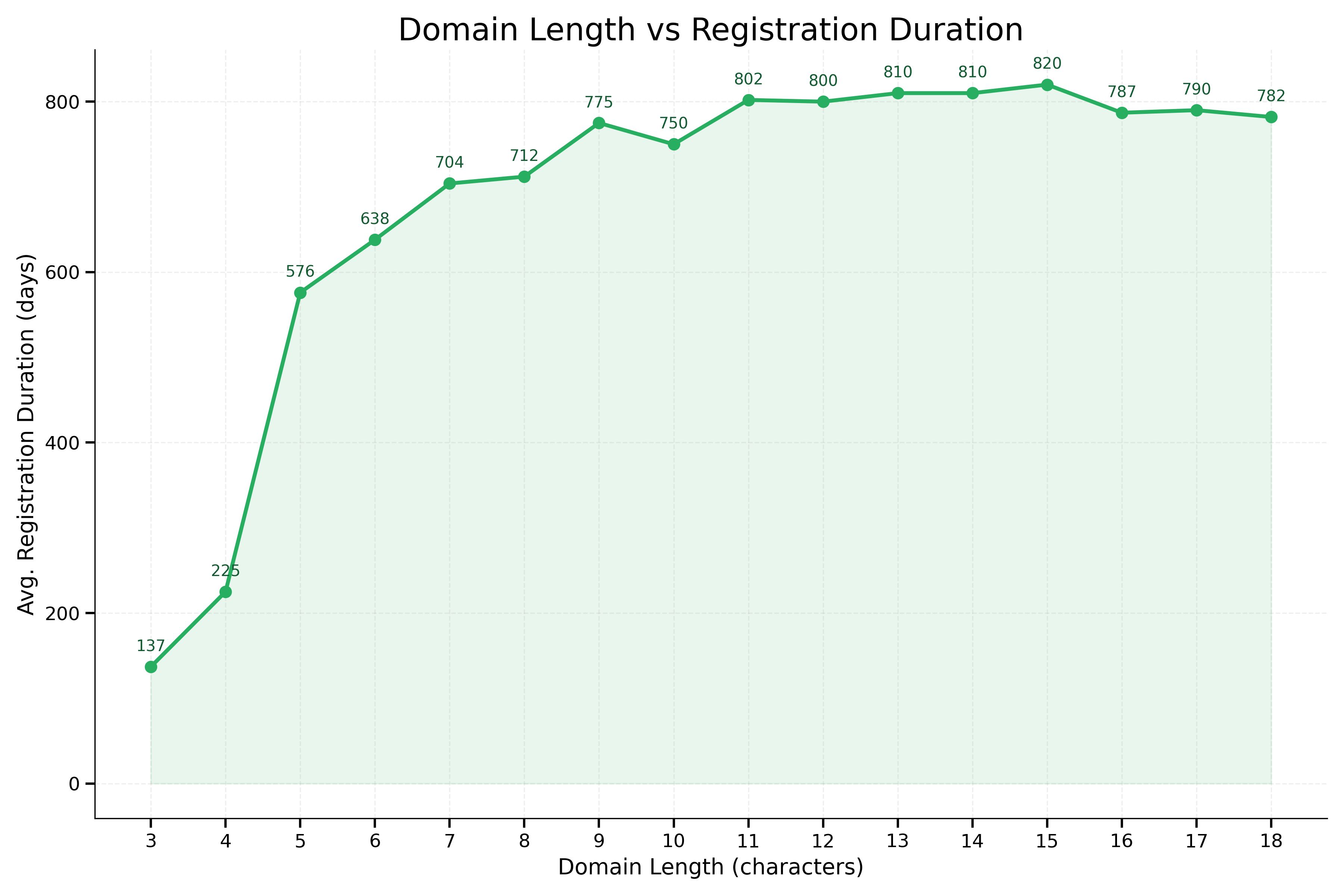
As for the average selected registration duration, we can again note the presence of a certain rule: at the point 9L, the duration increases sharply and then remains in approximately the same range of 800 days.

As noted in previous posts, the registration duration is the most reliable metric for classifying a user as a regular or a speculator. However, if we divide users into those with 1-3 domains (and mark them as regular) and those with 4 or more (and mark them as speculators), as we did earlier, we will find that their ratio is the same for all domain lengths longer than 5 – about 32%.

This means that we can assume that in the 5-7L (or 5-8L) section, there are many regular users who nevertheless register domains with some speculative interest. They register domains that have no particular value now, but they expect that such value will appear in the future.


Domain categories

To know this for sure, it is necessary to estimate the “potential virality” of domains of different lengths that are registered. I manually went through several tens of thousands of randomly selected names and identified three categories of encountered domains by specificity level.

1.Non-specific domains. Those that may be of interest to a wide range of people and have high speculative potential. These include:

  • Actual or modified names of popular brands that are not publicly known to have registered a domain. For example, chevrolet.eth or walmartrewards.eth.

  • Actual or modified names of celebrities that are not publicly known to have registered a domain. For example, richard-branson.eth or stephencurrynft.eth.

  • Names of fictional characters from famous works. For example, walter-white.eth.

  • Names of countries, cities, or world-famous places. For example, brooklyn-bridge.eth.

  • Names of any media or historical events. For example, civilwar.eth.

  • Numeric or numeric-like. For example, 41512.eth or 333th.eth.

2.Moderately specific domains. All domains “on the edge” that could, in theory, be of interest to a limited number of people. This includes:

  • Names of real, but little-known brands. For example, baysidebarbers.eth is the name of a Canadian barbershop.

  • Names of locally famous places. For example, cameronhighlands.eth is the name of a district in Malaysia.

  • Words or combinations of words that could well be used by a specific person as a nickname, but will also likely be of interest to other people. For example, digitalmillionaire.eth.

3.Specific domains. Those that are highly likely to be valuable to only one person/organization. This includes:

  • Personal names, not associated with celebrities. For example, stephanedelecroix.eth is the name of a French software engineer.

  • Nicknames/usernames, especially if it can be found on the Internet. For example, mengmeng123.eth.

  • Numeric domains that imitate a phone number or an eventless date. For example, 19940506.eth.

As you can see, the distinction is rather arbitrary. There could be two people in the world who use the nickname Mengmeng123 or have the name Stephane Delecroix. However, due to the large sample size, I believe that the output is approximately accurate.

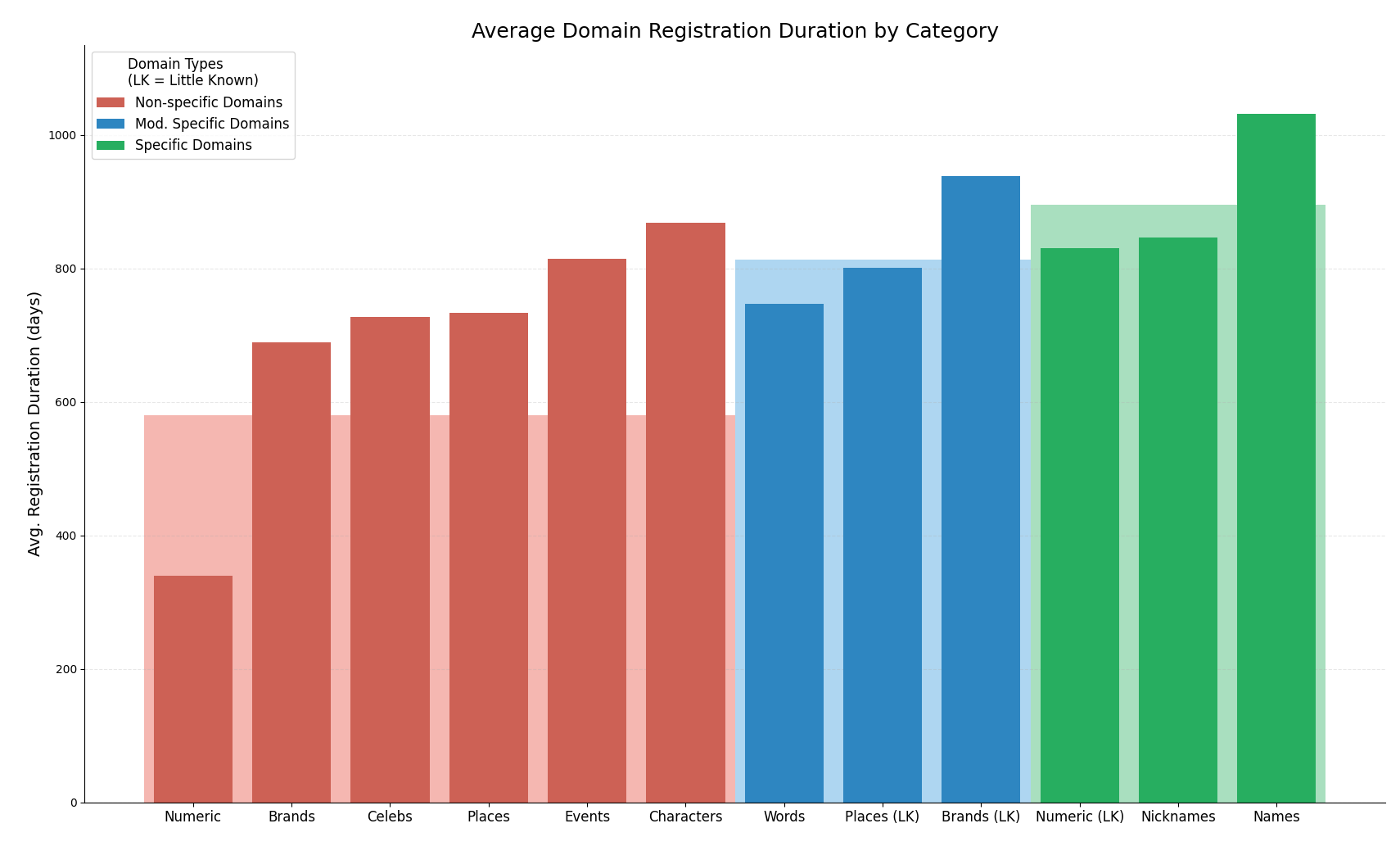
In the graph above, you can see what average registration duration is chosen for each domain category. The data once again shows that regular users (who register a domain specific only to them) choose long registrations.

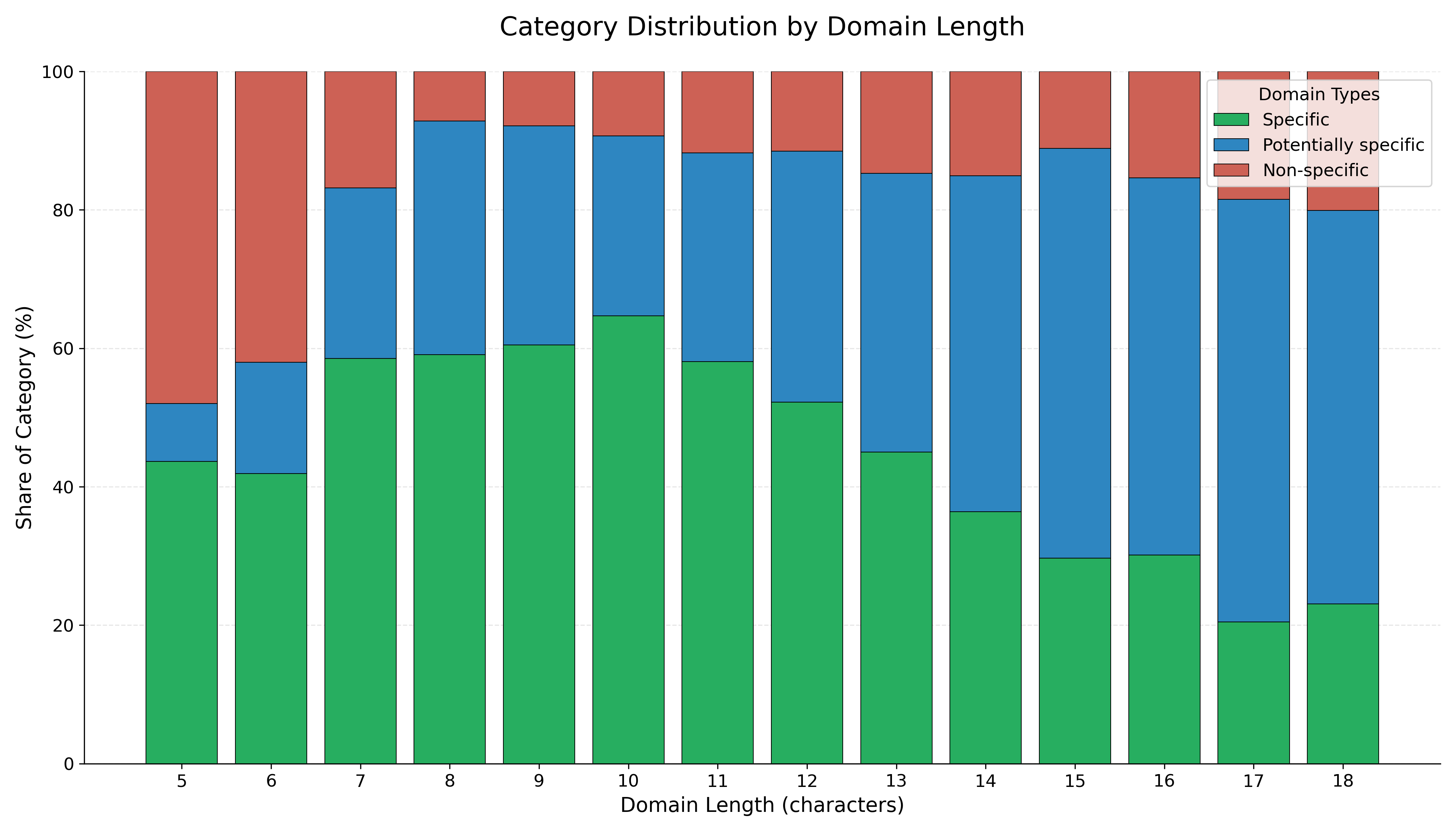
This graph shows how specificity is distributed by domain length.

In the 5-6L area, there are a large number of domains from the non-specific category. Mainly due to the numeric domains included in the potential 100k and 1mil clubs, which are known to be in low demand at the moment. In 7L, a large number of nicknames are already appearing, but they are still flooded with smaller numeric domains imitating smaller dimensional domains (for example, 0x69420.eth).

From 8L to 12L, nicknames dominate, and we can say that this is the area filled with the most specificity. Apparently, such a length is chosen as a nickname not only in ENS (here is a study on the lengths of Reddit nicknames).

In 13L+, the number of nicknames decreases, and personal names begin to replace them in the specific group. The group with moderate specificity comes to the fore, mainly due to word combinations.

With a small caveat, the obtained data can explain the anomaly in price sensitivity. For some reason, people registering their nickname as a domain are willing to pay more than for a domain that does not personally relate to them. Despite the fact that they are willing to pay more, I propose introducing a “softer” curve for them, so that this category of users, which is presumably the main driver of adoption, can always register a domain at a more affordable price.


Recommendations

The updated recommendation would be to split the 5L+ category into 5-7L and 8L+. For 8L+, I recommend using a curve with a starting point of $10 and an asymptote of $3. There will be no specific continuous formula, but the decay will be as follows:

Year 1 - $10 (avg. $10/y);
Year 2 - $7.5 (avg. $8.75/y);
Year 3 - $6 (avg. $7.8/y);
Year 4 - $5 (avg. $7.125/y);
Year 5 - $4.5 (avg. $6.6/y);
Year 6 - $4 (avg. $6.15/y);
Year 7 - $3.6 (avg. $5.8/y);
Year 8 – $3.4 (avg. $5.5/y);
Year 9 – $3.2 (avg. $5.25/y);
Year 10 – $3 (avg. $5/y);
Then $3 for each subsequent year.

Based on the curvature calculation (more details in the original post), we can expect that with such a price curve, users will choose an average of 8 years of registration. Registrations are not expected to decrease, however, the long-term income of ENS for this category of domains will not increase (however, the income “here and now” will increase).

At the same time, the user will have the opportunity to average the price to about $ 5 dollars if they choose an 8-year registration. Registering a domain for a period longer than 10 years will allow you to get the domain at your disposal for an average price less than the current fixed price.

Recommendations for other lengths remain unchanged, only the curve that was previously proposed for the entire 5L+ is now proposed for 5-7L:

  • For 3L domains: $ 640 for the first year, $ 430 for the second year, $ 360 for the third, and so on according to the formula P (t) = 420 / t + 220.
  • For 4L domains: $ 160 for the first year, $ 107.5 for the second year, $ 80 for the third, and so on according to the formula P(t) = 105/t + 55.
  • For 5-7L domains: $15 for the first year, $10 for the second year, $8.33 for the third, and so on according to the formula P(t) = 10/t + 5.
1 Like

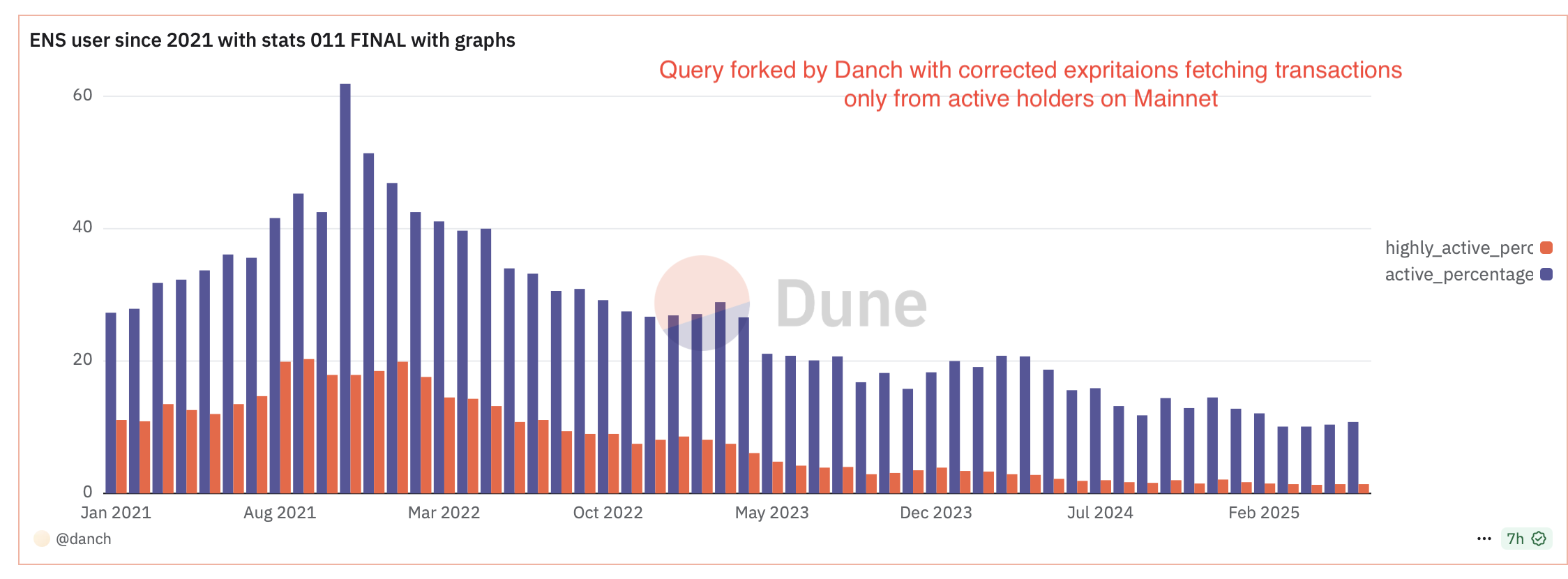
Soooo… I saw this analysis, and what immediately strikes me is that suggestion is to increase prices, so I decided to play with Dune a little bit. Please keep in mind that its not that I’m not pro data scientist, I’m not even amateur data scientist, but I did my best. Happy to apply any corrections, if you see that something is off.

I decided to try to understand what’s the real engagement within ENS ecosystem.

TLDR - protocol is deeply stagnating, and if anything we should be decreasing prices to lure more people in, not raising them.

Here is the link for those who just want to dive in - https://dune.com/spikewatanabe_eth/ens-users-engagement

Here are the comments.

Analysis includes only data from mainnet, it doesn’t include data from base.eth registrations. I acknowledge that this is big part of picture, however even findings from mainnet engagement already provide good temperature check as to what is going on.

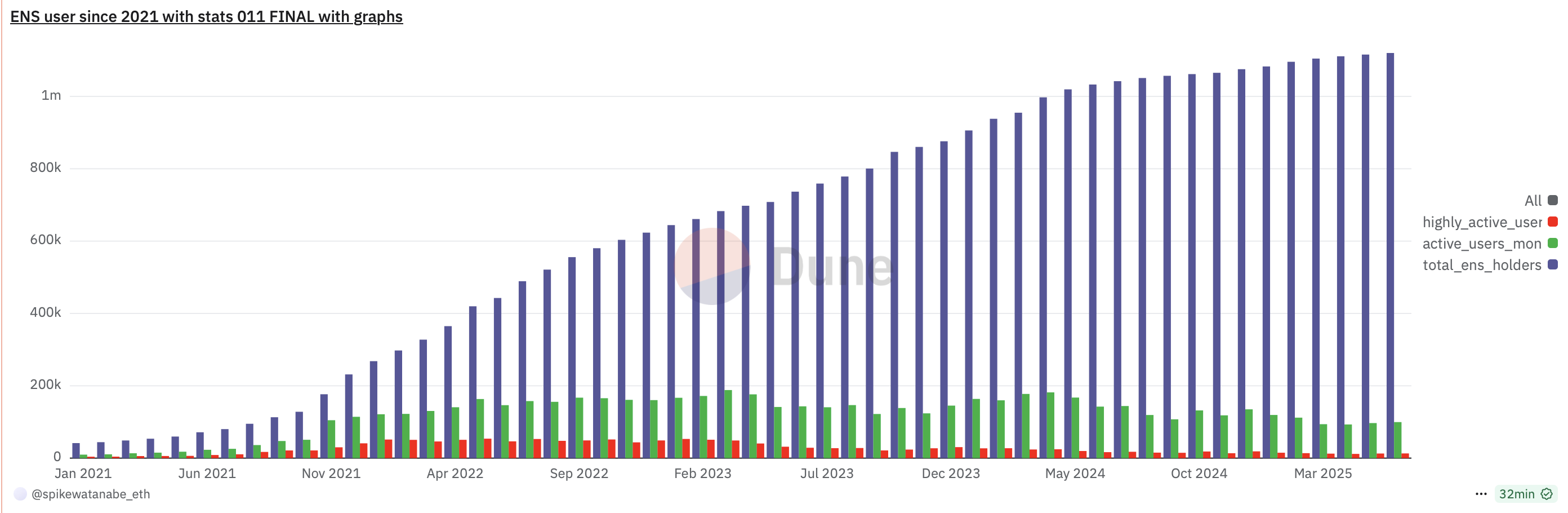
Here is graph plotting total number of name holders vs active users and vs highly active users.

I defined active user as user who has more than 3 tx in respective month, and highly active user as user who has more than 20 tx in respective month. Transactions in question exclude those related to ENS setup, so registration, profile interactions etc are not included, so everything else transfers, defi etc are falling into those definitions. As you can see there is huge proportion of users who are literary not doing anything at all with their names. Red bars shows “highly active users”.

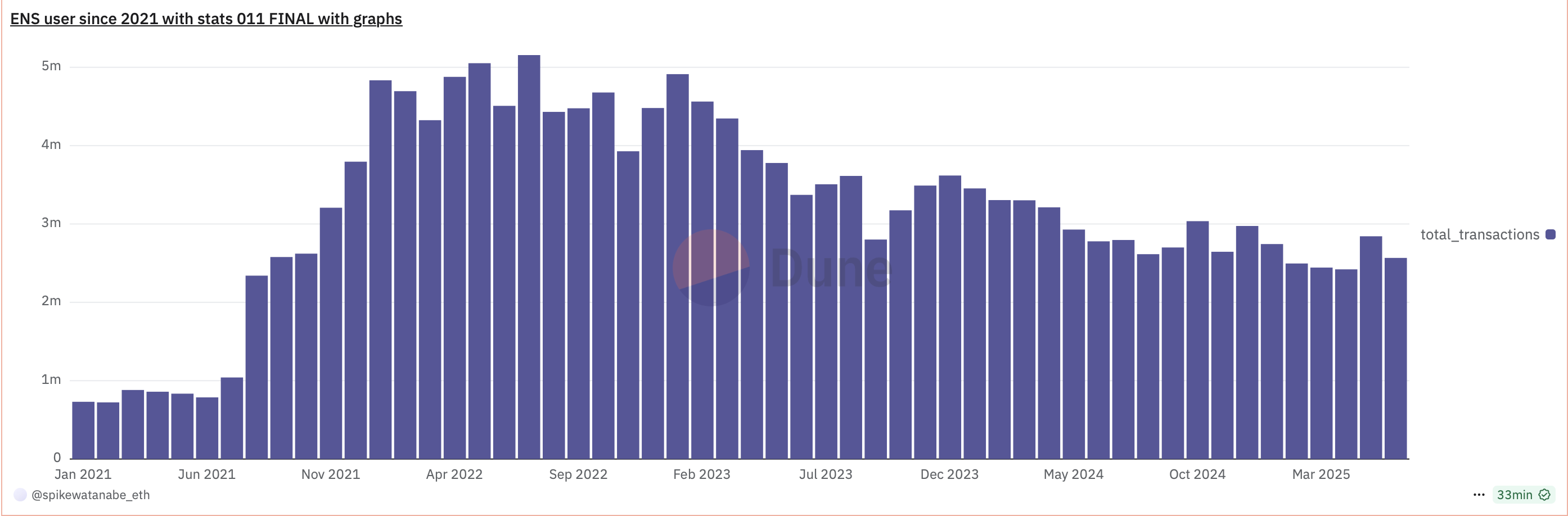
Despite growth of ENS registration total transactions if not falling, but I think it would be fair to say flat / stagnating.

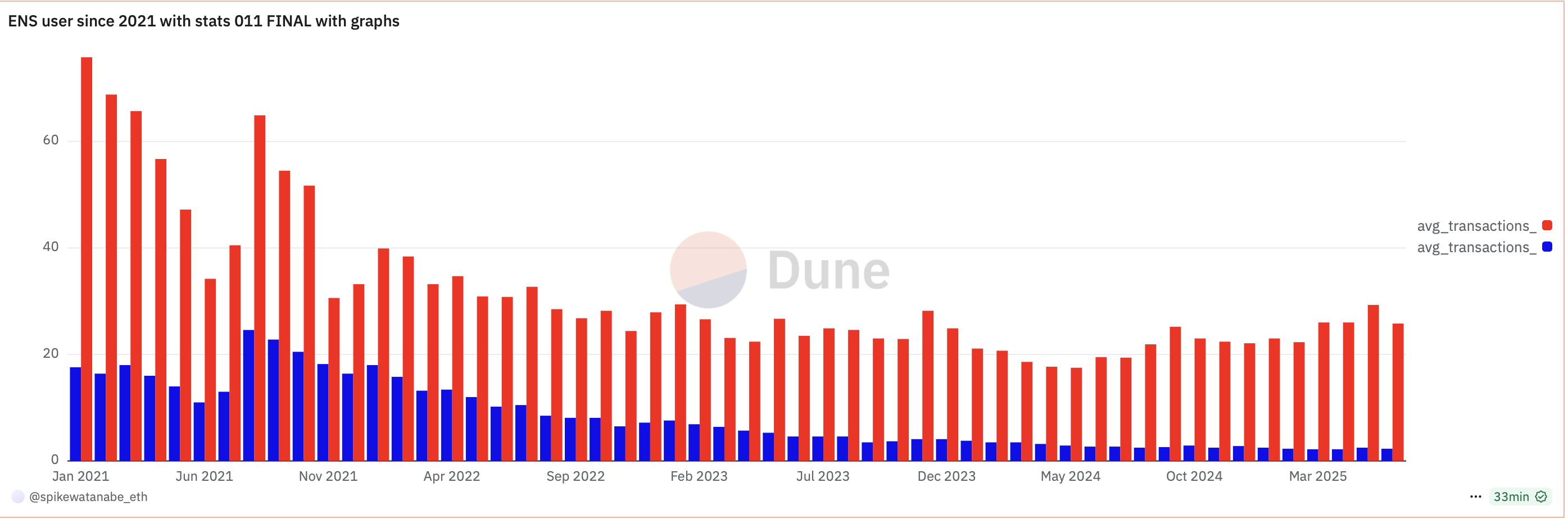
This chart plot transactions per total user base which is declining and flat, vs transactions per active user as defined above, which is somewhat stable at 25tx per active account.

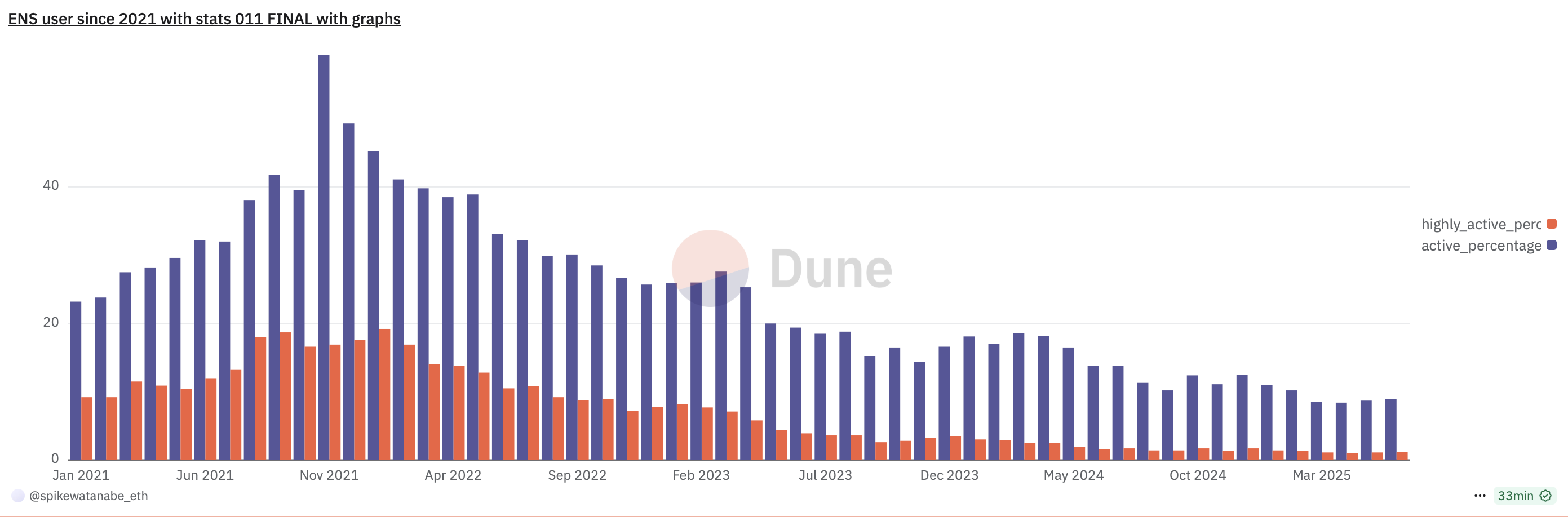
And finally in my opinion the worst graph of all

Percentage of active users and percentage of highly active users vs total user base - steadily declining.

So on mainnet as of today there are approximately 12k highly active users with more than 20tx on their accounts, which representents 1-2% from total accounts who hold at least 1 name.

In my book this is real ENS user base, at least on mainnet.

Again this doesn’t count L2. There are some limitations to what I can do with Dune, because I have free account with Dune, complexity of the ecosystem etc, not enough time to dive in etc. I’ll see maybe later if I find time, I’ll fund Dune account to run faster more complex queries, but for now it is what it is.

Please feel free to poke my code, happy to correct, if there are any errors, but it appears the general picture is more or less correct.

People, we need some monkey boost and fast :slight_smile: .

EDIT: I’ve been slaving over Dune whole weekend trying to get deeper insight into what’s going on, findings above are somewhat incorrect in the following way, total number of unique accounts is higher, than it really is because I didn’t incorporate expiration check into my analysis, so for example if someone had a name at some point in time, but let it expire, he is still counted as valid holder of the name and included into “transactional statistics”. Interesting fact is that a lot of other analysts on Dune who built various dashboards on ENS have the same problem and show inflated number of users.

There is official ENS dashboard built I presume by @matoken.eth - https://dune.com/ethereumnameservice/ens

It quotes slightly lower figure of unique participants of 757,561 at the time of writing, however from what I understand even that number is slightly inflated as well because it seems there are no expiration checks for certain groups of name holders. What I would like to do is to continue working with Dune throughout maybe this week, to get a more robust analysis, possible even with breakdown by group names, its a very complicated work (at least for me maybe :sweat_smile:), so I don’t know if I can “tame that beast” :slight_smile: , but I’ll try. Its a very interesting work, I wanted to do something like this for a while now, but it just so happens that stars aligned for me to do it now.
However! In the meantime I would like to highlight, that presented analysis even though data is fetched slightly incorrect as described above still paints the picture. You can just mentally adjust everything downwards by approximately 25-30% to get more or less accurate view of the situation and dynamics would probably be the same. I’ll make an additional post, or edit this one if I can come with better data.

Hey, Spike! Thank you for your involvement.

Yes, that’s correct. If you decide to use BaseRegistrarImplementation, you can find the most recent expiration date in the _evt_NameRegistred and _evt_NameRenewed tables. Compare them by tokenId and find the largest Unix number in the ‘expires’ column. Use that date to determine if a name was active at the time of the count in a given month.

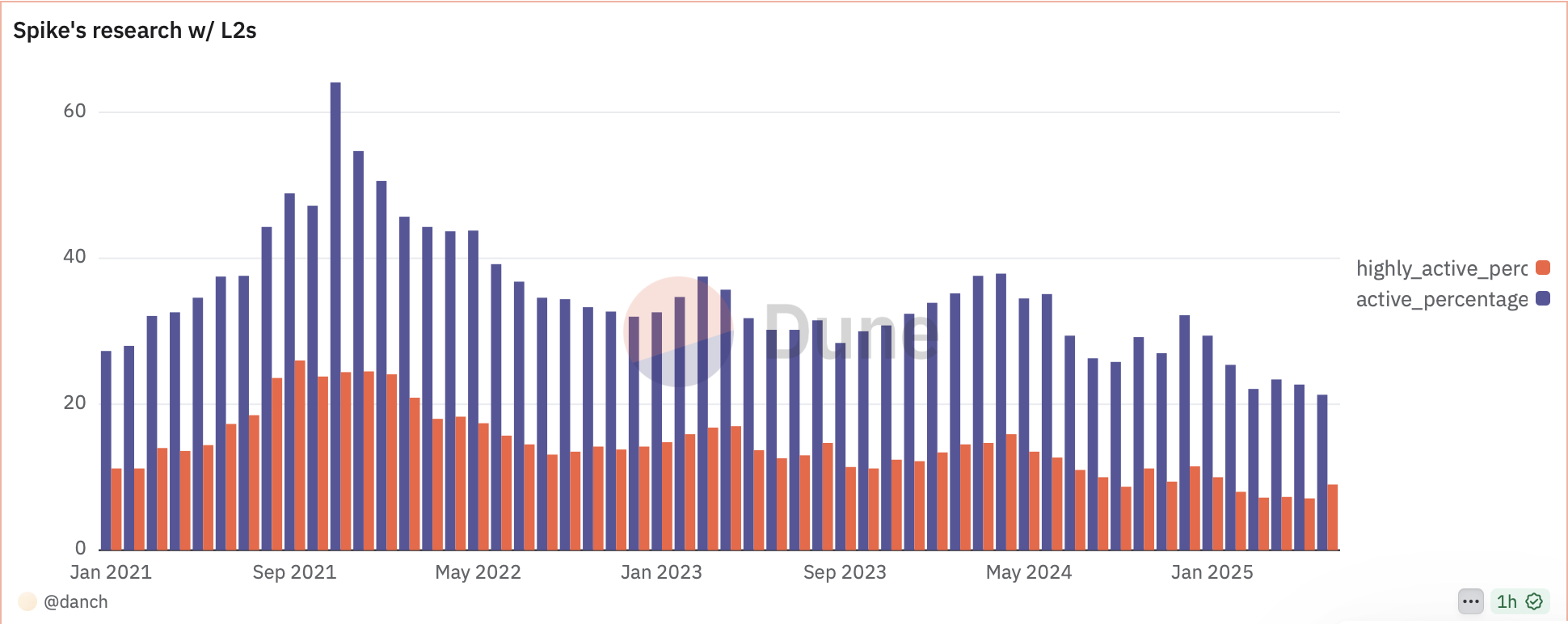
Here’s a fork of your query: https://dune.com/queries/5546820/9031385. It correctly displays the number of unique ENS holders (except that Makoto’s query also considers those released less than 90 days ago as active).


I also made a separate query where I included L2 transactions: https://dune.com/queries/5547583/9032698. While the decline is still present, the picture does not look nearly as dramatic. Overall, if you exclude the spike at the end of 2021, you can say that the number of users in different categories of your classification is roughly at the same range:

Speaking of “very active users”, there are now 9% of them, not 1-2%.


Let’s assume that your data does reflect reality and let’s imagine that we lower/didn’t raise the price based on this. Will this increase the number of transactions made by users? How will the fact that I bought ENS name at a lower price motivate me to make more transactions and be more active?

If you mean that this will increase the number of users, then it simply doesn’t work. For a long time, gas cost an average of $10 per domain registration complexity transaction. After it suddenly dropped to $1, the number of registrations after a short-term increase returned to the previous level. This has happened many times in the history of ENS.

Great, thanks a lot for your help and additional insight, it even matches the official @matoken.eth query. I would still like to continue doing my analysis, because there are a couple of question I wanted to see answer and its a very interesting exercise. Will be happy to share once it’s done.

So from your query on mainnet as I thought, the dynamics would be the same, just the absolute values would be lower.

Just wanted to add a couple of comments. I’m a trained economist myself, done my econometrics course, and I think your analysis is definitely spot on - measuring consumer sensitivity to change in price is one of the major cornerstones. I’m not disputing validity of your analysis or its accuracy or its importance.

What I’m trying to say is that when evaluating whether price should be changed its important to consider the broad picture, we also need to address such questions as to how well protocol is doing, what’s the growth dynamics, what’s the user engagement etc. As a banker in the past, I was involved in some deals where we needed to evaluate user activity and in fact it was one of the prime metrics of health of target company. So for example company with huge user base, which is largely inactive is obviously a signal of not a very good health of business.

I’m not saying that lowering the price will induce more transactions per user, it’s just an indicator helping to better understand the situation. In this particular case given the instruments available - that data is on blockchain and that its available on Dune with certain limitations, calculating transactions per active name holder is just one of the most obvious indicators we can use.

Thanks for also adding analysis which includes L2s, I was going to do that as well, and it’s very helpful. That certainly does provide better understanding of dynamics of protocol. One important point to consider is that from what I understand L2s are not paying anything into ENS treasury. Base names have price attached to them, but it’s all going to Base and Uni names are free to claim at all. Apparently I’m not human enough to claim Linea name, but that’s another story, going through PoH on Linea is another type of cost barrier, I would not include it in this analysis for now.

So your analysis is only applicable to names of Mainnet and dynamics is on decline. I certainly appreciate the point that Mainnet is expensive, people are migrating to L2s for cheaper txs.

The key question here what’s going to happen to dynamics on Mainnet and revenue going to ENS treasury given that for the past couple of years engagement has been falling?

My intuitive understanding is that some unknown proportion of name registrations was driven by people who don’t have intention to use name right now, and its not necessarily collectors, I would think that a lot of people register a name just to get a claim on that digital real estate to be future proof for example.

So those “active” and “highly active users” both on Mainnet and L2s are people who understand the value of .eth name and use it properly, in other words they know what they are paying for and get more value from it than then they paid, otherwise they wouldn’t buy it and number of those people declining.

I already did some analysis on base names, its not ready for publication yet, but from what I understand the dynamics is somewhat similar in the following way - explosive growth in beginning and gradual decline of active users. Also note that base names are relatively new, so if that dynamics continue it may fall even further.

Additionally given that .uni names are free to claim and they saw explosive growth - then argument can be made in favor of reducing price, although I can’t quantify it easily.

In the light of all of the above, what I’m trying to understand is that if we increase prices, what are the chances that we are going to crash revenue and registrations specifically attributable to ENS treasury?

I appreciate the argument that over the period of 10 years the price converges to 5USD per year. But it’s still not the same as paying 5USD per year, because you are asking user to commit significant amount here and now. This is starting to look more like unstoppable domains pricing model. As of today they charge 40USD for native crypto name one time payment. Look at it from financial mathematics point of view:

So effectively what they did is this, they thought to themselves, well ok, ENS is charging 5USD per year, why don’t we charge the same price, but instead of taking it on annual basis take whole lump sum today, take 4% as discount rate, that becomes 10 year pricing plan. 4% is very generous, make it 20% and it becomes infinite number of years. Either way we want to be cheaper than competitors, even if competition is lame.

yes, but are we really at this explosive growth point where mass adoption is imminent and consumer will not be that sensitive to price change?

they will extend it if they see utility

Just to draw the line here, I think you made amazing analysis, first of its kind in the history of ENS, what I’m trying to do here is to add more data points to the discussion, so that we as a community can make better informed decision on this matter.

1 Like