Delegation Incentives - Pilot review
Summary
The delegation incentives pilot ran for three rounds, July to September 2026, and paid 18,000 of the 90,000 ENS the DAO approved. Each month a pool of ENS, sized by how much voting power active delegates gained, went to those delegates and to the holders delegating to them. The mechanism worked. The volume came in well below what we expected. Voting power held by active delegates grew every month once one delegation is set aside, almost nobody who was paid undelegated or sold, and the pool moved up a band in September, from 5,000 to 8,000 ENS. On the same basis delegated supply did not move, and the program reached few people.
The pilot’s raw numbers
| Round 1 (July) | Round 2 (August) | Round 3 (September) | |
|---|---|---|---|
| Growth that set the pool | +0.56% | -70.69% | +15.19% |
| Pool | 5,000 ENS | 5,000 ENS | 8,000 ENS |
| Paid | 8 Aug 2026, one transaction | 4 Sep 2026, three transactions (1, 2, 3) | 8 Oct 2026, one transaction in three batches |
| Active delegates | 45 | 40 | 38 |
| Recipients | 734 (29 active delegates, 650 delegators, 55 lottery winners) | 541 (28 active delegates, 480 delegators, 33 lottery winners) | 697 (29 active delegates, 638 delegators, 30 lottery winners) |
Across the three rounds 18,000 of the 90,000 ENS approved went out, in 1,972 payouts to 988 unique recipients. The August figure includes a 3M ENS delegation to one delegate who stopped counting as active that month. The next section shows the growth without it.
What the data says
In the Temp Check we committed to report three things once the pilot ended, the increase in delegated and active supply, the share of rewards sold, and whether delegations stuck. The table has them, with delegated supply in the first subsection below, and the subsections take them together with the other items the Temp Check listed for this review.
Every voting power and supply figure in this section leaves out nick.eth and the 3,000,000 ENS delegated to him on 22 June and withdrawn on 8 September. At the end of July that one delegation was 69% of all voting power held by active delegates, the delegates who voted on 7 of the last 10 proposals. In August he voted on 6 of 10 and stopped counting as active, which is why the official figure printed -70.69%. The payouts followed the official figures, and the exclusion below is for reading the growth, not for sizing the pool. On Anticapture delegated supply goes from 7.05M to 4.06M ENS over the pilot, and the whole drop is that withdrawal.
| Round 1 (July) | Round 2 (August) | Round 3 (September) | |
|---|---|---|---|
| Voting power held by active delegates | +13.0% | +6.2% | +15.2% |
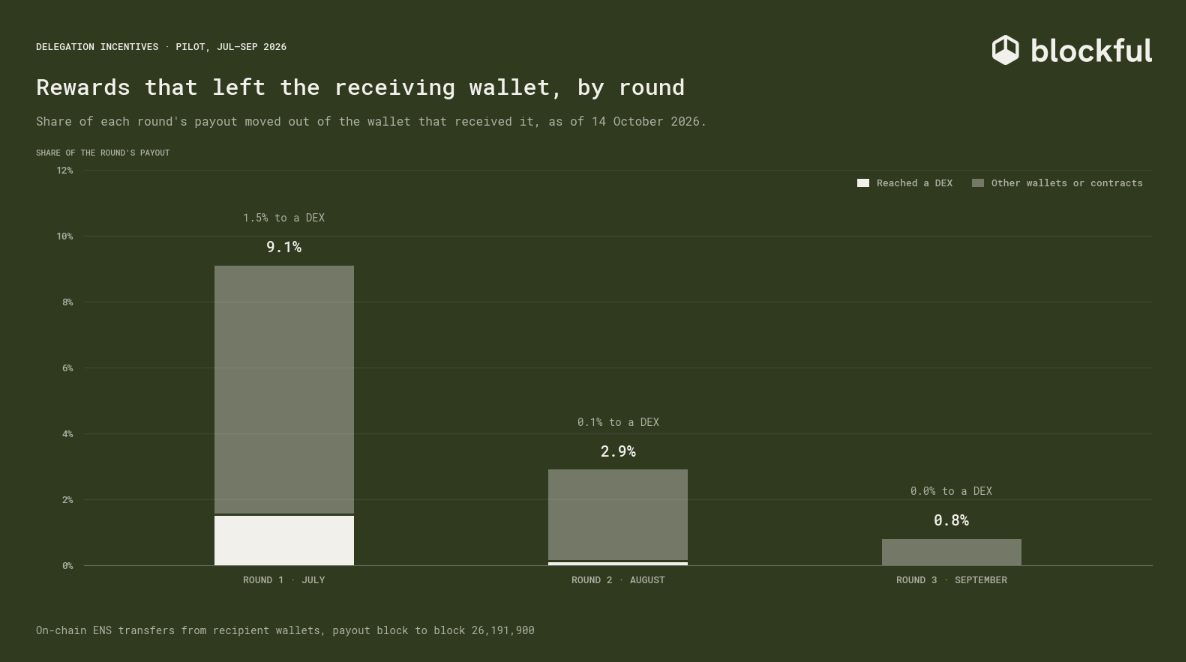
| Rewards moved since payout, share of the round | 9.1% | 2.9% | 0.8% |
| Delegators still on the same delegate | 637 of 639 | 469 of 469 | 628 of 628 |
Growth is measured from the end of one month to the end of the next. Rewards moved and delegations are as of 14 October, where our rounds 1 and 2 reply read them on 14 September. The last row counts direct delegations only, direct meaning the wallet delegates from its own address rather than through a vault or the multi-delegate contract.
Delegated supply
Excluding the 3M, delegated supply ended the pilot where it started, 4.05M ENS on 30 June and 4.06M on 30 September. The target in our SPP application was a 30% increase, and we said in the RFC we hoped to reach it within the pilot. We did not. What moved was the part of that supply held by active delegates. Their voting power grew 13.0%, 6.2% and 15.2% month on month, 38% over the pilot, from 1.06M to 1.47M ENS.
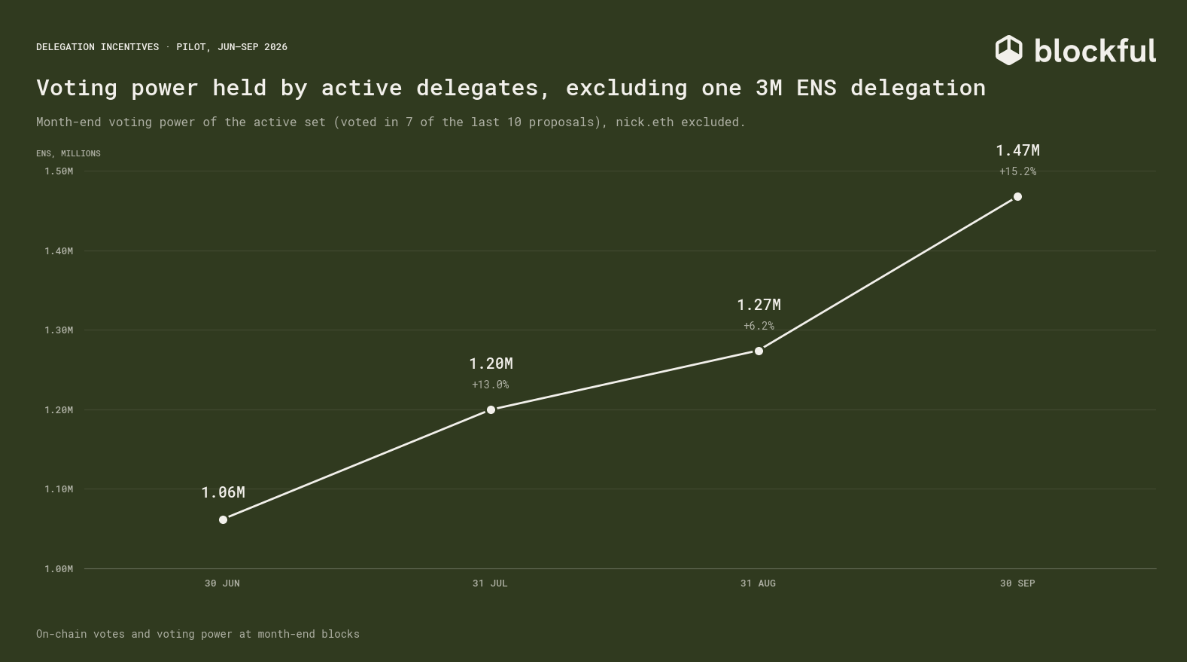
Part of that is composition. The metric counts a delegate starting to vote the same as holders delegating to active ones, by design, so most of September’s growth is a delegate entering the active set rather than new delegations.
Active delegates
The pilot started with 59 active delegates and ended with 38.
| Month end | Active delegates | Left during the month | Joined during the month | Voting power that left, excluding the 3M |
|---|---|---|---|---|
| 31 Jul | 45 | 16 | 2 | 51k ENS |
| 31 Aug | 40 | 5 | 0 | 58k ENS |
| 30 Sep | 38 | 3 | 1 | 7k ENS |
Every exit has the same shape, the delegate skipped the proposal that was closing while an older vote rolled out of the window, so 7 became 6. Two of the three who joined left again. Of the 24 who left, 16 have not voted since, on-chain or on Snapshot, and their delegators have not moved either. Seven kept voting, below the threshold. Only two proposals closed after July, so for the later exits “since” means one skipped vote, or none. The count fell with the DAO’s turnout, not with the program.
After payout
Almost nothing was sold. As of 14 October, 9.1% of round 1, 2.9% of round 2 and 0.8% of round 3 had left the wallet that received it, and the part that reached a DEX was 1.5%, 0.1% and 0.0%. The rest went to other wallets or contracts. Delegations held. Of the direct delegators paid in each round, 637 of 639, 469 of 469 and 628 of 628 still delegate to the same delegate, the two who changed moved to another active delegate, and nobody undelegated.
Dispersion among active delegates
One concern raised in the RFC was that the program would concentrate voting power in the largest delegates. It did not, and it did not spread it much either. Among active delegates, excluding the 3M, the figures barely moved.
| 30 Jun | 30 Sep | |
|---|---|---|
| Gini coefficient | 0.78 | 0.69 |
| Nakamoto coefficient | 5 | 5 |
| Share held by the ten largest | 80% | 80% |
Including the 3M, the June figures were 0.93 and 1, so most of the change the raw numbers show is that one delegation leaving.
What we learned
How we define an active delegate
The rule is binary, voted on 7 of the last 10 proposals or not, and the pool is sized by month-over-month growth in the voting power that set holds. Both choices were deliberate, and together they make the metric move on single events. One missed vote drops a delegate and all their voting power out of the count, which is how every exit above happened and how August printed its official figure. The reverse happens when a delegate crosses the threshold. All the voting power they already held starts counting that month, with no new delegation behind it, and that is most of September’s growth. And for a month one delegation was most of the metric. A metric built this way measures turnout among large holders as much as it measures delegation.
Concerns raised before launch
The RFC and Temp Check carried four worries we can now put numbers on.
| Concern | What happened |
|---|---|
| Rewards would be sold, or farmed and dropped | Under 2% of rewards reached a DEX. Nobody undelegated. |
| Holders would delegate, collect and ignore governance | Delegations stuck, and the two who moved went to another active delegate. |
| Rewards would concentrate voting power in the largest delegates | The share held by the ten largest stayed at 80%. |
| Caps would push people to split wallets | Caps bound 4 to 8 holders and 4 to 5 delegates a round, and four of the capped holders were the same wallets in all three rounds. |
Reach
We announced the program in the Temp Check and at launch, held office hours on 18 June and a Space on 15 July, posted about it ten times on X, presented round 1 and round 2 in the MetaGov calls, and posted their numbers in the RFC thread. The ENS DAO and ENS Labs accounts reposted it in the first two weeks, four issues of the DAO newsletter and ETH Daily carried it, and the DAO account shared the round posts in September. We also mapped the holders delegating to inactive delegates, and most of them had no public contact, so direct outreach stayed small.
The views did not turn into delegations. About 41,000 views on the July posts, plus the reposts, turned into about 200 visits to the app that month. In the first two weeks of July, while we posted daily, 28 new delegations went to active delegates. In the three weeks after posting paused, two. Our read is that reach, more than the mechanism, is where the volume was lost. Third-party amplification was a handful of reposts and newsletter items, most of them in July, and the community was less present in governance than it had been months before.
The question for the DAO
The program exists because voting power in the hands of active delegates is what keeps this DAO hard to capture, and that goal has not changed. We built the pilot for it, and the draft posted in July on delegating 5M ENS from the DAO comes at the same problem from the other side, much of the supply sits undelegated in the DAO’s own treasury.
The pilot’s mechanism did what it was designed to do for the people it reached, and it did not reach enough people. The section above says why we think that is.
So the question we bring to this thread is what the DAO wants to do with this. We see three options:
- Another three months of the same design, which we would only run with the community and the DAO’s official channels behind it, since reach is where the volume was lost.
- A different mechanism for the same goal.
- Or no spending on delegation for now and no delegation target in Year 2.