Hi everyone. I’m Cyrille from f(x) Protocol.
After a conversation with a member of the ENS DAO at ETHConf 2026, I was encouraged to bring this discussion to the forum. This post explores whether fxUSD and fxSAVE could be a useful addition to the ENS stablecoin strategy.
Summary
The ENS DAO holds a significant stablecoin allocation, mostly USDC and USDS. This post introduces fxUSD and fxSAVE as a potential diversification, being:
-
Trustless: fully on-chain, no custodians, no freeze function
-
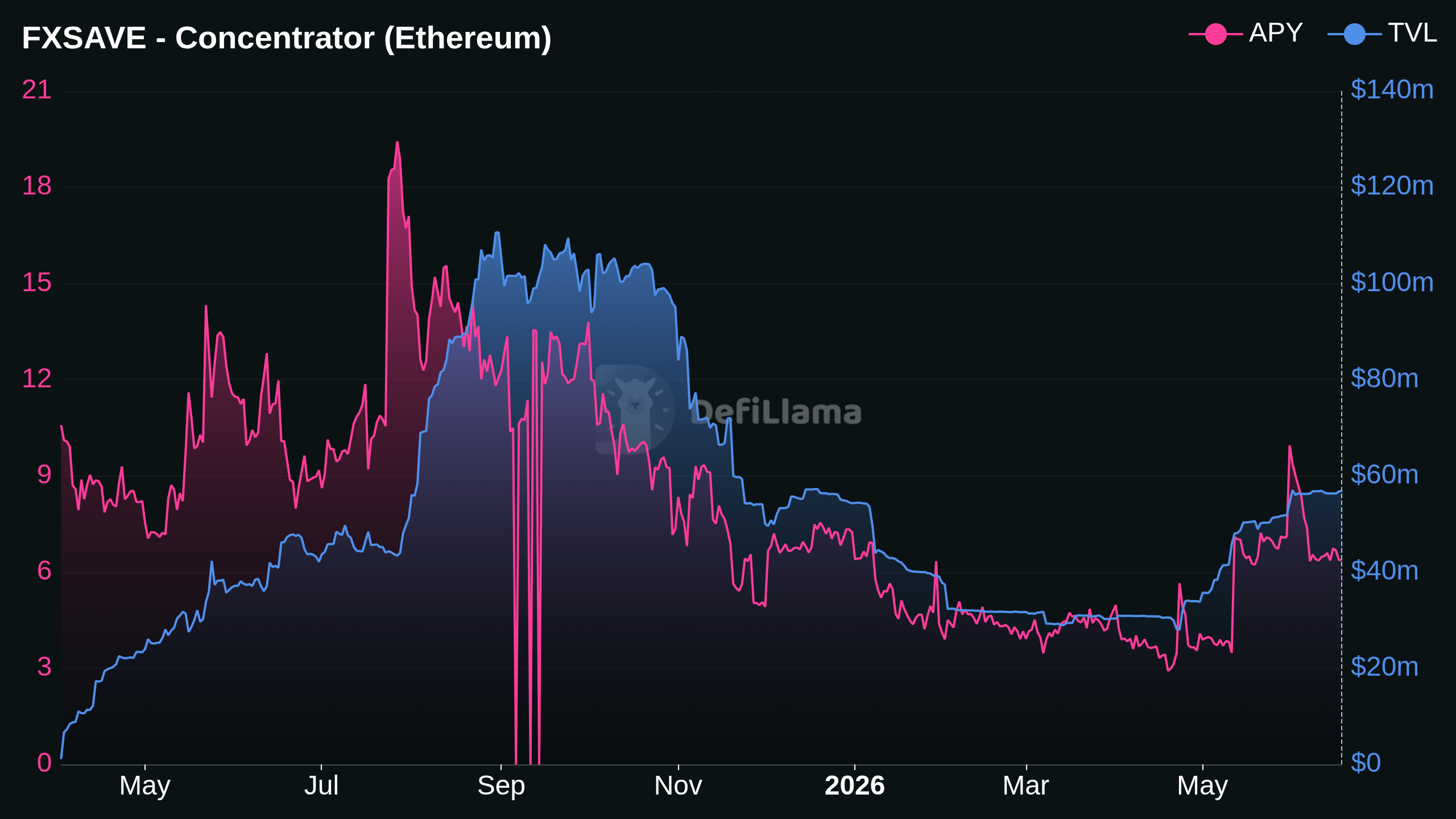
Productive: 6.44% APY from organic protocol revenue, not subsidies or emissions
-
Liquid: deposit and redeem anytime, ERC-4626 composable, no lock-up (one hour cooldown)
-
Ethereum-aligned
What Is fxUSD?
fxUSD is a scalable & trustless stablecoin with a strong peg to the dollar by design, issued by f(x) Protocol (built by Aladdin DAO). It’s backed entirely by on-chain collateral: wstETH and WBTC.
f(x) Protocol lets users borrow against ETH and BTC for 0% APR while protecting them from hard liquidations. Instead of a recurring borrowing cost, users pay a one-time fee: 0.5% opening, 0.2% closing.
16 audits were conducted by Trail of Bits, OpenZeppelin and Secbit.
Metrics: https://defillama.com/protocol/fx-protocol?denomination=ETH
Links: https://linktr.ee/fxprotocol
What Is fxSAVE and Where Does the Yield Come From?
f(x) Protocol’s main yield strategy is its stability pool. It accepts fxUSD or USDC as deposit and earns most of the protocol’s revenue.
The stability pool’s main purpose is to act as a liquidity buffer for fxUSD’s DEX LPs. It does not liquidate positions. It never has directional exposure. Yield is paid in wstETH.
fxSAVE is the tokenized stability pool: an ERC-4626 vault that auto-compounds all rewards into more stablecoins. Deposit fxUSD or USDC, earn yield, withdraw anytime.
Protocol revenue comes from:
-
Leverage demand: traders/borrowers pay one-time fees to open and close positions. Those fees flow to the stability pool
-
Collateral staking yield: all ETH-denominated positions are backed by wstETH; the staking yield is mostly distributed to the stability pool
-
Aave deployment: a portion of USDC and wstETH can be allocated to Aave V3. Currently unallocated. fxUSD’s purpose is resiliency over yield
Protocol revenue details: https://fxprotocol.gitbook.io/fx-docs/earn-with-f-x/protocol-revenue-and-distribution
Risk Profile
Exposure: fxSAVE gives you exposure to fxUSD and USDC. Non-custodial ERC-4626 vault.
Backing: On-chain wstETH + WBTC only. No off-chain assets. Collateral is visible and verifiable at any time.
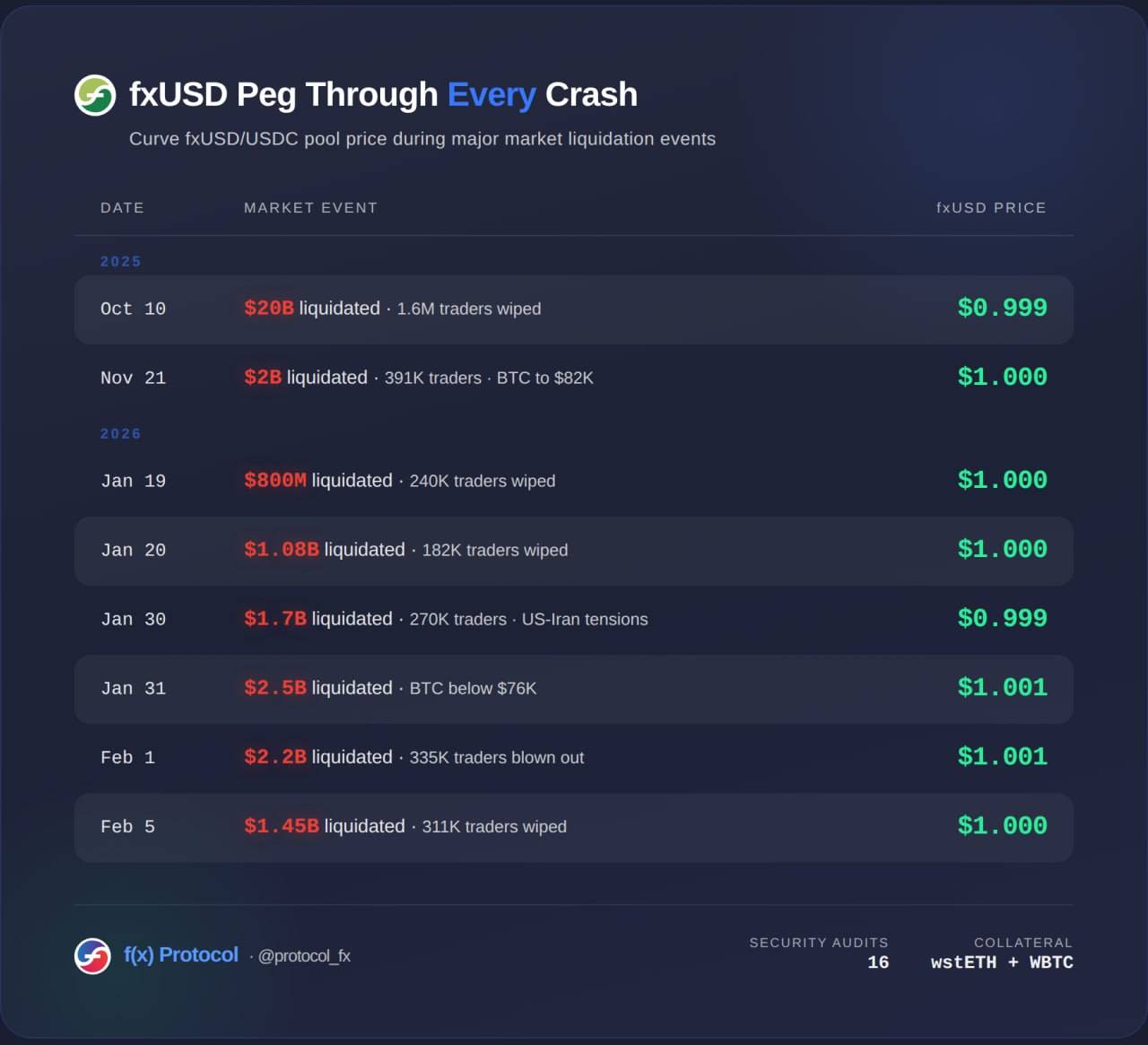
Peg stability — five progressive mechanisms, each activating before the next is needed:
-
Organic position flow creates natural buying/selling pressure
-
Stability pool automatically arbitrages deviations: buys fxUSD when < 0.998 USDC, buys USDC when fxUSD > 1.002
-
When USDC in stability pool drops below 5%, a temporary borrowing cost is applied on leverage positions. Extra revenue flows to the pool, attracting more USDC deposits
-
Emergency mode: minting halts, borrowing costs spike if USDC is exhausted and fxUSD EMA (42min) drops below $0.998 (never triggered in practice)
-
Redemption: hard floor at $0.995: anyone can redeem fxUSD for $1 of collateral minus 0.5% fee during emergency mode
If USDC itself depegs, the stability pool won’t accept more USDC deposits and limits USDC exposure.
Liquidity: fxSAVE deposits and withdrawals are always open. Withdrawal subject to 1h cooldown.
Governance: the protocol is upgradable via a 6/9 multisig with a 3-day timelock. The team doesn’t have quorum as external public signers are part of it. A 3/4 emergency multisig can pause the leverage side of the protocol.
Multisig and signers: https://fxprotocol.gitbook.io/fx-docs/more/resources/multisig
Timelock dashboard: https://fx.aladdin.club/v2/timelock
Audits: 16 audits across Secbit, Trail of Bits, and OpenZeppelin. Every line of production code has been reviewed.
https://fxprotocol.gitbook.io/fx-docs/risk-management/audit-reports
Team: Aladdin DAO, building on Ethereum since 2021. Three protocols: Concentrator, Clever, and f(x) Protocol. Community funded, no team token allocation.
Why This Makes Sense for ENS
This doesn’t change the 60/40 allocation. It’s about what sits inside the stablecoin portion:
-
The IPS mandates stablecoin reserves for runway: that’s unchanged
-
The IPS prioritizes “Ethereum-native, decentralised venues and public-goods ethos”: fxUSD is exactly that
-
Diversifying across stablecoin designs protects against an entire category of risk: USDC and USDS share many of the same failure modes. fxUSD does not, and fxSAVE lets you diversify into fxUSD with minimal trust assumptions
Any allocation would be conservative and incremental.
What I’m Asking
-
Is the ENS community open to exploring an allocation to fxSAVE?
-
Are there concerns that should be addressed before a formal proposal?
-
Would a governance working group presentation be useful?
Happy to discuss.