Overview
This proposal outlines a rigorous mixed-methods study to diagnose governance and operational challenges within the ENS DAO.
The study has three primary goals.
- First, at the institutional level, it will provide ENS DAO with the context for proactive, evidence‑grounded governance and organizational design reforms.
- Second, at the community level, it will offer transparent, credible analysis of current challenges, helping build shared understanding and legitimacy around any proposed changes.
- Third, at the ecosystem level, it will generate transferable lessons for DAO governance practitioners and researchers working on similar public‑goods infrastructures.
The research is organized into three phases:
- Phase 1: Stakeholder analysis and pre-retro data collection
- Phase 2: Retrospective assessment of spend
- Phase 3: Synthesis, research, and presentation
Throughout the process, milestone check‑ins ensure that ENS stakeholders can review interim findings, confirm alignment on research questions and methods, and provide feedback that is incorporated before moving to subsequent phases. Each party will have the opportunity to cease work upon milestone completion if mission drift occurs.
The final outputs will include a full research report, concise forum posts, and presentation materials for the ENS community.
One important open question: who is the direct project sponsor signing off on deliverables? This is not for us to decide though we are biased towards having a smaller group or committee as that makes it easier to move faster.
- Similarly, we would like input on how the community sees the minimum set of people to tinterview as part of the stakeholder analysis to be seen as legitimate.
Methodology and Process
Study Design Overview
This design is a mixed-methods case study with embedded comparative elements and relies on systematic qualitative inquiry, document analysis, and structured comparative method to build a robust causal understanding of governance challenges.
There are three phases to the research, with milestones built in to provide the opportunity for ENS stakeholders to ensure the research fulfills their objectives, adheres to the research design and provide feedback on emergent findings and input on remaining research tasks.
- Stakeholder analysis and pre-retro data collection: Phase 1 focuses on building a shared, evidence‑based understanding of ENS DAO’s current governance reality across key stakeholder groups and on preparing the data foundation required for a rigorous retrospective. This phase combines structured stakeholder analysis with targeted pre‑retro data collection, so that the eventual assessment of “what worked and what did not” is anchored in the DAO’s stated purposes, desired outcomes, and actual operational history.
- Retrospective: Phase 2 conducts a structured retrospective on ENS DAO spending and governance performance, using the purpose statements and desired outcomes articulated in Phase 1 alongside the data assembled through pre‑retro collection. The goal is to determine the extent to which key initiatives, programs, and governance processes delivered on their intended outcomes, and to surface root‑cause patterns that connect specific results (or failures) to underlying institutional design and implementation choices.
- Final Reporting: Phase 3 synthesizes insights from stakeholder analysis and the retrospective into a coherent diagnosis for ENS DAO. Additionally, relevant research will be conducted to help provide context for how other decentralized communities, in web3 or beyond, have dealt with similar challenges. This includes a full research report and community‑facing materials, designed to support transparent deliberation, consensus‑building, and staged implementation of governance and organizational reforms aligned with ENS DAO’s long‑term mission.
Phase 1 - Stakeholder Analysis and Pre-Retro Data Gathering
Overview
Phase 1 establishes the analytic and relational foundation for the entire study by clarifying ENS DAO’s purpose, mapping its stakeholder ecosystem, and documenting how different groups currently experience governance, coordination, and execution. Through background research, structured interviews, community discussions, and targeted external scanning, this phase generates a shared, multi‑perspective picture of “how ENS DAO is working today” and what outcomes its stakeholders believe recent spending and governance decisions were meant to achieve.
Phase 1A. Stakeholder Analysis
Goal
To have a clear understanding of
- What is the purpose of the DAO?
- What are the problems the DAO is facing?
- What were the desired outcomes of your spend that we will be reviewing in Phase 2?
Activities
-
Background context and ENS DAO research
-
Thoroughly reviewing the forum, community calls, and any other relevant materials, including initial conversations with the MetaGov team
-
Map the relevant stakeholders of ENS DAO (i.e., Delegates, Tokenholders, Stewards, Service Providers, Labs, etc.)
1. Role and formal authority (voting rights, execution rights, advisory)
2. Interests and known incentives
3. Reported engagement patterns and participation constraints
4. Known areas of alignment and conflict
-
Starting to sketch some potential areas for improvement
-
Conduct stakeholder interviews
-
Conducting 30+ hours of interviews with key stakeholders (MetaGov team, other working groups at the DAO, select delegates, Labs team, service providers, any other stakeholders? We ideally get community support for generating the list.)
-
Creating a process for anonymous and/or asynchronous contribution to the stakeholder analysis portion for those who are not able or interested in being interviewed
-
Potentially hosting up to 5 hours worth of community discussions, whether existing calls or dedicated town halls, to better understand the nature of the challenges from the perspective of both delegates and the broader community
-
Producing an overview of the perceived challenges from the perspective of key stakeholders, relating to how ENS DAO can improve
-
Present findings and recommendations to the MetaGov team and the community
-
Producing at least one forum post outlining the results of the research and findings
-
Partaking in 1-2 community calls to discuss conclusions and receive feedback
-
Hosting at least 1-2 dedicated calls with the MetaGov team to receive feedback on the recommendations
-
Producing a revised list of recommendations that factor in both the research findings and the community’s and MetaGov’s reception of said findings
Outputs:
- Summary of the current state of affairs in terms of ENS DAO (Activity 1 above) and a list of whom to interview
- Outlining the research questions that are at the core of the retro (see initial draft of research questions above)
Phase 1B. Pre-Retro Data Collection
Goal:
- To gather all of the relevant data that needs to be analyzed to understand if the desired outcomes defined through Phase 1 were or were not accomplished as part of conducting the full retro in Phase 2
Activities:
- Design and implement a structured data-inventory process (templates and checklists) to identify all initiatives, grants, working‑group programs, and major governance decisions to be included in the retrospective.
- Produce a master catalog of relevant documents and data sources (forum threads, proposals, working‑group reports, treasury and disbursement data, ENS Labs updates, call notes, dashboards, and any off‑chain documentation).
- Create and maintain a shared data repository for unstructured documents (e.g., forum exports, meeting notes, slide decks, research reports) with clear naming conventions and access controls.
- Outline and document standard operating procedures for sharing relevant data with the research team, including who is responsible for providing which data, in what format, and on what timeline.
- Where needed, work with stewards, service providers, and ENS Labs to generate structured exports of key quantitative data (e.g., transaction histories, budget vs. actuals, participation metrics) for inclusion in the repository.
- Log initial data quality issues and gaps (e.g., missing reports, inconsistent categorization, incomplete forum documentation) to inform both the design of the retrospective in Phase 3 and any recommendations about future data practice
Outputs:
- A data repository that will be used for the actual retrospective analysis
Milestone 1
Upon completion of Phase 1, the research team will produce a Phase 1 Stakeholder Analysis and Pre‑Retro Data Collection package, including: (a) a concise summary of ENS DAO’s purpose, problem statements, and desired outcomes as articulated by key stakeholder groups; (b) a stakeholder map with roles, authorities, incentives, and observed engagement patterns; and (c) a documented inventory and structure for the pre‑retro data repository. This package will be submitted to the designated ENS stakeholder group (e.g., MetaGov team, stewards, and selected delegates) for review.
Within one week of submission, the research team and ENS stakeholders will hold a milestone check‑in call to: (1) validate or refine the emerging picture of ENS DAO’s purpose, challenges, and intended outcomes; (2) confirm that the planned research methods and data sources for subsequent phases are appropriate and aligned with ENS priorities; and (3) surface any gaps, concerns, or additional questions. Following this session, the research team will revise the Phase 1 outputs and, where needed, adjust research questions, methods, or sampling plans to incorporate ENS feedback before formally closing the Phase 1 milestone.
Phase 2 - Retrospective Assessment
Goal
Analyse the data capture in Phase 1B in light of the purpose and desired outcomes articulated in Phase 1 & the Milestone 1 review to assess whether the spend achieved what was intended.
Activities
Phase 2 will systematically analyze the initiatives, grants, and governance processes identified in Phase 1 using the data assembled in the pre‑retro repository. Activities will include:
- Reconstructing the intended theory of change and desired outcomes for major spending streams
- coding qualitative and quantitative evidence against those intended outcomes
- identifying cross‑cutting patterns of success, failure, and unintended consequences.
The team will convene at least one milestone review (see below) with ENS Stakeholders and relevant stewards to validate interpretations, refine emerging findings, and prioritize issues that require deeper investigation before final synthesis.
Outputs
The research team will conduct a structured retrospective assessment that links ENS DAO’s historical spending and governance decisions to observed outcomes. Outputs will include:
- A set of initiative‑level and thematic retro summaries
- An integrated analysis of root causes behind recurrent challenges
- A prioritized list of leverage points where institutional or procedural changes are most likely to improve coordination and execution.
These outputs will feed directly into Phase 4, providing the empirical backbone for the final recommendations and governance roadmap.
Milestone 2
Upon completion of Phases 2, the research team will complete a retrospective of the spend of ENS DAO. This will include qualitative and quantitative data needed to produce the reports in Phase 3.
Within one week of submission, the research team and ENS stakeholders will convene a milestone check‑in call to: (1) Share what the report structure will look like to provide initial feedback; and (2) Review some initial learnings from the retro before moving onto Phase 3.
Phase 3: Synthesis, Recommendations, and Community Validation
Goal
Integrate findings from Phases 1 & 2 into a coherent diagnosis of ENS DAO’s governance and operational challenges and develop a prioritized, evidence‑based set of recommendations and a governance roadmap that are validated with ENS stakeholders.
Activites
- Synthesis of findings across phases
- Map stakeholder‑identified challenges and desired outcomes from Phase 1 against the retrospective findings from Phase 2.
- Identify areas where multiple lines of evidence converge on the same problems and candidate solutions, as well as areas of persistent uncertainty, disagreement, or trade‑offs that require explicit governance choices.
- Recommendation development and structuring
- Draft recommendations, each with a concise problem statement, proposed change, evidence base, risks, and implementation considerations.
- Organize recommendations into clear categories, such as:
- Governance infrastructure and process reforms (e.g., delegation mechanisms, proposal workflow, voting procedures, quorum/thresholds)
- Organizational structure and accountability (e.g., working‑group mandates, steward terms and elections, standing committees)
- Communication and information architecture (e.g., forum practices, information flows, transparency standards)
- Cultural and incentive alignment (e.g., contributor recognition, incentive design, participation norms)
- Roadmap and success criteria
- Sequence recommendations into a pragmatic roadmap with near‑term, medium‑term, and longer‑term actions, including dependencies and prerequisites.
- Propose high‑level success criteria and monitoring indicators for key reforms, so ENS DAO can assess whether implemented changes are delivering the intended improvements.
- Stakeholder review and validation
- Share a draft synthesis and recommendations package with ENS stakeholders (e.g., MetaGov team, stewards, key delegates) for review.
- Facilitate at least one discussion session to assess the clarity, feasibility, and perceived legitimacy of the recommendations, and to incorporate stakeholder feedback prior to finalization.
Output
- Full research report with findings and recommendations
- Community‑facing materials
- One or more forum posts summarizing major findings and recommended next steps for ENS DAO.
- A slide deck for use in community calls and steward discussions.
- A one‑page summary highlighting top recommendations, rationale, and immediate next actions for decision‑makers and contributors.
Timeline and Budget
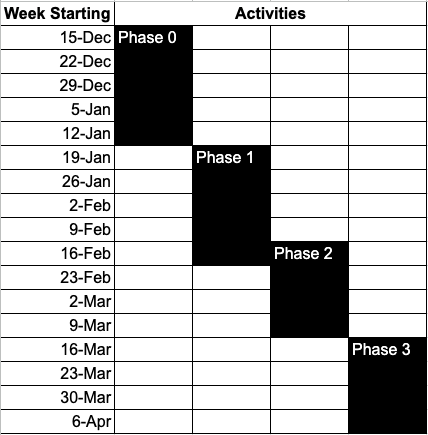
We propose a workplan that concludes the week of April 6th, however, the learnings could be shared in more informal outputs and via community calls starting mid-March. This is based on my understanding of realistic governances timelines.
Reminder of phases:
Phase 0: Proposal on the forum through voting
Phase 1: Stakeholder analysis and data collection
Phase 2: Retrospective analysis
Phase 3: Report synthesis
Here is a visual breakdown of the phases to give a sense of timing:
Here is a sheet that provides a tentative breakdown of activities.
The budget request for this work is $125,000. This budget will cover the cost of labor and any relevant tooling that can be used to enhance the outcomes.
- The cost of each phase comes out to $37,500 (doing an even split)
- Metagov takes 10% overhead for legal and administrative costs
Team Composition
Eugene Leventhal and Mike Cooper will lead the team. Additionally, there will be some other contributors from an advisor or two, the OpenGrants team, a data analyst, and potentially an additional research contributor to support delivery of the work in a timely manner.
Eugene Leventhal
- Eugene is currently the Head of Governance and Operations at Octant and a Research Director at Metagov, where he leads the Grant Innovation Lab and contributes to DAOstar.
- Eugene has been coordinating with various ENS stakeholders since early November to produce this proposal and will be the lead advisor on the project, focusing on co-defining the overall strategy, producing and reviewing all protocols and materials to be used, build the team, and program manage the effort.
Mike Cooper
- Mike is a Senior Researcher at Metagov, where he recently published the Grant Impact Handbook.
- Mike has helped shape this proposal and will be the primary research and execution lead on the project.
Other contributors may include:
- Christopher Lema
- Sam McCarthy and/or Rashmi Abbigeri from DAOstar’s Open Grants team to help with Phase 1B and 2
- TBC data analyst
- TBC additional research contributor