[Temp Check] ENS Retro: An ENS DAO Retrospective & Stakeholder Analysis

<EDIT: This proposal has been updated on 02/12/2025

tldr edits;

Title: added " & Stakeholder Analysis

  • Timeline & contributors section: Changes around Retro contributor structure. In line with wanting this process to be as credibly neutral as possible, the proposal now articulates Metagov.org as the primary and only contributor to the DAO Retro, while also creating structures for the the wider ENS DAO ecosystem to contribute to the retro in an open, permissionless way.
    • Updates around proposal timeline and development; CC Specification section below.
  • Working group extension section: More detail about if one/all of the stewards decide not to stay on during this extension.
  • Budget section: More clarity around budget development, governance and timeline, outlining a new proposal timeline which includes a snapshot > onchain vote delay which gives Metagov.org and the DAO (via the forum) time to further scope the proposal and budget.
  • Specification section: Restructured proposal specification to give clarity around proposal ordering and timelines. Added ā€œone weekā€ and ā€œ(By December 17th)ā€ to onchain vote timeline section

Summary

DAOs have had almost a decade of history, during which there have been very few retrospective reviews of DAO treasury spend. This proposal aims to bring more accountability to the DAO’s spending, developing clear and measurable datapoints that the DAO can use to continue to build its processes and decision making mechanisms.

This temp check proposes undertaking a formalised retrospective on ENS DAO; its impact, its spending, its goals and its outputs from the past two years. Examining grants, DAO service providers, DAO working groups and any other output from the DAO treasury.

This retro was initially an output of conversations at Edge City with @arnold and myself exploring d/acc ideas on DAO evolution. ENS DAO is the golden example of how projects can actively expand output, community, contribution and opportunity by operating as a DAO - however, this doesn’t mean that we shouldn’t look within to improve our processes and operations. To maintain this industry leadership, ENS must be willing to self examine our goals, structure, spending and output in an honest and encouraging way.

This idea was then shared to a telegram group including working group stewards, ENS labs and @clowes.eth because of how This post sparked initial thinking about more retrospective analysis of the DAOs outputs. This was then discussed during ENS & Governance events at Devconnect, and most recently the pre-proposal has been introduced to Metagov.org and Eugene who (as this proposal will outline) will ideally play the role of a data-backed, independent actor, motivated by increasing the rigor and efficacy of DAOs more broadly.

The retro will build upon the existing reporting structures developed across service providers and working groups (such as the quarterly updates from both, shoutout to @Limes for these excellent WG spending summaries).

The goal of this proposal is to establish clear accountability standards for the DAO and measure outcomes against intentions. While gathering strong data to improve governance cycles, service provider selection, working groups and DAO growth.

Motivation

ENS DAO has grown significantly since its launch in 2021, supported by a wide range of contributors, funded initiatives, working groups, and service providers. While the high-level success of ENS is objective and clear, the DAO lacks some elements of structure and accountability. DAOs have already made immense impact on the growth and opportunity within Ethereum and we see this proposal as a way to continue improving these structures. The motivation of this proposal is to examine ENS DAO’s purpose, practices, desired outcomes, spending, outputs, and outcomes.

  • What has been funded
    • What has not
  • What has been delivered
    • What has not
  • Tracking outputs from the ENS DAO as well as what impact do we think will be generated over a longer timeline (in as measurable ways as possible, as well as anecdotally where possible).
    • What outputs have not been tracked/considered
  • What was considered to be reported on, what hasn’t, understanding previous reporting standards.
  • What goals does the DAO have implicit and explicit
    • Are they only outlined in the constitution or do specific programs have specific goals?
  • What are ways in which the DAO can be more rigorous and more easily held accountable?
  • ENS DAO Stakeholder analysis that would use a combination of surveys and interviews to better understand the desired outcomes of the DAO, as well as the challenges it faces.

This list obviously isn’t fully expansive of everything that will be covered in the retro and I’d encourage all ideas and additions here! An open call for different metrics, milestones or ideas that ENS could be evaluating.

After speaking with a number of delegates, stewards and other contributors, we believe that a retrospective is the most high impact action that we can take as a DAO. Below is a synopsis of the conversations that lead us to this position:

  • ENS DAO is one of the strongest DAOs in the ecosystem; establishing more formal accountability standards further strengthens our position. Very few DAOs in history have conducted this type of activity, and this will continue ENS’ position as a clear industry leader.
  • Agreement that the SPP decision/vote structure needs improvement and that without conducting a retrospective on the decisions made to date it’s difficult to recommend a new path forward.
  • Working groups were an output from initial ideation around the DAO. Understanding their goals, output and processes is a perfect first step before executing any specific next step.
  • This type of retro mirrors reporting norms expected from comparable scale traditional organisations, foundations, and public companies.
  • Building structured evaluation into DAO operations improves signal for delegates and DAO contributors making DAO decisions.
  • This sets a precedent around transparent DAO accountability.

We acknowledge that this process could increase the workload of WG stewards, service providers, delegates, and DAO contributors in the short term, however ideally this process increases efficiencies and makes contribution easier in the long run. The intention is to create a foundational review that reduces ambiguity and improves operational efficiency in all future cycles!

Timeline & Contributors

We envision this process taking no more than 4 months, with the aim of having it completed by the start of March before the SPP vote.

The ENS DAO Retro & Stakeholder Analysis would be fully conducted by @Eugene and Metagov.org as an independent party. Contributions and data provision can be provided by anyone (in or outside of the DAO) however the data collection and analysis will be managed independently by Metagov.org, to ensure that no internal DAO politics, or external parties acting in their own best interest, blur the intent or output of the retrospective.

Another area for immediate feedback is the methods in which ENS stakeholders can contribute to this project. Community members will be encouraged to provide all relevant data and reports, which will be publicly tracked. There will also be a surveys and interviews meant to gather more qualitative information, ranging from people’s understanding of the mission, to outlining potential challenges or problems the DAO needs to solve.

It is important to remind readers - the goal of this project is not produce a proposal of what ENS DAO does next. This retrospective and stakeholder analysis is meant to provide clarity on where the DAO is and what are the some the challenges it is facing. From there, the community will use this information to inform subsequent proposals on where to take ENS DAO in Q2 of 2026 and beyond.

Request for Working Group Steward Term Extension

To ensure this retrospective informs the next SPP and WG cycles, this proposal also seeks to ratify the extension of Working Group Steward terms by up to 4 months, moving elections to ~March 2026.

We understand that a term extension without explicit opt in from WG stewards may incur some downstream effects as some WG stewards may have other commitments or already have made a decision about running in the next election. However this proposal would posit that by extending stewards term we encourage a minimum level of commitment in the retrospective where stewards have to opt out rather than opt in. This proposal would also extend the ongoing distributions to stewards to maintain their payment over this period.

If any steward wants to opt out and is not willing to continue to participate as a steward (or separately from the retro), then as long as one WG lead stays on the working group can be maintained over this extension (likely with an understood reduced output level, along with hopeful participation in the retro).

If a working group has all three stewards that are unwilling to participate in the term extension, this proposal would initially propose their WG would be ā€˜paused’ until the end of the extension and their multisig funds would be returned to the DAO.

This element is obviously a large and important part of the proposal - But after discussion with the ENS ecosystem (on & offline) and ideating on WG lead participation, it seems incredibly important to have the existing WG stewards (many of which have been here for the last two years) participating and bringing insight to this process.

On top of the reality that these stewards have insight to bring, because of these retro discussions over the past ~4 weeks (which I will directly take responsibility for alongside the MetaGov WG) there hasn’t been an announcement or any space for new possible electorates to propose themselves, which is another reason to extend these elections so we can have more time to invite wider contributors to the working groups.

As a part of this proposal it was considered to enable WG elections during the retro (over coming weeks), since extending working groups in this way disrupts the current structure that serves the DAO and community. However after consideration, keeping the current working group stewards by extending the current term for up to 4 months gives the retro the highest likelihood of engagement and ease.

Budget Requirements

As outlined below in the specification section, this forum post (and subsequent snapshot vote) is only an initial signal about whether the DAO retro and stakeholder analysis should go ahead. Specific deliverables, proposal scope and budget breakdown will be presented by Metagov.org as a part of the discussion between the snapshot vote and executable proposal, though as an initial estimate it’s envisioned that this budget will be ~$125k +/- $25k.

This budget could be managed by a range of actors; the MetaGov Working group, ENS Labs or Metagov.org themselves. This budget would also be tied to deliverables, timeline and scope defined by Metagov.org in the subsequent proposal.

Specification

This proposal is an initial temp check that is the first step in a multi-step process towards this retrospective:

  • This proposal will be posted on snapshot to signal from the DAO that this proposal and retrospective is a worthwhile exercise. (This week)
  • After a successful snapshot vote, this proposal will be further refined by Metagov.org to give a clearer scope of work around deliverables, budget breakdowns and clear goals & outputs of a DAO retrospective. (~one week)
    • ENS Working Group elections would be paused following this snapshot proposal until (at minimum) the following onchain proposal ratifies this proposal.
  • A ratifying onchain vote would occur that would enact this proposal, kick off the retro, extend working group terms, distribute the retro budget and empower Metagov.org as the independent party of the initiative. (By December 17th)
  • Work will commence immediately, accounting for time off during public holidays, with rolling updates shared on the forum.

Effect on working group rules:

This proposal affects Working Group elections and is utilising Working Group rule 12.1 around Working Group Amendments.

  • This proposal directly affects Working group rule 3.2 around term time limits and Working group rule 6. around delaying steward elections, by proposing an extension to the current Working Groups stewards term (as well as their compensation) and delaying the Steward elections window until either:
    • This proposal has an onchain ratifying vote that extends WG terms and pushes the next election window until March after the ENS retrospective.
    • This snapshot proposal doesn’t pass, triggering a start to the elections whenever viable:
      • Triggering Working Group rule 6.1, where steward elections will take place ā€œas soon as is practicable after the missed Nomination Window or missed Election Window.ā€ CC the post from Metagov Working group here.
  • If two or more WG stewards are no longer willing to continue in their positions, funds from that multisig will be returned to the DAO treasury, in line with the bylaws.
    • If one WG steward is no longer willing to hold their multi-sig position, the Metagovernance working group will decide on multi-sig governance or funds being returned to the DAO.

Conclusion

This retrospective is an opportunity to elevate global DAO governance standards, reinforce accountability, and continue to set ENS up for long-term success. By conducting this retrospective now and aligning upcoming governance cycles to incorporate its findings, the DAO strengthens its ability to deploy resources efficiently and transparently.

Despite this being a doubted time period in the history of DAOs, I’m extremely confident in ENS DAO’s ability to prioritise decentralisation, community contribution and genuinely building in public alongside Ethereum. Conducting this retro aims to strengthen decentralised organisations as a whole and empower ENS to continued industry leadership.
7 Likes

@netto.eth can you confirm this? You communicated during the Meta-Gov Working Group call yesterday that the retrospective would only be conducted after the WG elections.

1 Like

Hey @estmcmxci! I don’t remember saying that, also because during the delegates roundtable in Devconnect there was some consensus around this.

What I mentioned was probably that the retro proposal need to go live soon and have a definition so if it doesn’t pass, we are still on time to do WG election smoothly.

It’s not reflected in the minutes, but I did hear that the retro should be paused until after the WG elections.

I support the Replace the Working Groups with the ENS Admin Panel proposal. I believe this is what is best for ENS.

I do not believe that the passing of that prevents a retro to be done, if the DAO desires one. However, intertwining the retro with steward elections is not something I support.

Regardless, as mentioned on X, I won’t be serving as Ecosystem Steward in 2026 and plan to resign on 1/1/26 if steward timelines are extended.

1 Like

This reads as if you think replacing working groups with the ENS Admin Panel is a proposal pro or against the above retro proposal?

I would argue the retro perfectly leads us to a better place to understand the impact of Working groups and how to move them forward. Recommendations about working group structures would be an excellent output after we have conducted a retro.

We can meet in the middle, consider this bridge proposal.

Centralising the entire DAO to a central admin panel that controls all spending and decisions completely undermines the point of the ENS DAO and decentralisation. Who is on this panel, how are they elected, what does the DAO vote on around it, etc. A briefly written bridge proposal that completely changes the structure of the DAO doesn’t make sense.

However taking learnings from a DAO retro to develop a more thought-out structure around how the DAO can continue to innovate on the goals it wants to achieve makes total sense!

Bringing in a new set of stewards who lack context on the previous term’s operations introduces unnecessary risk and inefficiency.

By contrast, extending the terms of the current stewards would allow them to support data preparation and knowledge transfer, significantly expediting the process and preserving context.

Based on my understanding, the working group bylaws allow for term extensions for which this makes sense IMO.

My only feedback here is: we rarely get a whole new roster of stewards. New set of stewards doesn’t seem to be in the way of the past stewards bringing insights. The information held by the stewards is mostly of public domain and I don’t see it as a conditioner for the retrospective happening now. We don’t have such complex structure that it gets in the way.

In fact, I’d suggest it would even set an expectation for the new stewards to work in what would be the new environment, rather than having stewards extending their term to then just leave the changes to a new set of stewards that lack context and rationale.

Regarding this, this feels an amount a bit too much, if it can be specified or justified it would be helpful.

1 Like

Adding some additional context here: we were part of the d/acc residency, focused on expanding Signals as a sense-making protocol.

d/acc is intentionally a very broad container. Assumed that further references to d/acc from my PoV is though the lens of how internet native orgs operate.

Huge credit to @James as well for hosting two DAO-focused workshops during Edge City, which attracted a diverse range of participants and valuable perspectives from outside of crypto-native circles. I have a nice 70m video from one of those workshops that I still need to unpack and process.

We created a public Telegram sink to collect ideas and discussions over the four-week period, which now includes a large corpus of peoples contributions. We’re planning to run some deeper analysis soon to surface where there was meaningful collective alignment and what can be pushed forward.

I encourage those interested to read:

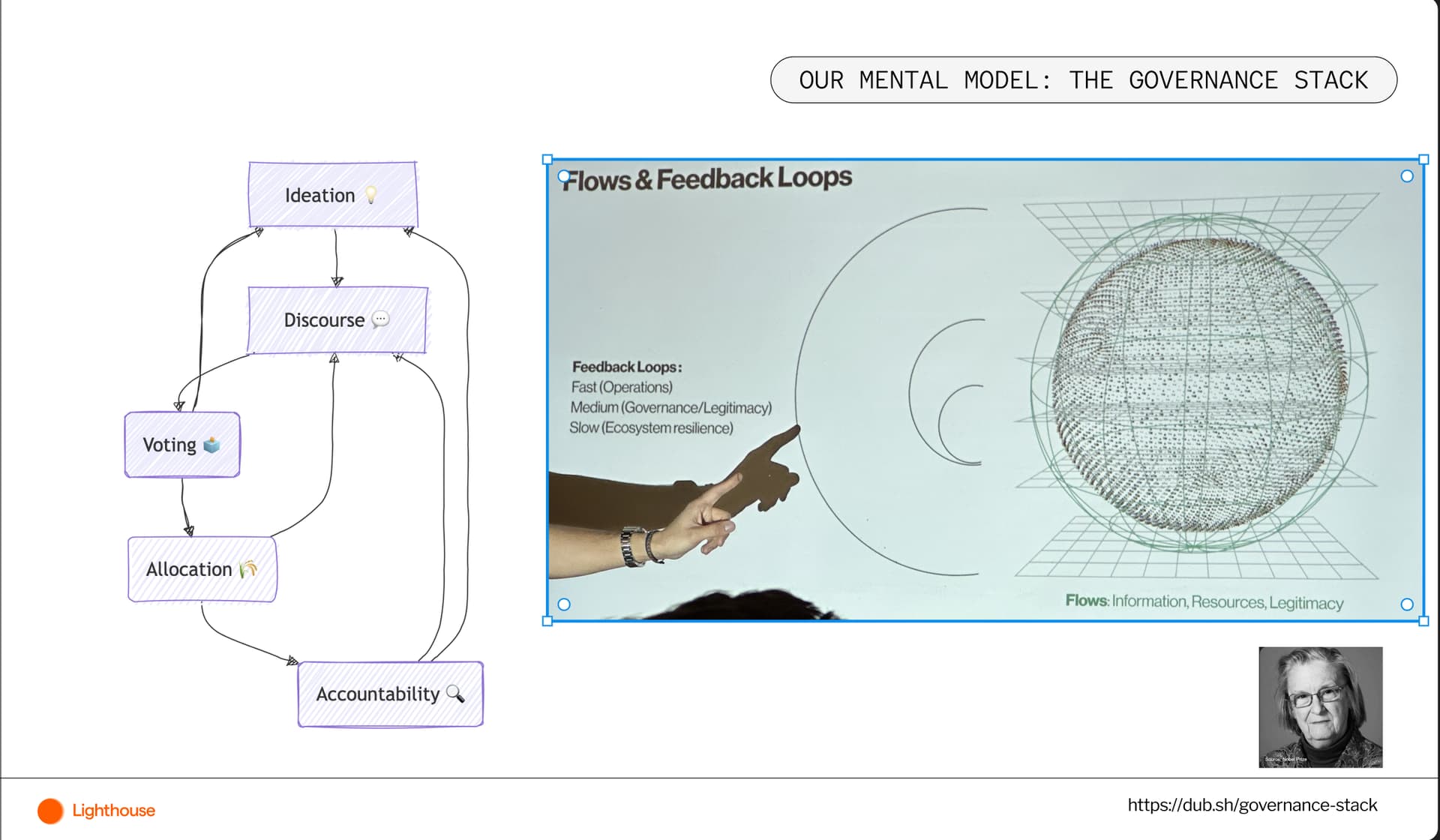
The idea of the ā€œRetroā€ emerged as a small, actionable practice that any organization can adopt to help refine and re-orient its direction. Fitting into the ā€œaccountabilityā€ section of what we (Lighthouse Labs) define as the ā€œGovernance Stackā€ and our one of our friend also saw as a reflexive feedback loop.

DAOs are still an emergent organizational form, and decentralized coordination is a relatively new operational modality. Yes, there are inefficiencies, but I believe we can make steady, incremental improvements by treating evaluation as a core component of how we move forward collectively.

1 Like

Nice feedback ser.

This is fair and an interesting way of looking at it.

If the retro was done and outcomes determined wouldn’t the new stewards have more context knowing what they would be signing up for?

Asking for >$100k to find inefficiencies and unneccessary expenditures seems like the setup to a joke, whose punchline I hope is obvious to anyone reading.

There’s no justification for this budget provided - how do you expect it to be spent?

2 Likes

Given this brief reply I would encourage you to read the proposal and give constructive feedback about how the DAO can run a retrospective on it’s spending and output. As the founder of ENS I would have thought this idea would have sparked joy, how do we improve the DAOs output. As i’ve stated multiple times as this proposal has been going through the wringer, this isn’t something I’m doing for fun - Clearly (for some reason?) this is a controversial post despite it being for the betterment of ENS and the entire industry. I hope you can see that despite your distain for my contributions.

In terms of the $100k number, given a spend of >$10m by the DAO, $100k would represent less than 1% of this - Now even if we take the Labs budget out; (hopefully this type of proposal can also encourage similar retrospectives for Labs but that can be a later goal) A $100k budget would be ~2% of the DAOs yearly spending, something that isn’t ā€˜unnecessary expenditure’ at all when comparing to traditional organisations at the same scale and their impact evaluation.

This budget was an output of conversations over the past weeks; The above proposal outlines the budget would be controlled by MetaGov as a part of their role as an independent actor in this process. I assume you’re not overly familiar with MetaGov, but they are deeply involved in web3 research and global academia - Something that isn’t cheap. The justification for this budget I agree can continue to be built out, but a large majority would be delivered to MetaGov team members for their work crunching the data and outputs acquired by the wider effort - I know Eugene is planning to post today once he gets perms sorted.

Excited to see more constructive feedback around this proposal. To be crystal clear, ENS DAO has a treasury of over $100m in cash equivalents and $500m in ENS tokens, spending $100k and 4 months on a retrospective on the last two years of spending is absolutely justified. Hopefully it can be noted that all actions :fire:_ :fire: take are conscious of the global DAO & token market and how we can drive positive sum outcomes.

A Retro of some kind is fine, but this temp check introduces more issues & concerns than solutions it may recommend.

The Temp Check asks delegates to make a single combined decision across three separate areas: 1) high-level design, 2) budget, and 3) team.

My position on each:

  1. A Retro does not require 9 stewards + secretary. At most, 1 steward per WG is sufficient. Information should already flow cross-team, and some WGs claim to have completed their own retros. While continuity can be valuable, several stewards seem focused on maintaining their roles or emphasising their own importance. If compensation for outgoing stewards is needed, it can be a simple line item - it doesn’t justify this structure.
  2. The proposed budget is high for a 4-month period and lacks detail such as headcount & individual rates.
  3. I cannot support the listed team. Several operate with their own agenda, and their conflicts of interest are no different from those they portray of others. They require dilution or replacement.

For me, the proposal fails on those fronts. I will vote against.

In any case, if ā€˜a Retro’ were to pass, I would strongly support dissolving the WGs - today & regardless.

This is necessary to move forward without the structures that are already acknowledged as broken and ineffective. It would also prevent further situation of manipulation & positioning from incumbents & pseudo-active contributors maintaining presence & indulging themselves purely for future roles. I am genuinely tired of busywork in our DAO. Furthermore, dissolving does not prevent future creation.

Thus, on balancing intents of retro and actual progress: I support this proposal [Temp Check] Replace the Working Groups with the ENS Admin Panel. An amended Retro can provide an opportunity for creation - which may include reinstallation of some forms - but retaining the current WG model for its sake makes little sense. If kept, it would be predictable that more noise is added than taken away and improved - so let’s cut to the chase and remove that which for too long extracts from mission focus.

I’ve plenty of thoughts on designs around DAO allocation, grants and programs, but none of that matters while we tolerate current wastage, distractions and enable the needless political playground that slows us down.

2 Likes

Doesn’t read like you’re encouraging a retro at all from the rest of the post, strange way to open.

That’s not whats being proposed at all. Whats being proposed above is MetaGov (the org not the WG) taking a point role on the retro with myself, @Arnold and @clowes.eth contributing alongside MetaGov on the retro. However very open to changes in this group structure.

Good to see you and Nick are on the same page - More detail can certainly be added around this budget.

This is exactly why MetaGov were introduced as a neutral third party - Very open to any other contributors that you think would be most well equiped to drive this retro. Everyone has their own bias - I think we can all agree we want this retro to be as credibly neutral as possible.

I’d love to understand Labs’ position in winding down these working groups. Limes told me he was planning to run for the next election until I brought up the idea of the retro - Now we have all of Labs posting about how we need to instantly delete working groups? Why not do a retro before making any rash decisions.

Working groups have achieved incredible outcomes for the Ethereum ecosystem and ENS. A retro is a way to identify their output and tradeoffs then have a strong foundation to make recommendations going forward.

This proposal is exactly designed to identity wastage and distractions - perhaps rather than just signalling about your plenty of thoughts its better to contribute them to the DAO in public!

1 Like

This is important. We’re all focusing on the gaps and the things we need to improve while not acknowledging the incredible success of the ENS DAO.
It’s a monumental undertaking to build and maintain new types of social and governance structures, but I’ve always personally always understood the intention is to learn and experiment and grow into better models.
I believe we undertake this more difficult path is because the outcome is better. It’s more robust and stable, and more protected from the common pitfalls of centralized systems.

This isn’t the first time that we’ve seen voices at ENS Labs share the same view that seems to discourage certain types of DAO operations. I have immense trust and respect for the Labs team, but often feel a bit bewildered and confused by the pov.

@184.eth - You’ve been a steward, and a Labs employee. So has @nick.eth, @AvsA, and @katherine.eth. I have to believe that walking both paths has shown you things that some don’t see. Is it that you feel the DAO is more trouble than it’s worth?

1 Like

Hi all. Eugene from Metagov here.

tldr: I think doing a retro could set a great precedent both for ENS and for DAOs more broadly. It sounds like there are a few different ideas (between retro, pausing WGs, rolling WGs into Labs, or a bridge proposal) that can potentially complement each other and bring up interesting elements of the appropriate order of operations, depending on the desired outcomes.

One thing to note on assumptions. I am fundamentally assuming that this community wants a) ENS to succeed as a product/ecosystem, and b) to find the most sustainable way to manage it in the future (which involves some amount of decentralization via the DAO to maximize resiliance). Please let me know if I’m off base here.

Importance of Retro

As @simona_pop mentioned in this comment, there is an overall trend towards contracting DAOs and/or generally centralizing. This trend comes with some real problems, as well as some over-correction.

One of the major criticisms of DAOs in general is that they don’t get things done, or if they do, they do so at tremendous cost and inefficiency. We saw that as part of the grant research we have done within the Grant Innovation Lab at Metagov, and I don’t know how many times I’ve heard the general DAO premium - that you can 2-3x the cost of a service or good for a DAO relative to more mature orgs, and that’s just accepted.

To put it lightly, this is not good for the future of DAOs and decentralized communities more broadly. If we, as a space, want to show that DAOs can actually be effective orgs, then we need to show a level of financial rigor that has mostly been lacking.

That’s where I got really excited by this idea of a retro. I think doing this kind of retro on 12-24 months of spend, combined with a stakeholder analysis of key players in the DAO to better understand desired outcomes and challenges for the DAO, can really set a great tone for the maturation of the space. I think it’s also important not to just to the standard over-correction of DAOs didn’t perform as well as a centralized org, so let’s not bother with any decentralization, as opposed to figuring out the specific problems dealt with and where/what kind of decentralization helps deal with the problem.

Phases

I strongly believe that the community should consider this project in a few phases:

  1. data gathering to collate all of the relevant information and to get confirmation from relevant stakeholders
  2. spend analysis and presentation to the community (this would be the bulk of the work as it could entail creating dashboards, contributing relevant data to OSO or Open Grants, potentially following up with some of the service providers or previous grantees, beginning an outcome/impact analysis, putting in place the infrastructure and processes to track impact in the future, and communicating this to the community)
  3. stakeholder analysis to help clarify the role of the DAO relative to Labs, and to gather what are seen as open problems for the DAO (politics, lack of talent attraction, lack of clear mission/vision, no COI, etc.)
  4. research on how other decentralized communities address some of the identified challenges
  5. a proposal with potential solutions to some of these issues

All of these components could help get the relevant information for the community to be able to make data-driven decisions about the future of the DAO.

Important to note: this is a really rough sketch of activities. If this goes forward, I’d want to talk to some more folks to produce a much clearer roadmap of activities.

Retro in the context of other discussions

Candidly, I haven’t been living the DAO like y’all have so I don’t have as clear an intuition around extending the WGs vs doing a temp or permanent pausing of the WGs vs @estmcmxci’s bridge proposal.

The questions I would want to know if I were one of the voting delegates would be:

  • if there is an extension of the current WGs, who would actually stick around (it seems at least one steward has committed to not renewing or resigning)? what about the others?
  • how difficult is it to conduct the retro if elections are not paused/there is a new election now? is it possible to get those rolling off of WGs to commit to at least being interviewed by the independent reviewer? I get where 184 is coming from in terms of whether all WG members really need to be involved, though it would be ideal to interview all of them at least for a one-time convo if possible.
  • if Labs takes over functions for now or the bridge proposal is followed in some way, what kind of commitment might there be to give back power to the DAO if that is deemed best by the community? or does the community lose its power absolutely if that happens?
  • is there a version where Labs helps build an oversight structure to WGs or their future alternative in collaboration with the DAO? Is that deemed desirable by the community?
  • is the problem with the DAO the fact that there is a DAO, or that it’s missing things like a conflict of interest policy (with enforcement), more accountability, more structures for combating capture, etc.?

Final thoughts

I don’t know the politics surrounding the DAO, but there is clearly a lot of history here, both officially and unofficially. This seems like a good time to revisit some of the goals for the ecosystem, and then what the best structure is between Labs, DAO, an OpCo-style org, or whatever else might make sense to accomplish said goals.

I get some of the criticism that spending money when there’s a lack on confidence in the legitimacy of the exercise sounds like a joke. At the same time, jumping to a new chapter without understanding the details of what happened (which seems to be the logic of a retro in the first place) can increase the chances of further mistakes.

If the idea of a retro of some kind is exciting to the community, I/we would love to be considered (whether for a small portion of the majority of it). I think ENS has a lot of potential to lead the next evolution of DAOs, and I hope y’all find a path forward that maximizes the chances of success for the ecosystem. Excited to see how this evolves.

5 Likes

Hey Eugene, great to have you here, and what a well-thought comment!

This initiative can save us time and, consequently, resources. Clearly identifying the points we can improve is crucial. The DAO currently has lots of politics that are inherent to emotions, trust, or the lack of it.

We ask and complain about accountability, goals, and coordination costs. This is moving in the direction of improving those necessities.

Having metagov.org involved in the process gives me confidence that we’ll have a neutral, high-quality third-party assessment. For this reason, I’m personally in favor of this proposal.


In case this passes, I commit to continue until the end of the term, and of course to help in the process.

Thanks @eugene

If this proposal passes, I commit to sticking around to support the initiative in whatever way possible.