There’s a lot of really important discussions happening here, which I suppose is the very point of a temp check and a DAO. It’s not lost on me how novel it is that consumers of a service even get to debate pricing. But to be clear, this is a temperature check. The DAO governs pricing, and this conversation is part of that process, not a formality before an announcement.
I have seen some recurring themes I think are worth clarifying, and also have some of my own alternative proposals for the community to consider. Sorry/not sorry for the longer post, but if you don’t have time to read my gpt-less prose, you can just use an LLM to summarize.
On pricing out users
I’ve been sympathetic to concerns about pricing out new users. I agree with @James that it shouldn’t “be at the cost of newer participants.” As @sat noted in the original pricing research thread:
If I’m onboarding someone in Africa or Asia, and I tell them they should register their name for 5 years, that’s already $25, in many of these countries that is a week or two of salary (yes I’m not kidding).
But it’s worth stepping back and looking at what’s actually been built to support users who don’t necessarily want to pay for a .eth name. The DAO has invested in the growth of the ENS protocol via free ENS subnames that support an app’s particular tech stack or preferred blockchain. Uniswap wallet lets users name every new wallet they create for free with a uni.eth subname. The 17.5 million World App users have a ENS subname with the root `world.id`. If you attended any SheFi summit, you can claim a free ENS name. Every attendee of EthDenver got an ENS name associated with their ticket. Basenames were free for a year, and now $2.22 annually for 5L+ (and 2.7 million have been minted so far).
Subnames are proof ENS is winning as a naming protocol. There are over 30 million so far, and serve as a gateway for a more premium 2LD: a .eth name on Ethereum. They also help us with new integrations. They provide optionality in how namespaces can be created for an app using the ENS protocol; not every app wants to charge their end users before growing past a certain point, and free usernames, that still resolve as addresses using the ENS protocol, are a better option initially. The growth of subnames also helps sell ENS by showing the network effects of the protocol across platforms and contexts. While many subnames only work in particular wallets that resolve DNS and offchain records, this is a known-painpoint that is being addressed in ENSv2 with the Universal Resolver.
Article II in the ENS DAO Constitution
I appreciate @garypalmerjr bringing up Article II in the ENS DAO constitution, which invokes fees to prevent speculation and fund ENS at a level sufficient to support ongoing development. I think this proposal addresses both:
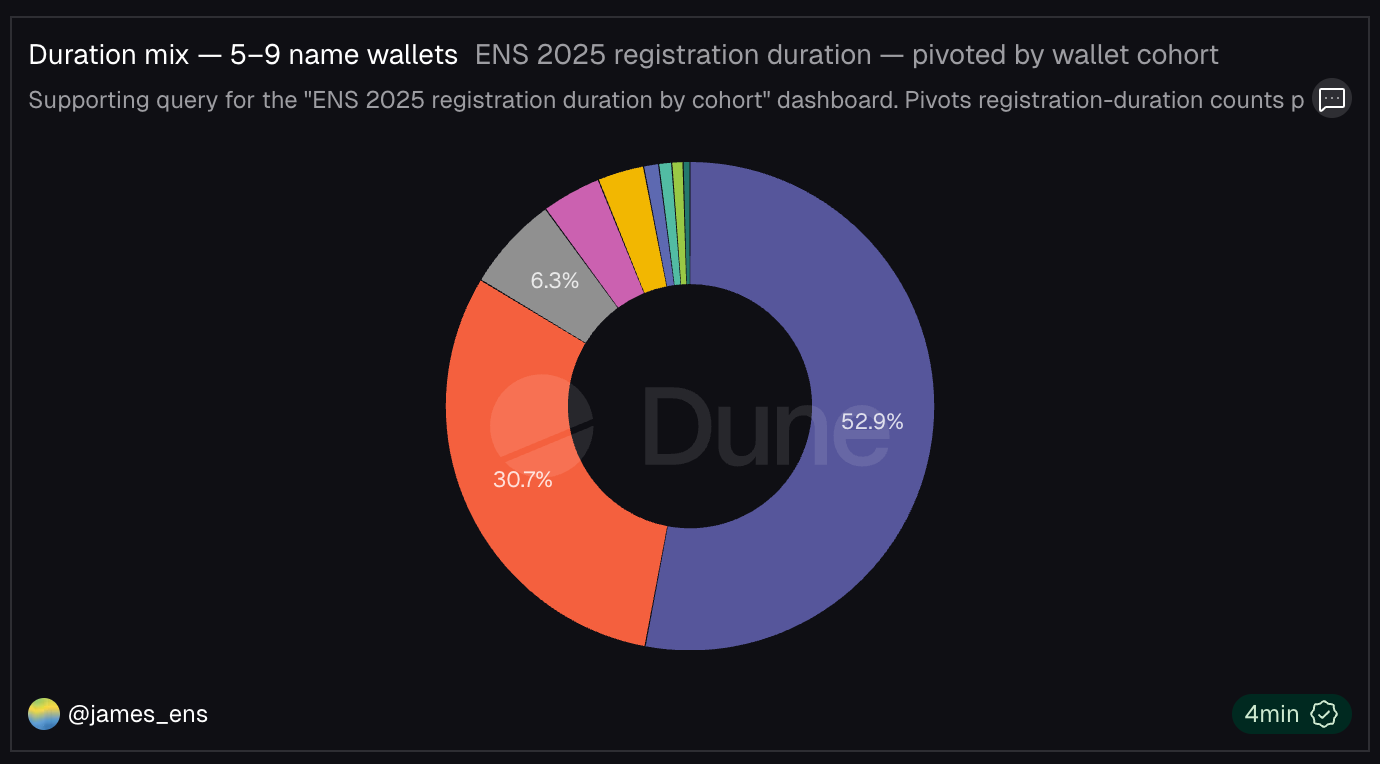
On speculation, registration-length data over the last year show a few things:
-
Only 3% of addresses with 1 ENS name register for less than a year; this cohort is also four times more likely to lock in a name for 5 years (7.9%).
-
More than half (52.5%) of wallet addresses with 5-9 names register for less than a year. Multi-year discounts shift the fee burden in aggregate away from the cohort that registers greater than a year (more on that below).
On funding: ENSv2 is the largest engineering undertaking in ENS’s history. The increased fees directly support bringing this upgrade to market. It’s what pays for the people building v2, audits of the contracts, the new apps and migration flows, and the challenging work to get all ENS implementations supporting the new universal resolver, which will help ENS names resolve in more places. It pays for the behind the scenes efforts to convince new apps and fintechs to use ENS for their naming infrastructure, as well as improvements to the protocol to work with legacy naming systems like ICANN, Swift, and GLEIF. It funds real growth opportunities like agent naming registries, EF chain interop, and integration into fintech apps that already have millions of users. Revenue funds more ambitious growth plans like video campaigns, user-generated content, ads, and free .eth names in countries where crypto is expanding. It also funds important SPP ecosystem work like subname projects, decentralized websites and docs, gateways, incentive programs, and more.
On the multi-year discount
I personally didn’t fully appreciate how the multi-year discount can be realized by extending the number of years on your name. In other words, the multi-year discount applies relative to the current expiry, not the years added in a single transaction. For example, if today you registered a name until April 21, 2030, in v2 you can extend that name 1 more year and qualify for a 5 year discount of 40%. This addresses the regressive-to-capital concern raised by @phatwallet.eth. As for 3 and 4 character names, this discount provides substantial absolute savings for committed short-name holders.
On timing
“Wait for better market conditions” is, in practice, indefinite. The DAO doesn’t control the market cycle, which has admittedly been pretty rough over the past year. ENSv2 is a rare attention moment among the wider ecosystem, and it makes sense to include new pricing logic alongside a new ENS App that enables notifications (don’t worry it doesn’t have to be your email, you can choose Telegram or in-browser notifications, @determined.eth).
That said, I wouldn’t want pricing changes to overshadow all the important improvements we’ve been making on v2. @danch.quixote ‘s research, Dune queries on different collector cohorts, and our own qualitative research supports long-term registration discounts and a 5ch+ increase. Yet ultimately, pricing elasticity does require real market conditions and real-time behavior. I think there’s an argument for considering a more conservative starting point like $8-10. Unlike typical subscription products, pricing is smart contract-based, and would require another DAO proposal, discussion, vote, etc.
Some alternative proposals that have merit
As for differentiating costs for non-Latin 3L and 4L words, I’m in favor of that type of experimentation, even though that’s not a standard in the domain world. There are strong arguments for differentiating by character-type, even if it would introduce more protocol complexity.
I’m also interested in how the community reacts to a cheaper pricing tier for higher-character names? If adoption of the .eth 2LD is a concern, would people support an 11L+ tier for $1? @danch.quixote ‘s follow-up research found that names 8 characters and longer are overwhelmingly registered by end users for personal use.