I agree with Gary. I’m a hard no as of now. This shouldn’t be decided by feels. i dont see how this proposal helps to limit the squatting or large scale speculation beyond what is already in place. Further, I’m not even sure either of those is negative. But setting that aside, as someone who uses ens for personal organization and sovereign identity, if it begins to feel too much like a subscription service, I will seek other solutions or work on my ability to remember long strings of random digits. And then who do you serve?
5 Likes
The justification for this price increase is not yet well articulated
(in constitutional terms, under the ENS DAO Constitution).
Moreover, the cited research appears counter to ENS’s adoption-oriented goals, and also, the “methodology, sample design, and supporting details” have not been adequately published or cited, (for meaningful community scrutiny).
2 Likes
There is no way - and I mean this literally - to make 3- and 4- character names affordable for “the average person”. There are only 17,576 3-character alphabetical names, and only 456,976 4-character alphabetical names. Meanwhile there are nearly half a billion people in the three countries you listed. If prices were low enough to be affordable to anyone who wants one, they would all be bought up and resold on the secondary market - at whatever price the market bears, which would still not be affordable. The inherent scarcity of these names is what warrants pricing them far above the price for longer names.
I’ve been a supporter of ENS for about five years and have never had any issues with the previous pricing. However, the recent proposal for a significant price increase has prompted me to voice my perspective.
I’ve always seen ENS as a public good project. I’m curious — why does the DAO take secondary market prices into consideration when setting registration or renewal fees? I’d love to better understand how this fits with the idea of ENS being a public good.
On the topic of 3 character names, I read that to qualify for the full discount would require an upfront cost of roughly $4,400 USD. That feels quite high for the average person who might simply want a nice short name. It seems like only well-funded individuals or businesses would be able to take advantage of it. I’m not sure how this aligns with ENS’s goal of being accessible to everyone.
The same question applies to the overall price increase. Since ENS is meant to be a public good available to all, and the DAO doesn’t appear to need the additional revenue, I wonder why we’re aligning prices so closely with for-profit projects — especially with short names being priced at roughly a 53x premium.
I’d appreciate any thoughts from the team or DAO on how these changes support the long-term vision of ENS as an open and inclusive public good.
1 Like
Seems like registrations are down to it’s lowest in years, so people aren’t even willing to spend $5, why would they spend $12+?
At the same time, surveys and “research” are useless. What’s the sample size? Were there incentives to participate? Was there proof/verification of ENS ownership with each participant?
Most of my other points have been covered here ad nauseum. Maybe the team needs to spend time and resources on driving adoption and integrations instead of trying to max extract from users.
3 Likes
As a long-time supporter of ENS, here’s my 2 cents about this temp check.
The debate over raising ENS registration fees from $5 to $12 looks like a pricing argument. It isn’t. It’s really a test of whether ENS governance is aligned with what the system has become.
The Wrong Frame
The proposed increase for 5+ character names isn’t obviously unreasonable. $12 per year is still modest. Multi-year discounts make sense. It’s clear the team has put real thought into this.
But “reasonable” is the wrong standard.
ENS isn’t operating in a world where pricing is just a product decision anymore. Looking at it that way misses the real risk.
What ENS Actually Is
Ethereum Name Service has evolved into something much bigger than a product. It’s now a coordination layer for identity.
Every wallet resolving .eth names, every dapp displaying them, every user treating an ENS name as them — all of this is part of a coordination game. And in coordination systems, value comes from shared belief more than features.
The belief is simple:
“This is the canonical naming system.”
And that belief is governed by legitimacy.
The Constitution as a Legitimacy Mechanism
The ENS Constitution isn’t just governance structure. It’s a Schelling point — a shared reference for what’s acceptable and what isn’t.
-
Name ownership rights protect continuity for users
-
Fee purpose constraints define why fees exist
-
Public goods funding principles anchor ENS in a broader mission
That’s the social contract.
So the real question isn’t:
“Is $12 fair?”
It’s:
“Has this change been justified within the rules ENS asked everyone to trust?”
The Core Issue: Misaligned Justification
The Constitution is clear about why fees exist:
-
to prevent harmful speculation
-
to fund ENS at a reasonable level
But the current justification leans on:
-
perceived fairness
-
“$1/month” framing
-
internal user research
Those are product and UX arguments, not constitutional ones.
That gap is the real issue.
A Key Tension in the Proposal
There’s also an inconsistency that hasn’t been fully addressed.
The research suggests:
-
everyday users are the most price-sensitive
-
those users are critical for adoption
-
different name lengths behave differently
Yet the proposal applies:
- a flat increase across all 5+ names
That doesn’t automatically make it wrong, but it does raise a question: if the analysis is nuanced, why is the policy blunt?
That’s something governance should explain more clearly.
The Real Risk: Legitimacy Drift
The risk here isn’t that $12 is too high.
It’s how decisions like this are made.
If pricing starts evolving based on:
-
internal research
-
discretionary judgment
-
“what feels right”
Then ENS slowly shifts from:
a rule-constrained system
to
a policy-driven one
That shift doesn’t happen all at once. Each step looks reasonable. But over time, it changes how users think about ownership.
Names start to feel less like:
something you own under stable rules
and more like:
something priced by an organization
That’s where legitimacy begins to erode.
Why ENS Is Especially Sensitive
ENS isn’t just another protocol.
-
It’s a naming system
-
It’s embedded across the ecosystem
-
Its value depends on universal recognition
That makes it highly dependent on legitimacy.
Most applications can lose some users and keep going. ENS can’t really do that. Its value depends on remaining a shared standard.
What a Legitimacy-Aligned Approach Looks Like
This doesn’t mean ENS shouldn’t raise fees. It means it needs to do it in a way that reinforces trust.
That probably includes:
-
Public evidence of:
speculative pressure
funding needs -
Clear alignment with the Constitution’s fee purpose
-
Transparent reasoning for:
why 5+ names
why this level of increase
why a flat structure -
A serious look at alternatives:
segmenting 5–7 vs 8+
phasing changes over time
leaning more on discounts first
This isn’t bureaucracy. It’s what credible neutrality actually looks like in practice.
The Deeper Principle
ENS governance isn’t just managing a product anymore.
It’s managing a shared namespace that people and applications rely on as a stable layer of identity.
And in that context:
Pricing decisions aren’t just economic choices.
They’re signals.
They signal:
-
whether the rules are stable
-
whether governance is constrained
-
whether ownership means what users think it means
Final Take
The proposal is economically reasonable.
But it’s legitimacy-light.
The real issue isn’t whether ENS should raise fees. It’s whether it can do so while preserving:
-
trust in the rules
-
credibility of the process
-
shared belief in the system
If ENS wants to increase fees, it should.
But it needs to do it in a way that is:
-
publicly evidenced
-
clearly grounded in its own rules
-
and transparent enough that people don’t have to guess
Because in coordination systems, the most important asset isn’t revenue.
It’s legitimacy.
4 Likes
adoption is what makes or break a technology
1 Like
Strongly disagree with the price increase at the moment. Adoption is dwindling and the backlash on Twitter/ X has already severely hurt the protocol. I like ICANN’s restrictions on price increases being limited to 10% a year. I believe we should stick to that rule as guideline for decentralized naming services. If you search “ENS” on Twitter/ X it’s embarrassing seeing the newest posts of what people are saying about the protocol. Hopefully the dao sees that the clear consensus so far is the price should remain the same. Using ai to calculate the support vs opposition to the price raise shows opposing opinions lead 6:4 only accounting for unique users. Love the tech but ens needs to put that new marketing manager to use and grow the protocol significantly before comparing itself to .com and its 400m registered domains. We have a long way to go before that comparison has any validity. I’m not asking you guys to support secondary sales. I understand your view point of not doing so. However, I don’t understand the lack of marketing and tutorials being produced to bring forth adoption. IMO this seems like you guys are scalping your strongest supporters. I wish you guys would make a pole that we can vote on too. Our voices deserve to be heard even if we don’t have enough capital to have a DAO vote.
4 Likes
Against the Price Increase. A Perspective on Trust, Marketing, and User Disconnect
I want to be clear upfront: I agree with the community and oppose raising renewal prices from $5 to $12. It is fundamentally contradictory to the goal of acquiring new users.
The Market Regulates Hoarders Better Than Pricing
From my own experience building projects, the market naturally regulates those who hoard names. Higher renewal fees are not the answer. If anything, they create the wrong incentives at the wrong time.
The Real Problem: Marketing, Not Pricing
The issue here is not the price point itself—it’s the complete absence of marketing effort. I live in Spain. Less than 0.001% of people here know what ENS is. This is not unique to Spain; I can say this confidently because I’ve built multiple projects attempting to expand ENS adoption and communicate its value across different regions and countries.
ENS may believe it operates globally, but the effort doesn’t reflect that reality. In dozens of countries, ENS remains virtually unknown. Before raising prices on an already niche product, the focus should be on making people aware ENS exists in the first place.
The Trust Crisis
But here’s what concerns me most: this proposal reveals a deeper problem—a trust issue.
If ENS Labs and the DAO are willing to make a decision this disconnected from reality—raising prices precisely when adoption is declining, when user research methodology is unverifiable, when the grace period is being removed—then what else are you capable of doing in the future?
This single decision creates doubt. Regardless of whether the price increase ultimately passes or fails, it has already conditioned my behavior. I am now more hesitant to register new domains. I’m more conservative. I’m waiting to see what comes next.
This is the real damage: you’ve eroded confidence in the stewardship of the protocol. Users like me are asking: If you’re this disconnected from your user base and real-world conditions, how can I trust ENS with my identity long-term?
The Disconnect Between Leadership and Users
This proposal exposes a fundamental misalignment. The group leading ENS and the group using ENS are operating in different realities. One is optimizing for treasury metrics. The other is trying to build a sustainable, trustworthy identity layer.
These are not the same goal. And right now, they’re in conflict.
My Recommendation
Instead of raising prices, invest in marketing. Invest in adoption. Make ENS known to the billions of people who don’t yet know it exists. Build trust through reliability and simplicity—the very things that made $5/year a psychological anchor for 8 years.
Once you break that anchor with a 140% jump, you don’t get it back easily. And the doubt lingers longer than any price increase ever could.
3 Likes
After trying all kinds of name services over the past few years, ENS is the one with the most potential, so I ultimately chose to support ENS. As a quiet long-time ENS user, I can clearly see that ENS still has many shortcomings.
Good product ≠ good market.
The free market determines how a product circulates freely, how efficiently it circulates, at what price it circulates, and which users it ultimately reaches.
Do not try to interfere with the market too much, and do not try to label users as good or bad. The market has no morality. Do not try to go down the path of a planned economy.
What this team should focus on is where there is strong demand and demand expectations, and which places and sectors can cultivate or even create demand.
This price increase proposal exposes ENS Labs’ long-standing and serious lack of understanding of the market, and even a deeply flawed understanding.
Those who still hold a large number of ENS names are, in fact, the people who support ENS the most. Those who gave up on ENS simply left quietly, without a word.
Getting more revenue through a price hike is nothing more than a nice illusion. What ENS should really be doing is growing its real user base by 10x; not doubling the price. Raising prices is a terrible move. Real user growth = win-win. Unilaterally raising prices = lose-lose.
If the ENS team is helpless when it comes to growing its user base by 10x from its current level, and instead chooses the easiest, most blunt price hike, then that amounts to an attack on the ENS system itself. That is a huge risk.
Based on long-term observation and market feedback, ENS Labs should focus on product and technical development. Any decisions involving the market should not be interfered with by the team. Technology is your strength; marketing is your major weakness.
Ignoring silent users = the biggest mistake.
ENS’s largest user group is silent users. Their behavior is very simple:
If they are unhappy, they do not complain.
They do not participate in governance.
They leave, or stop using the product altogether.
This group is being harmed by ENS’s price increase and by a loss of trust, yet you will never see their feedback in governance discussions.
Silent users do not speak. They vote with their feet. When they feel ENS is no longer reliable and no longer trustworthy, they will quietly leave.
ENS Labs’ misunderstanding of the market has two major problems:
ENS is not free and not cheap. Labeling long-term supporters and users who have accumulated ENS as negative speculators is a huge mistake. ENS users are supporting the protocol’s development with real money under clear rules, yet they are being casually dismissed as negative speculators. No matter whether these users are long-term or short-term investors, they are positive ENS investors and supporters because they have put real money into supporting ENS. Under the existing rules, they have done nothing wrong. If ENS Labs insists on treating them as negative speculators, then that is a problem with ENS’s own rules, and ENS Labs should bear full responsibility instead of blaming users and shifting the blame onto them.
Suddenly and arbitrarily raising prices punishes ENS’s existing users. It’s a joke that the users who support and hold ENS become the biggest victims, and that is honestly absurdly ironic. New users will also inevitably become potential future victims. When a product turns its existing users into victims and its new users into potential victims, everyone should ask themselves: can that kind of product really succeed? I think everyone already knows the answer. Stop abusing users immediately.
Once again, ENS’s technology is world-class, but its market understanding is embarrassingly immature. For all these years, ENS has been the best product I have seen in the blockchain world, and also the most promising one, even though there is still a lot that needs improvement; for example, how can a medium-to-large platform manage and operate 10 million, or even 100 million, second-level domains in a simple, convenient, safe, and effective way?
ENS is a revolutionary product, and it is very different from Web2 domain names. It is not just a .com-style domain. ENS is not only for B2B users. It must also serve a massive number of C-end users. The market logic is completely different. ENS’s potential and role are far greater than something like .com. The new era is here. Stop looking at the future with outdated thinking. Use new thinking to look ahead.
If ENS Labs no longer values the voice of the community, and insists on using the team’s large number of votes to push this price increase proposal through (even though that looks democratic), then that would be a sign that ENS Labs is becoming bureaucratic, which is a very dangerous signal for a DAO.
For a DAO, one of the biggest risks is the team’s authoritarian tendency. That deserves serious caution. Self-restraint against the team’s authoritarian impulses and tendencies is also one of the key things that needs to be done.
The price increase itself is a premature victory lap. Real strong competitors are often hiding where you cannot see them. This should be treated with caution. Raising prices at this stage will seriously hinder ENS’s growth.
Does the ENS team only want to hear things it already agrees with, “good things,” and refuse to hear different voices or criticism?
Truly putting users first is what ENS Labs should be doing. Ask yourself: is ENS still a one person’s product? Or the product of a small group of people? Does ENS truly belong to its users? Does it truly belong to everyone?
Again, I strongly oppose a price increase at this stage.
6 Likes
I agree 100% with this.
And honestly, the so-called “squatters” are often the visionaries. People don’t register domains randomly, they see future use cases and potential. These are exactly the people who should be contributing ideas and helping shape ENS, not being dismissed, especially when they’ve been supporting the system with their own money.
1 Like
Firstly I want to acknowledge the incredible amount of engagement on this temp check, getting these perspectives and hearing from twitter posters that generally don’t engage on the forum is great to see.
This post has spurred more discussion about ENS on twitter than any recent proposal, at minimum showing there are still a lot of people who care about ENS and it’s accessibility even in the current market! Although we acknowledge that ENS Labs may view this forum engagement as sandbagging or slowing down decision making, getting collective discussion and buy-in in this way is great to see.
Pricing/fees is always a controversial topic and it’s no different here. I do want to echo comments above re the language in Nick’s post that probably should have been framed in a more inviting way; CC these comments:
This reads like the decision has already been made. Generally temp checks are to invite discussion and amendments to a potential proposal not just to inform the community of the reasoning prior to the protocol upgrade.
FireEyes stance is that a multi-year discount for ENS registrations is an excellent idea and something we fully support, however a 140% price hike for average (english) names (CC @0xc0de4c0ffee graphic) seems excessive.
If registrations were booming at all time high an increase of this amount might be more justifiable, but at a time where registrations have slowed this proposal seems likely to reduce registrations even further rather than being a catalyst for growth.
A few quotes from the thread to discuss:
Agree with the sentiment shared here - This really doesn’t seem ideal timing for such a large increase in price.
+1 to these quotes, especially given the public goods nature described in the ENS constitution and the network effects that ENS is aiming for. Though a discount curve does incentivise longer term holders we don’t want this to be at the cost of newer participants (which likely just decreasing the price from $12 to $6, $8 or $10 will significantly mitigate).
Re the timing aspect here, @lightwalker.eth makes an important point around the comms of ENSv2. We (as contributors, name holders, ENS token holders) want the release of ENSv2 to be a huge positive for the ENS and Ethereum ecosystem. Based on twitter sentiment and the replies in this thread, it seems clear that large parts of the community aren’t supportive of this price increase whilst likely being big supporters of most other aspects of ENSv2.
Although including the pricing updates as part of the broader ENSv2 upgrade is technically and operationally pragmatic, it is clear that there’s far more contention around the pricing changes than any other component of the upgrade. As such, we’re at risk of conflating the entire v2 upgrade and all of the incredible work that’s gone in here with that same contention.
Agree here that the justification for this proposal hasn’t referenced the constitution or constitutional elements enough given how critical a price change is to the constitution.
A few productive possible next steps & thoughts:
On the price change specifically:
We see ENSv2 as a huge step forward for ENS, all .eth holders and the Ethereum ecosystem, however a sharp price increase for ENS name registrations during a sustained bear market and subsequent drop in ENS registrations doesn’t seem strategically aligned.
- Given this, we would propose three different potential solutions:
- Changing the price per year to $6 ($0.5 per month, a 20% increase to roughly match inflation over a similar period) with a largely reduced discount model (perhaps maxing out at 33% for 10 years+) meaning registrations would be ~$4 for 10+ years.
- Changing the price per year to $8 (a 60% increase as a middle ground) with a similar or slightly reduced discount curve.
- Changing the price per year to $10 (a 100% increase to roughly match the change in the mainnet gas environment since ENS launch) with an unchanged discount model (meaning at 10+ years the price point would be almost the same as current registration)
We would support any of these potential price points over an increase to $12. Going beyond a 100% price increase with current market conditions and reduced registration rates seems a step too far.
On the discount structure:
The proposed model would mean:
- 3 year registration receives a 25% discount
- 4 year registration receives a 25% discount
- 5 year registration receives a 40% discount
Does it not make more sense to have this on a curve so that a 4 year registration receives a ~33% discount?
+1 to more curved curves.
Overall despite the strong negative feedback this proposal has faced on twitter and the forum, we believe the ideas proposed are positive and important for ENS, with the one caveat being the actual price increase. Without clearer justification for this 140% increase in price it just feels too extreme given wider market conditions. We would be in favour of increasing the price point to $6-$10/yr and keeping a similar discount structure, meaning long term registrations (10yrs+) would be almost identical or even cheaper than they are today.
The most important outcome from our perspective is coming to a solution around the pricing and wrapping everything back up into a positive ENSv2 launch and narrative. The worst outcome would be for all of the great technical and UX improvements to be outshone by a messy debate over pricing.
5 Likes
Under ICANN rules, the maximum annual price increase for .com domains is capped at 7%. I believe this is the proper standard for a true public good.
7 Likes
I already pointed out in other threads, that from economics / finance points of view in a way discount curve is pointless, because on one hand yes, longer term offers lower price per year, however longer term means much higher cash outflow for consumer here and now. Of course consumer preferences do vary, and that can be a point of research on its own whether consumer prefers to pay less per year and tolerate high cash outflow momentarily or pay more per year but have relatively small cash outflow momentarily.
I would strongly argue, that in most cases consumer tends to dislike paying for stuff in advance large sums of money.
ENS is supposed to be like utility - how often do you see people paying in advance for gas / electricity / internet? Of course in theory that can happen, but in practice that never happens. In general I would say there are very few examples where consumer prefers to pay in advance for something, and in case of ENS he is not even sure that he needs it - its not like electricity, consumer will happily survive without ENS name, its not a must have. To be a genuine must have there supposed to be serious world wide adoption. You don’t get adoption by making stuff more expensive.
Uber operated at a loss for over a decade, just to gain market share.
There are a few cases where consumer would prefer to pay in advance - those are connected to managing uncertainty - for example pre-ordering highly anticipated electronics, buying concert tickets months in advance. ENS is not supposed to be associate with uncertainty by definition.
I just don’t understand this - what is the rationale behind this?
Is ENS at financial crisis and needs more funding?
Is there some strategy developed behind the scenes which requires a lot of money and justifies price increase?
Even if price increase is a success (which it can be), where is the extra money going to go?
Is ENS having problems with working capital which needs to be managed with some complicated pricing policy?
How is increasing the price benefits ENS in a broad scheme of things?
5 Likes
Support this move, as it addresses ENS’s biggest market-structure problem: low carrying costs on underutilized inventory, while simultaneously rewarding long-term, high-conviction holders through multi-year discounts.
love the active discussion and have been following diligently.
my 2 cents: i’d probably add another, cheaper level for long names (like +10 chars) similar to what was done with basenames
6 Likes
There’s a lot of really important discussions happening here, which I suppose is the very point of a temp check and a DAO. It’s not lost on me how novel it is that consumers of a service even get to debate pricing. But to be clear, this is a temperature check. The DAO governs pricing, and this conversation is part of that process, not a formality before an announcement.
I have seen some recurring themes I think are worth clarifying, and also have some of my own alternative proposals for the community to consider. Sorry/not sorry for the longer post, but if you don’t have time to read my gpt-less prose, you can just use an LLM to summarize.
On pricing out users
I’ve been sympathetic to concerns about pricing out new users. I agree with @James that it shouldn’t “be at the cost of newer participants.” As @sat noted in the original pricing research thread:
If I’m onboarding someone in Africa or Asia, and I tell them they should register their name for 5 years, that’s already $25, in many of these countries that is a week or two of salary (yes I’m not kidding).
But it’s worth stepping back and looking at what’s actually been built to support users who don’t necessarily want to pay for a .eth name. The DAO has invested in the growth of the ENS protocol via free ENS subnames that support an app’s particular tech stack or preferred blockchain. Uniswap wallet lets users name every new wallet they create for free with a uni.eth subname. The 17.5 million World App users have a ENS subname with the root `world.id`. If you attended any SheFi summit, you can claim a free ENS name. Every attendee of EthDenver got an ENS name associated with their ticket. Basenames were free for a year, and now $2.22 annually for 5L+ (and 2.7 million have been minted so far).
Subnames are proof ENS is winning as a naming protocol. There are over 30 million so far, and serve as a gateway for a more premium 2LD: a .eth name on Ethereum. They also help us with new integrations. They provide optionality in how namespaces can be created for an app using the ENS protocol; not every app wants to charge their end users before growing past a certain point, and free usernames, that still resolve as addresses using the ENS protocol, are a better option initially. The growth of subnames also helps sell ENS by showing the network effects of the protocol across platforms and contexts. While many subnames only work in particular wallets that resolve DNS and offchain records, this is a known-painpoint that is being addressed in ENSv2 with the Universal Resolver.
Article II in the ENS DAO Constitution
I appreciate @garypalmerjr bringing up Article II in the ENS DAO constitution, which invokes fees to prevent speculation and fund ENS at a level sufficient to support ongoing development. I think this proposal addresses both:
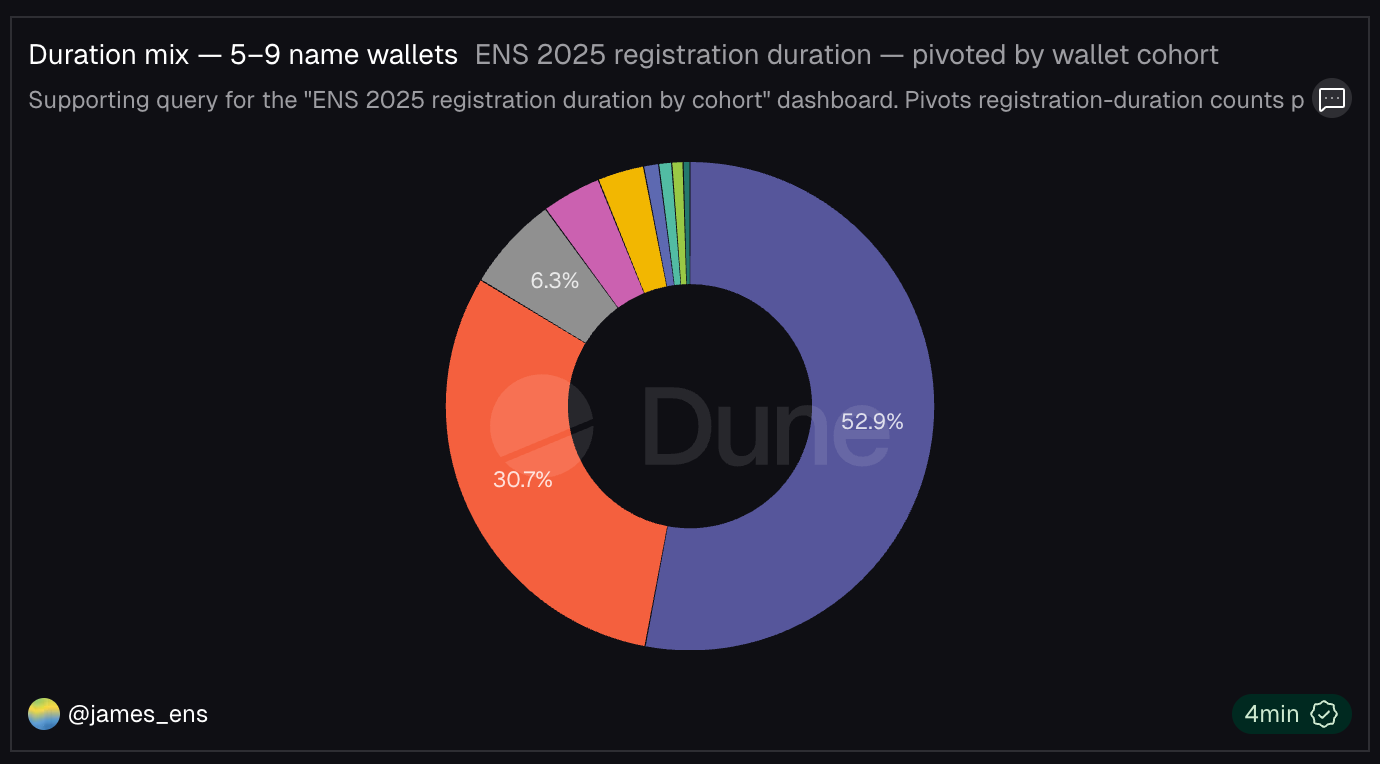
On speculation, registration-length data over the last year show a few things:
-
Only 3% of addresses with 1 ENS name register for less than a year; this cohort is also four times more likely to lock in a name for 5 years (7.9%).
-
More than half (52.5%) of wallet addresses with 5-9 names register for less than a year. Multi-year discounts shift the fee burden in aggregate away from the cohort that registers greater than a year (more on that below).
On funding: ENSv2 is the largest engineering undertaking in ENS’s history. The increased fees directly support bringing this upgrade to market. It’s what pays for the people building v2, audits of the contracts, the new apps and migration flows, and the challenging work to get all ENS implementations supporting the new universal resolver, which will help ENS names resolve in more places. It pays for the behind the scenes efforts to convince new apps and fintechs to use ENS for their naming infrastructure, as well as improvements to the protocol to work with legacy naming systems like ICANN, Swift, and GLEIF. It funds real growth opportunities like agent naming registries, EF chain interop, and integration into fintech apps that already have millions of users. Revenue funds more ambitious growth plans like video campaigns, user-generated content, ads, and free .eth names in countries where crypto is expanding. It also funds important SPP ecosystem work like subname projects, decentralized websites and docs, gateways, incentive programs, and more.
On the multi-year discount
I personally didn’t fully appreciate how the multi-year discount can be realized by extending the number of years on your name. In other words, the multi-year discount applies relative to the current expiry, not the years added in a single transaction. For example, if today you registered a name until April 21, 2030, in v2 you can extend that name 1 more year and qualify for a 5 year discount of 40%. This addresses the regressive-to-capital concern raised by @phatwallet.eth. As for 3 and 4 character names, this discount provides substantial absolute savings for committed short-name holders.
On timing
“Wait for better market conditions” is, in practice, indefinite. The DAO doesn’t control the market cycle, which has admittedly been pretty rough over the past year. ENSv2 is a rare attention moment among the wider ecosystem, and it makes sense to include new pricing logic alongside a new ENS App that enables notifications (don’t worry it doesn’t have to be your email, you can choose Telegram or in-browser notifications, @determined.eth).
That said, I wouldn’t want pricing changes to overshadow all the important improvements we’ve been making on v2. @danch.quixote ‘s research, Dune queries on different collector cohorts, and our own qualitative research supports long-term registration discounts and a 5ch+ increase. Yet ultimately, pricing elasticity does require real market conditions and real-time behavior. I think there’s an argument for considering a more conservative starting point like $8-10. Unlike typical subscription products, pricing is smart contract-based, and would require another DAO proposal, discussion, vote, etc.
Some alternative proposals that have merit
As for differentiating costs for non-Latin 3L and 4L words, I’m in favor of that type of experimentation, even though that’s not a standard in the domain world. There are strong arguments for differentiating by character-type, even if it would introduce more protocol complexity.
I’m also interested in how the community reacts to a cheaper pricing tier for higher-character names? If adoption of the .eth 2LD is a concern, would people support an 11L+ tier for $1? @danch.quixote ‘s follow-up research found that names 8 characters and longer are overwhelmingly registered by end users for personal use.
8 Likes
This is “anti” to the ENS DAO Constitution.
3 Likes
I have to call out the above statement @jamesbeck this really reads like Labs employees justifying a 140% increase in price because these ‘fees directly support bringing this upgrade to market’ ie. paying ENS Labs employees. Even if this wasn’t the intention of this statement being more purposeful and delicate with how we’re talking about this fee increase is incredibly important (especially when labs employees rush to upvote the post).
+1, a $8 price is a nice middle ground to ~match inflation. If ENS Labs/community feel strongly $10 is more compelling then I wouldn’t strongly oppose it but $5 > $12 is a step too far.
3 Likes
What @jamesbeck wrote in that specific paragraph includes everyone and more, not just ENS Labs.
as well as improvements to the protocol to work with legacy naming systems like ICANN, Swift, and GLEIF. It funds real growth opportunities like agent naming registries, EF chain interop, and integration into fintech apps that already have millions of users. Revenue funds more ambitious growth plans like video campaigns, user-generated content, ads, and free .eth names in countries where crypto is expanding. It also funds important SPP ecosystem work like subname projects, decentralized websites and docs, gateways, incentive programs, and more.
Conveniently leaving out that part for what reason?
1 Like
Wasn’t conveniently missed out, just highlighted a section that was most relevant.
Regardless of the entire quote, the point is that justifying a fee increase with “these fees support bringing the upgrade to market” is misguided.
ENS has a $100m treasury and a decreasing number of registrations. Using the treasury to support ENS Labs and service providers to ship improvements to ENS should be the framing, which doesn’t necessarily require us to increase the price of registration by 140%.
3 Likes