[Temp Check] ENS v2 Pricing: 5-Character Name Price Adjustment & Multi-Year Discounts

This is exactly it.

The ENS Treasury has already accumulated over $100 million in ETH/Stablecoins. You guys have already proved that you can accumulate a 9-figure treasury with little adoption, compared to what your end goal is.

There has only been <10 million registrations so far. If you expect hundreds of millions to even billions of people/agents to utilize .eth then we’re still only in the beginning stages with already a $100+ million dollar treasury

I’m truly baffled at the seemingly universally perspective within ENS Labs to want to increase pricing of 5+ character names if the goal is real universal adoption, because money seems to be the last of your problems especially when it comes to funding what @jamesbeck underlined here.

You already have suitable funds to make all this adoption and upkeep happen… It just needs dedicated people to actually perform their duties, which has been lagging more so then the lack of funding.

You guys need to start utilizing more of these treasury funds to get .eth adoption.
But then you might say “well if we use more of the funds then that means we have less funds to use later, so we should raise the registration cost of 5+ characters to compensate.


No, the more funds you appropriately use for adoption = more registrations/adoption, which will be a net positive and will be what compensates for spending the initial 10-20 million for that traction. It’s not about the amount of money, it’s about the skillset of the people involved who will make the biggest difference.

Nick uses hypotheticals of there are half a billion people in the three countries.”

So if you think those people (or even 1/4 of those people) will eventually get a .eth domain (with your hypothetical framing) then the treasury would be in the multi to tens of billions (including 5+ character .eth) with the current price model.

Am I for multi-year price discount? Yes.
But we can do that without having to increase the price of 5+ character to $12/year will hurt the majority of .eth holders, while only benefitting the treasury which already has over $100+ million

Let’s focus on getting .eth adoption together, without having to increase the price for adoption.

1 Like

The discussion seems like the temperature check failed.
Between the grace period getting nuked and the 140% (!) baseline increase “temp check“ that’s basically not a temp check at all… are you guys trying to lose users before reaching critical velocity?

In recent months, ENS has shown the lowest registration rates since 2021. The majority of extensions is coming from whales / squatters / people who believe in ENS long term and are speculating on the success of the space and ENS in general.
Barely any new users are coming into the crypto space → barely any new users are going to need an identity. The people carrying ENS are the degens that have already been in this space for a while. The people who already paid you a crapload of $$$ and still continue to. You have no valid reason for a price raise other than “idk it seems kinda low”, so you’re straight up trying to bump it by 140%? lol, lmao even

Registrations are down to it’s lowest in years and people are barely willing to spend $5, why would they spend $12/y and extend for 10 years a pop?
As people mentioned earlier, that also continues to price out a lot of people in developing countries. Aka the massive amount of underbanked users who depend on crypto, and who would benefit from ENS just as much as ENS would benefit from them.

We haven’t reached escape velocity nor is there a valid reason to raise prices - and you’re basically “temp check” notifying users that the extensions will more than double for no valid reason?
Increasing registration prices will NOT attract new domainers and will most likely discourage people from using multiple names. Or any names at all. Just save the addy in your wallets address book for no cost at all. This is what a lot of people from developing countries prefer over paying for ENS, and you would basically price them out further. I thought the 3-4L registrations are high so 5L can be low?

The handful of people in developing countries who actually use ENS will drop it after a 140% hike. Domain whales and squatters will also slim down the names they keep extending. Aka you will get less money. Maybe the math works out, losing X% users and X% of domain extensions is compensated by the 140% price hike :joy_cat: But it’s extremely shortsighted, and let’s be honest, motivated by greed.

Let’s get painfully real for a moment. The price hike is most likely on your mind because the Namechain L2 development burned through a shitload of funds for no reason, before you ultimately decided that the ETHEREUM name service shall remain on Ethereum. Gotta drive short-term revenue to compensate for that useless burn, eh?

The Namechain development started, as said by ENS in tweets and blog articles, so you could drive the cost of registrations down (!) - mainly because of gas spikes. You wanted to keep ENS names affordable.
You mentioned that the median $5 gas (that wasn’t going into ENS pockets LOL) was so high that it warranted making a whole L2 to drive the cost down. You were prepared to build a whole L2 (and burn a crapload of money doing so) to keep extensions affordable. Because the additional $5 was too much to pay for your identity (!!!).

“This upgrade not only makes ENS more AFFORDABLE but also faster.”

Now that the mainnet gas went down: you stopped the Namechain development which started over a $5 gas increase on top of current registration prices. And now you want to drive the cost up by 7$ (+140%) - but now it’s okay because it’s going into your pockets instead of being spent on gas?
Make it make sense? What about the “affordability“ which allegedly contributed to why you wanted to build the Namechain in the first place? Where is the logic here? Other than, idk, “we need more money because of Namechain”?

The L2 development was already a strategic mistake, this price raise stemming from it is just making it worse. Even though you stopped the development, the price raise is the direct result of the Namechain burn. (Either that, or just straight up greed. Maybe both.)

ENS has two unique issues on both ends - short and long extensions have their own set of issues.
People forget to extend their names and the grace period is a massive lifesaver. Removing that is not going to enhance user retention. That v2 grace removal is imho. stupid. Bundle it with the price raise and your user retention plummets.

On the other hand, long extensions, especially incentivized by 50% discounts, have another set of issues.
I know many people specifically avoid extending for over a year, as they wouldn’t want to lose their identity for 10+ years in case they would get rekt.
I definitely wouldn’t extend my 3-4L for 10 years for exactly that reason, not even with a heavy discount incentive.
There’s a few names out there that I’m personally interested in, but they are either in wallets that were lost or the names were moved after someone got hacked. Those names are locked out for YEARS now, because the original owners extended them for a long time.

The whole “temp check” proposal screams of greed. Not only the price raise itself, but also the discount mechanism incentivizing multi-year payments upfront.
You’re thinking about short term revenue and trying to get those 10 years registration fees upfront and trying to bait people with discounts, rather than having the funds trickling over time.

Multi year discounts not only cater to people with more capital, but incentivizing 50% discounts on 10 years will sooner or later lead to a bunch of names being locked out for a decade because some people wanted to save on extension costs and then got rekt - losing their identity for a decade. Imagine another 2021-esque hype bubble - aka a time where people were making “my apes are gone” posts on a daily basis - but with their identity. “My identity is gone. For a decade.”
That’s why a lot of people don’t do long name extensions.

“More than half (52.5%) of wallet addresses with 5-9 names register for less than a year. Multi-year discounts shift the fee burden in aggregate away from the cohort that registers greater than a year.“

Incentivizing it because you want more money upfront is not the way.

Plenty of things have been said in this thread. But one thing hasn’t. You’re getting too greedy and it’s motivated by the whole L2 fiasco. And all you’re doing is just digging a deeper hole before ENS actually reached escape velocity.

“You cannot consider just the first-order consequences of a proposed action. You have to think about how people will change their behaviour in reaction to it.”
I believe that’s something that was said by nick.eth at some point.

2 Likes

These two statements are not at odds. Rationally, a 3 character name should sell for more on the secondary market the longer it has remaining on its registration; however, this is not what we’ve observed; people do not sufficiently take the remaining duration into account when pricing domains. Plausibly this is because the value of the remaining registration is often much smaller than the value of the name on the secondary market.

As a result, resellers register for short durations, since longer registrations cost more but don’t return proportionally more on the secondary market.

The other point you’re citing is that of carry cost: the higher the carry cost (annual fee) of an asset, the lower the capital value of that asset. This is well established in economic literature - see for example this article in the context of housing prices.

A good metric for the usefulness of ENS is this: what proportion of registered names belong to their obvious owner? ENS is more useful if nick.eth is held by someone who calls themselves Nick (though not necessarily me), if rainbow.eth is held by something called Rainbow (such as the wallet) and so forth.

Simultaneously, secondary markets tend to be less liquid than primary markets: on secondary markets, names are often priced out of reach even for their highest-utility potential owners, and availability is fragmented across multiple platforms. This means that it’s better for our users - and names are more likely to end up in the hands of an ‘obvious’ owner - if they can obtain the name directly from ENS rather than from a secondary source.

We can do this by making speculation on names less attractive. As I pointed out above, increasing the carry cost reduces the capital value of an asset, so when it comes to scarce names such as 3- and 4- character ones, a higher renewal fee makes the name less attractive to speculators for resale, while also reducing the number of names they can hold in their portfolio. This increases the chance an end user can obtain the name off the primary market, and if it does still end up on the secondary market, reduces the price they will have to pay.

As I said in the quote you’re posting - there’s no way to price 3- and 4- character names affordably for the ‘average person’; there simply aren’t enough of them. Pricing them lower would reduce the annual cost for such a person, yes, but directly result in much higher prices on the secondary market for those users, putting the name out of their reach because of excessive capital cost, rather than excessive operating cost.

I’m very much interested in peoples’ feedback and so are others at Labs, and we’re discussing how best to adjust the proposal in response to all the valuable feedback so far. Please refrain from framing your own biases as “acknowleding” something that is completely unfounded.

You’re certainly aware of this, but for the benefit of anyone in doubt: ENS Labs’ budget is fixed by the streaming requests approved by the DAO. ENS Labs does not get any funding directly from registration or renewal fees; 100% of these go direct to the DAO. The only manner in which these pricing changes benefit ENS Labs is by ensuring the long term stability and viability of ENS.

Given you already know this, James, I’d expect you to be clarifying this for anyone confused on this point, rather than sowing confusion yourself.

2 Likes

I fundamentally agree with this.

However, this is not what we have observed.

The 000-999(.eth) category reached above 40 ETH secondary floor price in 2022/2023 and has maintained a secondary floor price above the yearly registration cost ($640/yr) for nearly 4 years. In doing so, people have proved this “well established economic” principle to have no standing in this realm, why? Because at the end of the day it’s digital ocean front property; backed by scarcity and the ability to be used 1:1 across all ENS Integrations (being Alphanumeric ASCII) while also being a universal numbering system. Though the upkeep is $640/year it has proven to have capital value, despite it’s current market price. The 000-999 account for some of the highest .eth secondary sales in history, despite having the highest renewal costs.

Like I said, I do fundamentally agree with your initial approach, but the scarcity/usability is the counter balance.

Now, when it comes to 5+ character (where per your logic people the average user would be more akin to buying on secondary) we rarely see any sales due to the simple lack of general scarcity.

Lastly, if what you said above is the case (which I don’t believe it is), then why should we add multi-year discounts for people to register domains for 10 years each, if what you’re saying historically speaking is you haven’t seen a return on value per those extra years of registration?

In that sense, what it sounds like you are saying is people will pay more to the ENS DAO upfront with a 10 year registration, without getting any further value return on secondary versus a name registered for 1 year on secondary. If this is what you’ve seen, then it’s unlikely cutting the renewal for the 10 year will even be of thought for the secondary buyer, even if you’re intention is to build further game theory on this seemingly unadopted principle. :thinking:

At the end of the day, there is a difference between logical intention, and the reality of what is via unforeseen outcomes. Or maybe they were foreseeable, we just need to look at them through a diverse lens, and that’s why I appreciate having the ability to voice my perspective here and read everyone else’s.

For the record, I am in favor of a reasonable price increase. However, a sudden 2.4x hike feels entirely inconsistent with the claim of being a ‘public good.’

Has anyone here ever experienced a public utility more than doubling its rates overnight? It makes terms like ‘public good’ and ‘neutrality’ feel like superficial marketing jargon.

If ENS intends to keep claiming to be a public good moving forward, shouldn’t we establish a rule capping the maximum annual price increase, similar to ICANN?

Tax capitalization does not say that an asset that is taxed will have no capital value. It says that, all else being equal, the higher the tax, the lower the capital value of the asset. Since prices on 3- and 4- character names have not changed since they were launched, we cannot see by example what the prices on these names would have been if they were cheaper (or more expensive).

This is precisely the reason to add tiered discounts: because they positively impact end users, who get direct value from the reduced carry cost, while being cost-neutral for speculators, who gain no additional value from registering a name for longer.

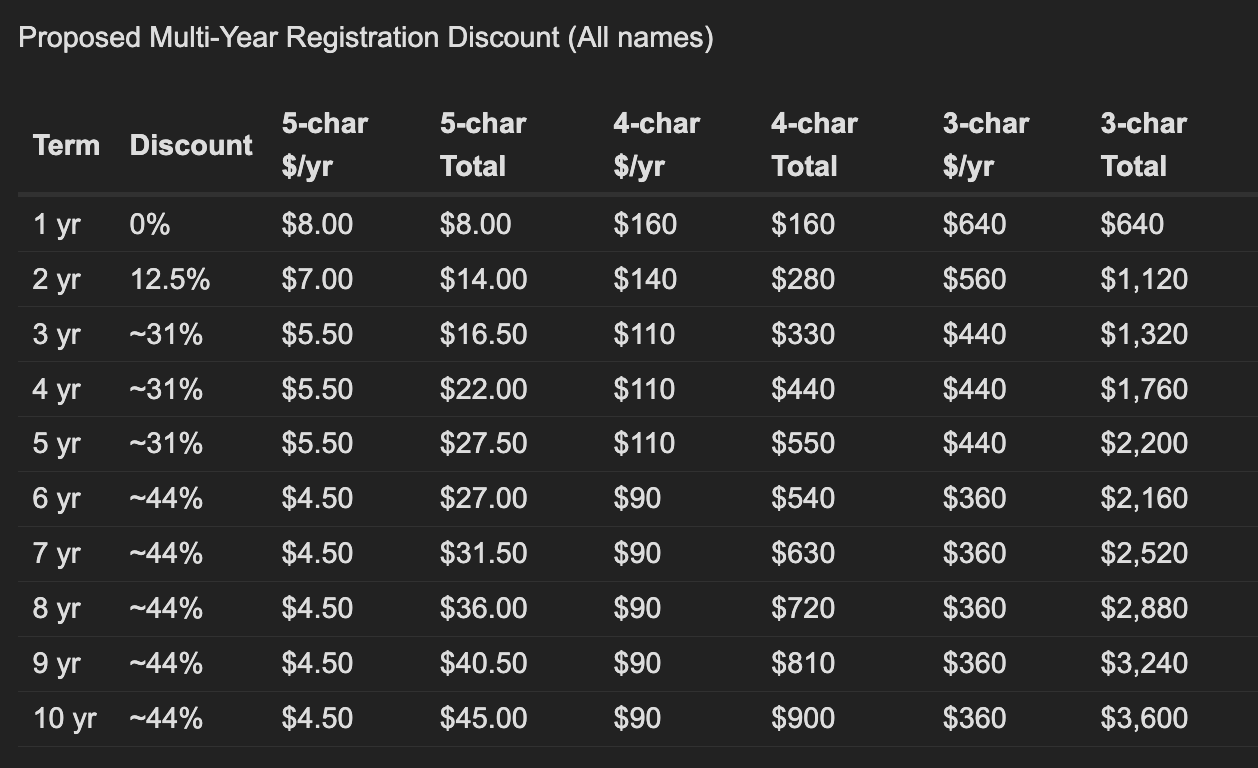
We’ve been listening closely to everyone’s feedback, and a number of delegates have made valuable points, particularly in relation to the current market conditions and ENS’s position as ‘adoption phase’ infrastructure. We’ve amended our proposal as follows:

  • Prices for 5+ character names start at $8/year instead of $12.
  • A simpler three-tier discount curve, identical for all names, with “Casual” (1-2 years), “Committed” (3-5 years), and “Long-Term Identity” (6+ years) discounts.
  • Discounts are applied based on the number of years in the registration/renewal transaction, and apply to the whole transaction, rather than being incremental. This is less optimal but has much more intuitive and easy to communicate results for end-users. Renewing a 5+ character name for 6 years costs $27, regardless of the name’s current expiration date.
  • Reintroduction of the grace period, capped at 28 days rather than 90. During the grace period, names appear as expired (untransferrable, unresolvable, no modifications permitted) but can be renewed by their original owner to restore them. The alternative we had previously implemented, where the original owner can reregister a name during the temporary premium period without paying the premium, will be removed.
  • We’re asking the DAO to commit to reviewing pricing every other year, and adjusting it if necessary.

I’ve updated the first post with these details.

8 Likes

How about better v2 length/tier params?

len $/yr
5 8
6 7
>=7 6
  • Any long term discounts are floored at $5/yr.
  • Based on length/frequency of english dictionary words.
  • Use different pricing/length params based registrar for regional unicode blocks/scripts and emojis.

Registrar contract should only care if rent fees are paid, & not look into who’s paying. Records should be resolvable & modifiable until end of grace period.

Asking again for small % refund from premium fund to ex-owner in v2 design..
This will give owners last exit strategy instead of playing sunken cost game forever, and this also solves hoarding issues at core.

Why can’t ENS be better than old centralized/web2 systems? Grace period should be like full year 300 days with 65 days of premium window. Add % fines for delayed renewal @ 100% extra at 300 days or whatever it takes.. but 28 days is too short notice for our glorious web3 id/property rights.

This is already the case.

During the grace period, the name has expired - it’s not yours anymore, but you can reclaim it. Thus, the name doesn’t resolve. This also raises the chances of someone noticing that their name has expired before it’s too late.

The grace period is a chance to recover your name before it’s lost forever - it’s not a free bonus registration period.

1 Like

Real-user feedback is obviously important here. My concern is that this discussion seems heavily influenced by secondary-market participants whose incentives are very different from those of real ENS users. The useful signal is not their preference, but the observable gap between protocol-level pricing and realized secondary-market prices. That gap can inform pricing decisions, but primary-market pricing should still be guided mainly by real-user adoption and ENS delegate/tokenholder judgment.

6 Likes

That sounds like we’re renting IDs from the ENS DAO, it’s not real “ownership”. Owners have full rights to their property until last minute of extended period to pay gov’t “tax”, before it’s seized and sold out to highest bidder. Ex-owners getting something in refund from premium bids is extension of that property rights.

  • I’m not a lawyer.. won’t comment more about ownership as this thread is for v2 pricing.
1 Like

I am pleased with the amended proposal. The DAO has done an excellent job.

Openness to discussion and constructive feedback is essential for the long-term viability and success of any public good protocol. This process has clearly demonstrated the value of such openness. I appreciate that community members, including myself, were able to voice our opinions and concerns, and that those perspectives were genuinely heard and addressed.

The result is a strong and balanced compromise for everyone involved.

5 Likes

I think Nick’s revisions are substantial improvements of the implementation design…but they do not materially resolve the core constitutional and evidentiary concerns raised in my original post.

I appreciate the revisions.

Reducing the proposed increase from $12 to $8, simplifying the discount structure, and committing to regular review are meaningful improvements.

But my core concern was never only the size of the increase.

It was that, (under Article II of the ENS Constitution), the DAO should be shown a public case that this pricing change is justified, (either by anti-speculation necessity or by reasonable funding necessity).

On this central point, I do not think the revised proposal has yet materially closed the gap, (which is important both now and again every couple years when this topic is revisited). “Name ownership shall not be infringed”, and “pricing is a core tactic for infringing on name ownership”, (regardless of weather or not cheap sub-names exist).

Value-based Pricing Drift Vs. Article II

I remain concerned about “value-based pricing drift”, as the revised framing still seems to move ENS from the Constitution’s limited fee rationale, (namely anti-speculation and reasonable operational funding), toward a more open-ended model of “charging based on perceived protocol value”.

3 Likes

the DAO should be shown a public case that this pricing change is justified

  1. Only 3% of addresses with 1 ENS name register for less than a year; this cohort is also four times more likely to lock in a name for 5 years (7.9%).

  2. More than half (52.5%) of wallet addresses with 5-9 names register for less than a year. Multi-year discounts shift the fee burden in aggregate away from the cohort that registers greater than a year. (Source: https://dune.com/james_ens/ens-2025-registration-duration-by-wallet-cohort)

    I’m curious why you don’t think that supporting evidence has been provided? There are many ways to cut the data and show that discounts based on registration duration benefit holders that are more likely to be using a name for identity, versus speculative intent.

1 Like

I would like to suggest removing the monthly registration feature in ENS v2. Ideally, registrations should be yearly. This change could serve as one of the most effective deterrents against domain squatting, particularly for premium 3- and 4-character names.

2 Likes

James, I think we may be focused on slightly different parts of the proposal <3

I agree that:

  1. the data you cite seems relevant to the case for multi-year discounts,
  2. and, to the view that:
    • longer-duration registrations are more associated with identity-oriented use, (than shorter-duration registrations).

Where I still see a gap is that:

  • it seems more supportive for the discount structure,
  • …than for the full case for the baseline 5+ increase, itself.

My point:

  • was not that “no supporting evidence” has been provided for “any” part of the proposal.
  • It was that: (under Article II of the ENS Constitution),
    • I still think the DAO should be shown a clearer public case,
      (for why “the specific base-price increase is justified”), as:
    • A. “an anti-speculation measure”, (or as),
    • B. “reasonably necessary funding for ENS”,
  • …rather than “only why duration-based discounts may be directionally beneficial”.

So I do not think we are disagreeing about “whether the data is relevant”, necessarily.
…I do think the disagreement is more about “what exactly that data is sufficient to establish”.

To me, it helps support the logic of multi-year discounts,
…but it does not yet fully carry the broader constitutional burden for the proposal as a whole.

Watching this conversation unfold here and on Twitter and it has made me think of it all in the context of how pricing systems evolved. We seldom do that in this space and make a lot of assumptions as if nothing existed before.

In trad domains, price increases (e.g. .com) have been gradual and typically came after domains were already a default layer of the internet. Those increases didn’t break adoption but affected behaviour: fewer multiple registrations, more consolidation around core names.

In SaaS pricing does tend to increase over time (usually 8-12%), but the direction has been in line with increased usage or hybrid models aka cost scales with value/use. Flat increases without a clear shift in perceived value have a tendency to create friction especially at entry point. That top of funnel being affected is not great for adoption - there’s the risk that we compress that top of the funnel at the very moment we should be widening it. Making the default experience more expensive could reduce the kind of casual experimentation that often turns into that long term conviction we are after and also give advantage to competitors.

There’s also another useful parallel in how other network effect marketplaces evolved. If we look at Uber and Lyft, they initially leaned heavily into subsidized growth keeping prices low to build network density on both sides. Only once that network became strong did they start shifting toward profitability, raising prices and reducing incentives.

ENS still feels closer to the phase where network effects are forming rather than fully locked in. Which makes me wonder whether increasing the base cost of entry at this point risks slowing the very thing we’re trying to build. Historically, the systems that have succeeded at scale tended to make themselves indispensable first and only then start extracting more value.

I like looking at patterns and this one is relatively consistent - pricing power follows adoption and value creation, it doesn’t typically precede it. ENS still feels earlier in the curve…It feels like we’re trying to engineer commitment through pricing before fully earning it through utility.

That seems to be where some of the discomfort with this proposal is coming from (and very much reflected in broader current community sentiment as well). It’s not the idea of evolving pricing but the sense that ENS may be front-loading monetisation before fully unlocking or demonstrating solid next layers of value.

If the goal is to encourage long term alignment and commitment:

  • keep the entry point as open as possible without sacrificing sustainability
  • shift incentives toward depth of use vs just duration of ownership

A far more comfortable path introduces changes gradually allowing for behavioural impact analysis or ties pricing more directly to usage/value creation vs increasing the base cost of participation. Even staging the increase over time would give room to observe behavioural changes and make decisions based on that. I also agree with comments made here re the assumption that people can pay - it feels similar to the assumption we have made for years in this space that everyone uses a laptop for crypto, they don’t.

The direction makes sense, I’m not sure the shape is quite right yet…a lower increase (as detailed in some comments here re 50-60% vs 140%) and staged with deeper thought on stimulating depth of use vs mere length might be a better strategy.

2 Likes

Weighing in to comment on the unique constraints of pricing validation in a DAO context. The normal playbook doesn’t apply: it wasn’t possible to release pricing at scale in alpha/beta (even on Sepolia) without triggering DAO discussion prematurely, can’t run a Van Westendorp or gabor-granger survey or A/B test on the live app for the same reason—would also require a contract change. And the standard approach—ship directional pricing that’s had baseline validation, monitor 30/60/90, and adjust if off—doesn’t work because contracts are permanent. Adjustment means another full DAO process.

Danch’s quant work plus our qualitative research was meant to generate enough signal to start a discussion, which it has. The qualitative work focused heavily on the pricing curve (strong positive signal), while $12 and $15 year was tested for friction, which came back low even with price-sensitive users. That’s a good directional indicator, but directional doesn’t mean deterministic. Testing adoption curves at scale will provide definitive insight.

On the specifics: with an $8 floor for 5L names and the curve in @nick.eth’s updated proposal, the yearly price for 5L is, in fact, cheaper than the current $5 at 6 years and sits not far above $5 for shorter terms. There’s a reasonable case for a more conservative starting point on base prices that reflects the feedback in this thread, and I’m supportive of that.

2 Likes

When it comes to “commit to reviewing pricing every other year”, I believe it would be better for the community to have it reviewed every 5 years. In my opinion, I don’t believe it would be wise to have people on edge about the prices potentially changing every 2 years.

Otherwise, I believe the amended proposal is solid and a reasonable balance, on all fronts. :+1:

Lastly, I would highly encourage further discussions on 3-4 length non-ASCII Unicode character sets and how we can appropriately price them to influence further adoption + integrations. Non-ASCII Unicode is a unique benefit for .eth, which can further help adopt .eth globally for other native language speakers. I believe they should all be pegged to the price of 5+ length ASCII characters as their scarcity might be biased depending on the character set as well as more importantly —> they ALL do not resolve 1:1 the same way ASCII can across applications (and most likely never will universally). If we peg the 3-4 length non-ASCII Unicode characters in this manner, then we can further discuss price changes after we leverage this initial push for adoption.

1 Like