Thank you for a thoughtful and relevant post, Thomas. I largely agree with your points here - it’s an unreasonable burden to put on delegates to expect them to rank 25+ detailed proposals objectively, and they’re not domain experts on what ENS and the DAO needs. A committee or working group is likely a sensible way to approach this instead.
There are a couple of areas where I disagree, which I’ll highlight below.
I don’t think this is a degree of flexibility that would be useful to add; it would further complicate matters without any attendant benefit.
In order to be eligible for a two-year stream, a team must have already completed a one year allocation. The DAO is thus re-electing them for a second time, showing a vote of confidence in their ability to deliver, backed up by at least a year’s evidence. In that circumstance, why would someone vote “yes, but only for one year”? If there’s question about the team’s ability to deliver on their promises, they shouldn’t be re-elected at all.
The exception here would be if the team is requesting a significantly larger budget, or proposing to do something entirely new. In retrospect the program should probably have some consideration for whether a team can qualify for a 2 year stream if their new ask is significantly larger than their original one.
I don’t think it makes sense to disqualify a service provider on the basis that they have, well, provided services to the DAO. That would put us in the rather absurd situation that we would be unable to fund any of the teams who have proactively worked to improve the DAO - and thus discincentivise proactive efforts. It would also place you in a position where any input into revising the service provider program is also a conflict of interest!
This also reflects, I think, a problematic attitude towards conflicts of interest. Unless a conflict is so pervasive that it would prevent a candidate from doing their job at all, conflicts should be dealt with by proactively declaring them, and recusal from votes that involve the conflict. Attempting to exclude anyone who may have any kind of conflict once again sets up a perverse incentive where we discourage our most ardent supporters from participating in the DAO.
This seems off-topic for the rest of the conversation here, but since you’ve raised it and it directly concerns me I feel compelled to respond.
Here’s a chart of delegated tokens since the ENS DAO launched in 2022:
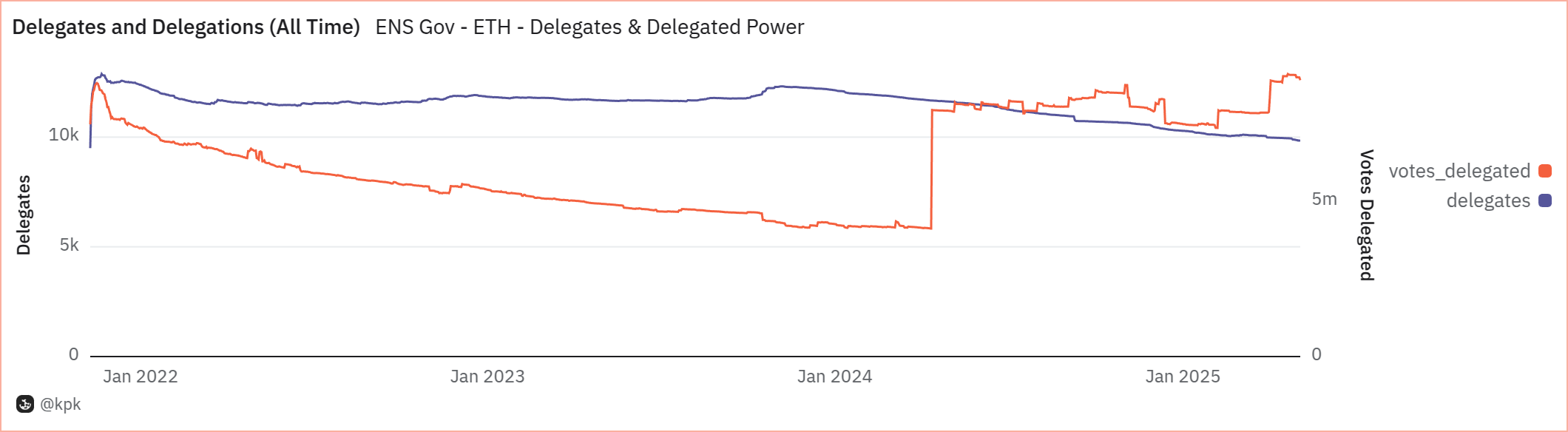
Notice anything? Excluding the veto and the multidelegate contract, it’s pretty consistently down and to the right since launch. That’s been the general trend, and we’re rapidly approaching a point where it’s a danger to the DAO: the lower the delegation rate, and the lower the participation, the more vulnerable we are to both voting attacks and social pressure from parties with motivations that don’t necessarily align with the DAO’s. A longer term solution to this is needed, but in the meantime the deployment of the multidelegate contract finally makes it practical for tokenholders to selectively delegate some of their tokens to community members who have shown themselves to act with the interests of ENS and the DAO at heart.
Previously I haven’t delegated any of my tokens, but now that it’s practical to do so in limited quantities, I’ve chosen to delegate to a few individuals that I believe represent the best qualities of ENS. I’ve been careful to do so to a level that is commensurate with other delegates; 50k tokens is presently in the range of 25th - 30th in the delegate rankings, and is less than a quarter of the top delegate, fireeyes (whose own delegation is >85% from their own pre-launch allocation).
Here’s a list of delegates I’ve chosen to delegate to. If you believe any of them to be unsuitable of the trust I’ve placed in them, I’d like to hear why.
- slobo.eth
- daostrat.eth
- obstropolos.eth
- limes.eth
- liubenben.eth
- imtoken.eth
- ethdotlimo.eth
- governance.kpk.eth
If this kind of responsible and measured use of a limited number of my tokens to enhance the security and representation of the DAO isn’t what the tokens are for, I’d like to know your view - what are they for?
We’re not limited to “now” or “next round”. The DAO isn’t obliged to continue the service provider program in its current configuration for a moment longer than it serves its purpose. Both the delegates and the candidates would be better served by a calm reconsideration of the program than another sudden halt and subsequent rushed reimplementation.