Before getting into the proposal itself, I want to thank the many people who shared opinions, criticism, suggestions, disagreements, and feedback with me over the last few weeks.
This proposal seeks to replace the existing ENS DAO Working Group structure with a single operational DAO Coordination Layer operating as a 12 month pilot program.
The core premise is that ENS DAO’s primary bottleneck is increasingly operational coordination and execution rather than ideation.
The proposed Coordination Layer would:
- Replace the current Working Group structure,
- Operate as a bounded operational coordination body,
- Coordinate DAO initiatives, contributor engagement, governance operations, and ecosystem programs,
- Operate subject to transparency requirements, timelock constraints, and veto mechanisms,
- Explicitly not oversee ENS Labs or Service Provider funding responsibilities delegated to the SPP committee,
- And continuously self-evaluate throughout the pilot period via public reporting.
The proposed initial stewards of the Coordination Layer are:
- Thomas Clowes (clowes.eth)
- Jiyeon Park (jiyeonpark.eth)
One of the initial responsibilities of the Coordination Layer would be to facilitate an open delegate election process within the first 30 days of the pilot period for the appointment of a third steward, strengthening ecosystem representation and broader delegate participation.
This proposal attempts to reduce governance fragmentation whilst preserving transparency, delegate oversight, and public-facing DAO coordination.
Precontext
On May 12th, Alex (Netto) posted Path forward on Working Group elections for Term 7, outlining a path where, if [Temp Check] Working Group Restructure has not moved forward by May 31st, the ENS DAO will revert to the status quo and run elections for new stewards under the existing three Working Group structure.
I do not believe there is generalized support for the status quo. My concern is that, absent a concrete alternative, the DAO may default back to a structure that many participants already recognise as suboptimal.
In March, Katherine outlined [Temp Check] Expanding the ENS Foundation Board to Strengthen Operational Accountability for ENS DAO. On the latest Metagov call, she stated that she did not want to rush changes of that nature given their significant implications for the DAO. I agree.
I also do not think that proposal and this one are mutually exclusive. In my view, they address related but distinct parts of the DAO’s operational problem.
Back in November 2025, Limes proposed [Temp Check] Replace the Working Groups with the ENS Admin Panel. That proposal ultimately failed. My interpretation was that, whilst many agreed the current Working Groups were not working well, there was not broad consensus that the proposed alternative was the right replacement.
Over the first half of 2026, Mike and the team at Metagov Research conducted the ENS DAO retrospective. The outcomes of that research are outlined here: ENS Retro Draft Final Report. In Mike’s response to requested commentary on the existing proposals, he stated that “it is our opinion that none of these proposals align with or integrate the Roadmap proposed by the Retro”. That roadmap is documented in their Final Report.
What I outline below is largely aligned with opinions I previously shared in Toward Accountable and Strategic Funding in ENS, and is intended to complement Colton’s successful proposal regarding the Service Provider Program: [6.42] [Social] SPP3: Program Authorization and Committee Model.
Proposal
High Level
My perception of the commentary and discussion across the ecosystem is that there is clear interest in creating clearer operational ownership of initiatives to move the DAO forward.
Even people who disagree on implementation generally accept:
- The DAO cannot continue with many weak overlapping structures,
- Delegates cannot operationally manage everything,
- Execution needs clearer ownership.
There is recurring support for:
- An accessible public-facing layer,
- Community calls,
- Grants,
- Onboarding contributors,
- Ecosystem engagement,
- Experimentation/Public Goods.
But general agreement that current structures are not effectively achieving those goals.
At present, ENS DAO lacks a clearly empowered operational layer responsible for ensuring initiatives, contributor coordination, and DAO improvements are actually executed.
I am proposing the formation of a single DAO Coordination Layer with a high level mandate to act as the operational coordination body for ENS DAO. This would replace the current Working Group structure.
This structure would exist to coordinate and operationally advance initiatives that improve ENS DAO effectiveness, contributor participation, and ecosystem growth.
Why a Single structure?
The current Working Group structure creates:
- Diffuse accountability,
- Coordination overhead,
- Duplicated process,
- Unclear ownership,
- Inconsistent execution,
- And operational fragmentation.
Rather than the DAO maintaining multiple Working Groups, the new Coordination Layer would have the autonomy to establish, fund, and operationally own temporary initiatives, committees, or contributor groups focused on specific objectives that advance the ENS DAO.
Boundaries, Transparency, and Oversight
Any delegated operational structure requires:
- Vetoability,
- Transparency,
- Reporting,
- Defined scope,
- And visible limitations.
This Coordination Layer IS NOT the DAO but rather would act as the DAO’s coordination body.
This proposal seeks to reduce governance fragmentation whilst preserving transparency, community accessibility, and delegate oversight.
Comparison with ENS Admin Panel Proposal
Limes ENS Admin Panel proposal outlined the following responsibilities:
This proposal diverges from that structure in a few important ways.
Whilst the Coordination Layer would execute transactions on behalf of the DAO and take on general operational and administrative responsibilities, it would not act as a reporting or oversight body for ENS Labs or Service Providers. Oversight and accountability for those entities should remain within the remit of the delegates and the SPP committee.
Mandate
The Coordination Layer will serve as the DAO’s primary operational body responsible for facilitating initiatives, contributor engagement, ecosystem programs, governance execution, and DAO operations.
The Coordination Layer will have bounded delegated authority to allocate funding and initiate operational programs without requiring governance-wide executable proposals.
This authority would be subject to transparency requirements, timelock constraints, and veto mechanisms.
The Coordination Layer will be initially funded for a 12 month pilot period.
The Coordination Layer may receive up to $500,000 in operational funding per six month period subject to governance approval and ongoing review throughout the pilot period. This amount can be adjusted through future governance proposals should the initial pilot prove successful or require refinement.
This funding level is intended to provide sufficient operational flexibility for contributor support, experimentation, ecosystem initiatives, grants, and general DAO coordination.
Funds held by the multisig may be deployed by the Coordination Layer subject to the transparency, timelock, and veto mechanisms outlined within the accompanying Coordination Layer ruleset.
My current view is that the existing ENS Security Council is likely the most pragmatic mechanism for executing emergency vetoes during the timelock period, given its existing operational structure and ability to act quickly where required.
The Security Council would not oversee routine operations or governance decisions of the Coordination Layer, but would instead act solely as an emergency veto mechanism during the timelock window.
As a default operational practice, outgoing transactions should generally be initiated on Mondays and remain subject to a mandatory 7 day timelock period.
The intention of this cadence is to improve predictability, visibility, and consistency around outgoing transactions and veto review windows.
All proposed outgoings will:
- be documented in a public GitHub repository subject to a standardized template,
- be documented on the ENS forum,
- include any transaction-specific Conflict of Interest disclosures.
Coordination Layer members will publish up-front Conflict of Interest statements.
The Coordination Layer will publish monthly transparency reports outlining:
- Funding allocations,
- Operational initiatives,
- Contributor engagement,
- Active initiatives/subcommittees,
- And ongoing DAO improvement efforts.
Budget Comparison
This proposal is intended as a consolidation and simplification of existing operational structures rather than the introduction of a fundamentally new category of spend.
Per the published ENS Working Group spending summaries, Working Group spending during 2025 was:
| Quarter | Working Group Spend |
|---|---|
| Q1 2025 | ~$642k |
| Q2 2025 | ~$684k |
| Q3 2025 | ~$627k |
| Q4 2025 | ~$379k |
This represents approximately ~$2.33M in Working Group operational spending during 2025.
Additionally, 21,637 ENS was distributed as compensation during this period.
By comparison, the proposed Coordination Layer structure consists of:
- $198k annual member compensation,
- ENS-denominated compensation aligned with existing steward structures,
- and up to $1M annual operational allocation subject to transparency requirements, timelock constraints, veto mechanisms, and public reporting.
Importantly, the proposed operational allocation represents a maximum authorized budget rather than a requirement that all allocated funds be spent.
The Coordination Layer would initially receive $500k for the first six months of operation. Continued funding for the second six month period would be requested only where operationally justified and subject to review of the Coordination Layer’s performance, reporting, transparency, and demonstrated effectiveness during the initial 6 month period.
Whilst the compensation structure is aligned with the existing Lead Steward model, the proposed Coordination Layer would consist of only three members compared to the previous nine Working Group stewards, representing a materially smaller overall compensation footprint.
Initial Composition
Given the short timeframe before fallback to the existing Working Group structure, I believe it is reasonable for the initial composition of this Coordination Layer to be explicitly proposed upfront.
The proposed initial members of the Coordination Layer are:
- Thomas Clowes
- Jiyeon Park
Thomas Clowes
I have been an independent ENS contributor since 2017, am co-founder of an ENS DAO Service Provider (Unruggable), and have worked as a developer in the traditional domain industry for nearly 20 years.
I have full visibility into both current and historical DAO structures, am an established ecosystem participant, and have a deep technical understanding of the ENS protocol and surrounding ecosystem.
I have pushed forward many conversations on advancing the ENS DAO over the years, for example:
- Toward Accountable and Strategic Funding in ENS; and
- From Stagnation to Structure: Fixing ENS Governance;
Jiyeon Park
Jiyeon is the APAC Lead at Steakhouse Financial. She has worked as a portfolio manager in both traditional finance and crypto since 2016.
Prior to Steakhouse, Jiyeon worked as Portfolio Manager at JP Morgan’s Chief Investment Office, where she managed proprietary structural FX and Rates risks on the bank’s APAC balance sheet. She later worked as the lead Portfolio Manager in a Hong Kong-based market-neutral crypto hedge fund.
She is not new to the ENS ecosystem, having previously participated extensively in our Metagovernance calls through her collaboration with karpatkey in 2024-2025, the entity that manages the ENS endowment. In that capacity she contributed to Metagovernance discussions on treasury strategy, endowment composition, and risk management, and has familiarity with both the financial mechanics and the governance dynamics of ENS DAO.
She has no current financial relationship with the ENS DAO, which provides the structural independence the role requires.
I believe this is a pragmatic starting point given:
- Existing operational involvement within ENS DAO,
- Longstanding ecosystem participation,
- Familiarity with the governance and operational shortcomings identified in the retrospective,
- Technical and financial expertise
- And willingness to actively take ownership of moving DAO operations forward.
The initial two-member structure is intended as a bootstrap mechanism, with an open delegate election process for a third steward to be facilitated within the first 30 days of the pilot period.
Compensation
The proposed compensation structure is aligned with that of existing Lead Stewards as outlined in EP 5.18.
Specifically:
- $5,500 USD per month ($66,000 USD per year),
- ENS tokens equal in value to the total annual USDC compensation.
This diverges from the reduced compensation outlined in James’ initial proposal reflecting the expanded operational scope, accountability expectations, and ongoing time commitment associated with the Coordination Layer role.
Starting Point
The ENS DAO Retrospective dashboard highlighted several immediate operational and governance issues. These signals should serve as an initial starting point for improvement efforts facilitated by the Coordination Layer.
Coordination Calls
As a starting point I propose weekly Coordination Calls. These calls would serve not only as an open discussion forum, but as a mechanism for coordinating and advancing actionable DAO initiatives.
Initiatives discussed through this process may ultimately result in responsibilities being delegated to more specialized groups, contributors, or temporary initiatives where appropriate.
My intention is that proposals and initiatives discussed through these calls would result in concrete operational follow-through, with outcomes, responsibilities, and actions documented publicly and progressed transparently.
Transparency
All discussions, outcomes, and proposed spending would be documented in a public GitHub repository and shared on the ENS forum.
Additionally, the Coordination Layer would publish a monthly transparency report summarising operational activity, funding allocations, ongoing initiatives, contributor engagement, and notable outcomes or challenges.
All proposed spending would be disclosed at minimum 7 days prior to execution, allowing sufficient time for community review and potential veto.
Growing the delegate pool
I think it is worth highlighting the following:
“incoming contributors cannot accumulate meaningful delegation through merit alone”
One potential initial initiative for the Coordination Layer would be defining processes for delegating ENS voting power to consistent contributors who demonstrably add value to the ecosystem.
Discussion should also occur around mechanisms for appropriately rewarding long-term contributors and expanding meaningful governance participation.
This would serve to address some of the concerns outlined in the Retro report, namely our:
“failure to cultivate widespread governance engagement despite operating for over three years”
It is concerning to me that at the moment:
“Small-holder votes are not just marginal — they are structurally irrelevant to outcomes. Removing all small-holder votes from every one of the 40 most recent on-chain proposals produces zero outcome flips”
The First 3 Months
During the first three months, the Coordination Layer would focus on establishing operational cadence, improving visibility into DAO activity, and converting previously discussed ideas into actionable initiatives.
We intend to host weekly Coordination Calls every Tuesday at 9am ET serving as a public entry point into DAO coordination, contributor onboarding, and operational discussion.
Initial focus areas would include:
- identifying previously discussed but unexecuted initiatives,
- improving contributor coordination,
- ecosystem outreach and onboarding,
By the end of month 1, the Coordination Layer commits to having delivered:
- Outreach across the broader Ethereum ecosystem intended to increase awareness of the Coordination Layer and encourage broader contributor and delegate participation within ENS DAO.
- An open delegate election process for a third Coordination Layer steward seat.
By the end of month 3, the Coordination Layer commits to having delivered:
- 12 weekly Coordination Calls held, with public notes on each
- 3 monthly transparency reports published
- A clear inventory of unexecuted DAO initiatives, prioritized for execution
- A draft contributor and/or delegate-growth framework opened for community feedback
- A summary, opinion, and direction on ENS’ Public Goods positioning
- At least one public-facing ecosystem call re-established
Additional calls may be scheduled where particular initiatives require more focused coordination, subject-matter expertise, or operational ownership.
Importantly, the intention is not simply to create additional discussion forums, but to ensure initiatives are documented, operationally owned, and progressed transparently over time. Priorities and focus areas may evolve based on subjects surfaced during Coordination Calls and broader ecosystem feedback. The examples above are intended to provide initial starting points and directional focus, not to be prescriptive.
Discussion and Responses
I have attempted to collate and respond to commentary across the various governance, Working Group restructure, and retrospective discussions that are relevant to this proposal. This section is non-exhaustive, but seeks to address some recurring themes and concerns raised across the ecosystem.
Governance Access and Coordination
There were a number of comments from DAO participants indicating a desire to preserve a clear public-facing governance structure within the ENS DAO.
This proposal seeks to preserve and expand that function through the Coordination Layer.
The intention of the Coordination Layer is to provide operational coordination, proposal support, contributor onboarding, and a neutral DAO-facing coordination layer whilst reducing fragmentation between overlapping governance structures.
Public Goods and Ecosystem Engagement
There has been recurring discussion surrounding Public Goods funding, ecosystem engagement, public-facing calls, and maintaining accessible entry points into ENS DAO.
My view is that ENS DAO should continue supporting ecosystem coordination and Public Goods initiatives in some capacity. However, I do not believe the Coordination Layer itself should directly administer large-scale Public Goods funding programs.
Instead, I believe the Coordination Layer should facilitate the creation of lean operational structures capable of continuing these initiatives in a more focused and accountable way.
This includes:
- public-facing ecosystem calls,
- editorial and social media coordination,
- contributor onboarding,
- Public Goods initiatives,
- and broader ecosystem engagement efforts.
Scope and Operational Responsibilities
This proposal is intentionally focused on DAO-facing operational coordination responsibilities.
The proposed Coordination Layer would focus on:
- governance coordination,
- proposal process support,
- operational execution,
- contributor coordination,
- governance communication,
- and DAO-facing ecosystem initiatives.
It would not replace governance itself, nor would it oversee Service Provider funding responsibilities currently delegated to the SPP committee.
ENS Labs Separation
There were recurring comments throughout the broader discussion emphasizing the importance of maintaining separation between ENS Labs and ENS DAO operational responsibilities.
This proposal intentionally maintains separation between ENS Labs, the SPP committee, and DAO operational coordination responsibilities.
The Coordination Layer would not oversee Service Provider funding or operate as an extension of ENS Labs. Instead, it would focus on DAO-facing operational coordination and governance support.
Legal Obligations
I believe the Coordination Layer should help ensure the DAO appropriately identifies, prioritizes, and coordinates around emerging legal and operational obligations, including bringing in relevant external expertise where required.
Conflict of Interest
I feel obliged to explicitly respond to this noting that I am co-founder of Unruggable, a Service Provider.
My view is that these conflicts are manageable, disclosed, and structurally mitigated through the separation of responsibilities between the Coordination Layer and the SPP committee.
I am appreciative that many ecosystem participants are embedded within ENS in various capacities, myself included. I am generally aligned with comments previously shared by Nick, namely that:
Should this proposal pass, I would support formalizing clearer Conflict of Interest standards and disclosure expectations for the ENS DAO.
Multisig Structure
The proposed initial two-member structure is intended purely as a bootstrap mechanism to make the Coordination Layer operational ahead of the existing Working Group fallback deadline. The longer-term intention is not to maintain a permanently two-member operational structure.
One of the Coordination Layer’s initial responsibilities during the pilot period would be to facilitate an open delegate election process within the first 30 days to appoint a third steward, expanding the multisig to a 2-out-of-3 signer structure.
The initial two-member composition is intended to minimise operational overhead during the bootstrap phase whilst relying primarily on transparency, timelocks, and vetoability as the core accountability mechanisms.
This approach attempts to balance:
- the need to rapidly operationalise the Coordination Layer ahead of the fallback timeline,
- reducing concentrated signing authority and key-loss risk over time,
- and preserving the lean operational structure this proposal is built around.
During the interim two-member window:
- single transfers above $25,000 would be deferred until the third steward is seated,
- all transactions would remain subject to the standard 7-day timelock,
- and the Security Council would retain its emergency veto function as the ultimate backstop.
Should this proposal move forward, further discussion around multisig structure, operational safeguards, and steward expansion mechanisms would be welcomed.
Proposed Structure
The following section outlines the concrete structural changes proposed by this post.
This proposal calls for the dissolution of all three existing ENS DAO Working Groups pursuant to Section 2 of the current Working Group Rules:
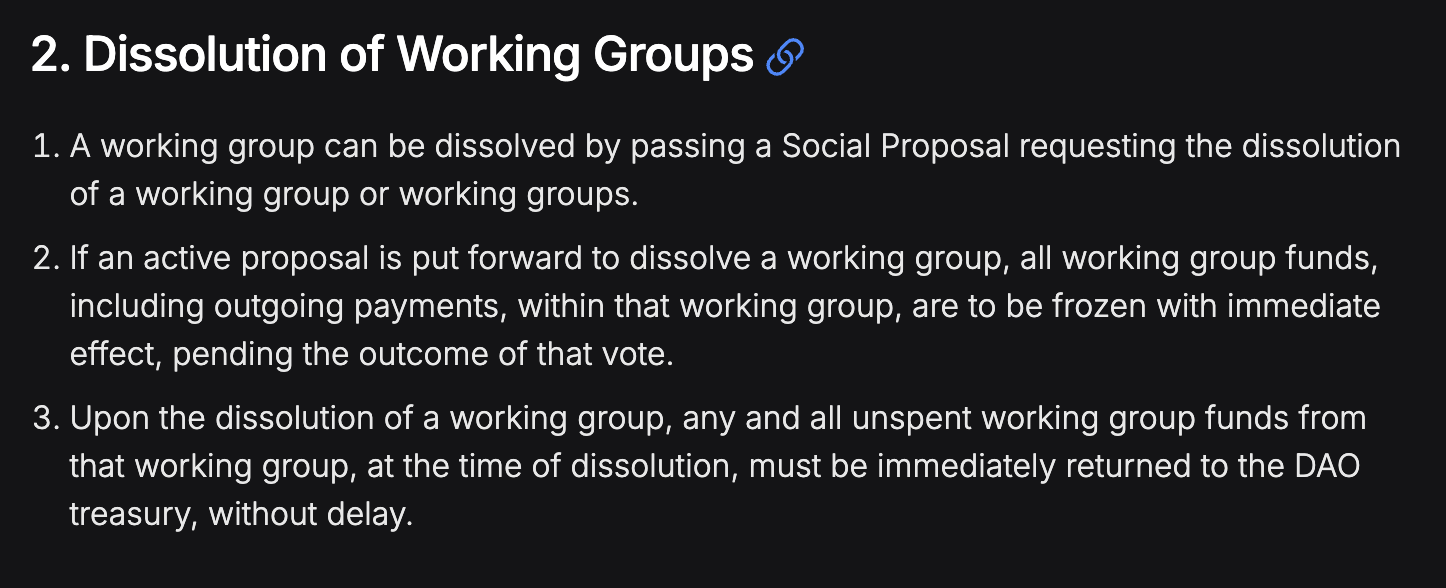
Simultaneously, this proposal calls for the creation of a new singular operational structure named the DAO Coordination Layer.
The Coordination Layer would:
- replace the existing Working Group structure,
- operate for an initial 12 month pilot period beginning June 1st 2026,
- be administered initially by two proposed stewards, with a third steward elected through an open delegate election process within the first 30 days of the pilot period,
- and operate pursuant to a separate Coordination Layer ruleset.
This structure is not a Working Group as previously defined, but rather a bounded operational coordination body operating subject to transparency requirements, timelock constraints, veto mechanisms, and governance oversight.
A draft DAO Coordination Layer rules document has been produced alongside this proposal and is linked here.
Pilot Evaluation
The Coordination Layer should be evaluated throughout the initial 12 month pilot period rather than only at the end of the term.
As part of its monthly transparency reporting, the Coordination Layer will include a self-evaluation section outlining:
- Initiatives started,
- Initiatives completed,
- Initiatives abandoned or paused, with reasons,
- Funds allocated,
- Contributors engaged,
- Operational bottlenecks identified,
- Governance or process improvements proposed,
- And areas where the Coordination Layer has failed to make meaningful progress.
The purpose of this self-evaluation is not to mark its own homework in isolation, but to create a regular public record that delegates, contributors, and tokenholders can use to assess whether the structure is working.
At the end of the 12 month pilot period, the Coordination Layer will publish a retrospective report summarising its work, evaluating its effectiveness, and making a recommendation to governance on whether the structure should be continued, modified, expanded, or discontinued.
| Responsibility | ENS Labs | ENS Foundation | SPP Committee | DAO Coordination Layer |
|---|---|---|---|---|
| Protocol development | Owns | |||
| Legal entity and contractual counterparty for the DAO | Owns | |||
| Administrative custodianship (records, filings, statutory compliance) | Owns | |||
| Service Provider selection and renewal | Owns | |||
| Service Provider performance oversight | Owns | |||
| ENS Labs accountability to DAO | Owns | |||
| DAO multisig operation (treasury, streams) | Legal counterparty where required | Operates dedicated coordination multisig only | ||
| Proposal process support (drafting help, calendaring, governance liaison) | Owns | |||
| Weekly community / coordination calls | Owns | |||
| Contributor onboarding and coordination | Owns | |||
| Small grants and experimentation funding | Owns (within bounded authority) | |||
| Public Goods funding mechanism design | Owns or Facilitates | |||
| Editorial, social media, newsletter | Facilitates | |||
| Ecosystem calls and public engagement | Owns or Facilitates | |||
| Delegate growth and merit-based delegation | Owns or Facilitates | |||
| Legal coordination (counsel engagement, obligation tracking) | Owns legal relationship | Surfaces obligations and supports counsel engagement | ||
| Conflict of Interest standards | Applies to staff | Applies to directors | Applies to committee | Drafts DAO-wide COI standard |
| Protocol-level votes (constitution, treasury) | Reports to the DAO directly |
Closing Thoughts
ENS remains one of the most important and ambitious projects built on Ethereum.
Despite the governance and operational challenges outlined throughout this proposal, I still fundamentally believe in the long-term importance of ENS, the broader ecosystem surrounding it, and the potential for ENS DAO to evolve into a genuinely effective steward of a critical identity primitive.
My intention with this proposal is to improve coordination, increase contributor participation, and ensure good ideas are consistently translated into meaningful execution.
I look forward to working with delegates, contributors, Service Providers, ENS Labs, the Foundation, and the broader ecosystem to help make this pilot successful and strengthen the ENS DAO’s operational effectiveness over the coming years.
We welcome further discussion and feedback around the proposal, and are very open to additional public calls if people feel that would be useful for discussing the structure, concerns, or potential improvements in a more accessible format.