[Temp Check] Expanding the ENS Foundation Board to Strengthen Operational Accountability for ENS DAO

Abstract

The discussions leading up to and surrounding the ongoing retrospective are surfacing what most of us long-time ENS contributors already know and feel deeply: ENS DAO’s coordination structures aren’t keeping pace with the importance of ENS. ENS remains one of Ethereum’s greatest success stories. It is core Ethereum infrastructure, and yet the governance layer between token holders and execution is slow, under-specified, and increasingly a source of friction rather than accountability.

This proposal builds on prior calls for a DAO accountability layer by expanding the mandate and formal authority of the ENS Foundation and restructuring its Board of Directors from three to five seats. The goal is to move more day-to-day accountability into the Foundation under an expanded board with greater independent and external participation, and clearer responsibility to the DAO.

This Board will be given direct budget allocation authority from the DAO over ENS Labs, service providers, and public goods initiatives on behalf of token holders. The goal is to reduce delegate fatigue, establish a genuine accountability layer between the DAO and the entities it funds, and create a coordination body with the standing and mandate to act.

Most importantly, protocol governance would remain exclusively with tokenholders. Contracts, pricing, root control, and all other core protocol decisions would continue to require tokenholder approval, exactly as they do today. Tokenholders would also retain the power to approve or remove Board Members.

What changes is not the authority of token holders, but how that authority is exercised, by delegating operational accountability to a body that is answerable to them.

The Problem We’re Solving

Four things come up consistently in this forum and in conversations with delegates and contributors:

1. Delegate fatigue is real and getting worse. Delegates are asked to vote on an expanding range of decisions — many of which they don’t have enough context to evaluate well. The cognitive load of governance participation is high, and the signal-to-noise ratio is low. Good delegates are disengaging because the cost is too high relative to the impact.

2. The DAO makes too many small decisions and too few big ones. Token holder votes are a scarce and expensive resource. We routinely spend that resource on operational questions that don’t require it, and then lack the bandwidth for the strategic decisions that do. The result is a DAO that is simultaneously over-governed and under-governed.

3. There is no accountability layer between the DAO and the entities it funds. When a grant recipient (be it a service provider, a vendor, or Labs itself) underdelivers, the DAO has no formal mechanism to respond short of a public vote. When the community disagrees with a DAO spending decision, there is no procedural channel to raise that concern. The absence of a middle layer means every tension surfaces as a political fight, and the lack of nuanced understanding of differing perspectives often exacerbates tensions.

4. Coordination across working groups is slow and inconsistent. There is no body with the standing and mandate to coordinate across these structures. This has a downstream negative effect on contributors (especially painful for programs such as the SPP) as decisions that should take days take months, and contributors are repeatedly blocked waiting for clarity that never formally arrives.

Working group stewards have contributed immensely to the functioning of the DAO since inception, and this is not an indictment of that work. However, the lack of a coordination layer means that oftentimes the difficult work that stewards and contributors do goes unacknowledged or underappreciated, especially as the scope of work has crept far beyond its initial bounds over the years. A new structure should optimize for operational efficiency at scale while still respecting the decentralized, open-source, and credible neutrality that make up the core values of the ENS protocol and Ethereum.

The Proposal

This proposal has two components: expanding the mandate and formal authority of the ENS Foundation, and restructuring the ENS Foundation Board of Directors to give it the composition and powers needed to execute that role effectively. Critically, this would replace the working group structure entirely (more details on this below). Together, these changes require amending the ENS Foundation’s Articles of Association and bylaws — something that the Foundation’s existing independent legal counsel could take on if the DAO endorses this direction.

1. Right Sizing the ENS Foundation for Decision Making and Accountability

The ENS Foundation is an existing Cayman Islands foundation company that already serves as the legal entity for ENS. It currently handles offchain administrative and legal matters on behalf of the DAO. Its board currently consists of three directors.

Under the structure proposed in this temp check, the Foundation Board would hold and allocate the DAO’s annual budget (exact budget number to be proposed, but ballpark $15m in the first year based on previous data) on behalf of token holders. The Board sits formally between the DAO and the entities it funds, and is accountable to token holders for how that trust is exercised.

Under this model, the DAO ratifies an annual budget and delegates its allocation to the Foundation Board. The Board then distributes funding across three categories: ENS Labs, service provider program (SPP), and public goods and ecosystem initiatives. Notably, the selection process for SPP should be separated (i.e. adopting a committee model) as the Board’s main purpose is accountability, not gatekeeping. Both ENS Labs and service providers (or in the case of a revamped committee-lead SPP, the committee) report directly to the Board, and continue to publish public quarterly reports directly to the DAO. Assuming there is broad reception to this proposal, the funding relationship and structure will be defined further in the formal proposal.

This transfers budget allocation authority to a coordination layer that is purpose-built for operational accountability, insulated from cycle-to-cycle political noise, and answerable to token holders through ratification and removal powers.

The Foundation has no authority over protocol-level decisions. Contracts, pricing, root control, and all other core protocol governance (in addition to treasury management) remain exclusively with token holders. That boundary is unchanged.

2. Restructuring the ENS Foundation Board of Directors

The Foundation Board is the governing body that makes this structure work. Its legitimacy derives entirely from token holder ratification — the DAO’s power to appoint and remove directors is already established in the Foundation’s Articles of Association, and this proposal builds directly on that existing mechanism.

Composition and Expectation of the Board

The existing Foundation Board would be expanded from 3 seats to 5 seats through the addition of 2 new directors. The restructured board will consist of five seats: two held by ENS Labs representatives, and three held by external and independent directors (meaning that independent voices will make up the majority on the board). The goal is a board where ENS Labs is represented but not dominant, and where external directors bring genuine independent judgment to budget allocation and accountability decisions.

External directors should bring substantive experience in at least one of the following areas:

  • Nonprofit or foundation governance: experience running or serving on the board of a mission-driven nonprofit or foundation, with direct accountability for organizational strategy and financial stewardship.
  • Protocol or ecosystem leadership: a track record of building or stewarding foundational infrastructure at the ecosystem level, with credibility across the broader Ethereum and open-source communities.
  • Financial and business acumen: experience allocating capital at scale, with the financial judgment to evaluate budget proposals and hold funded entities accountable to outcomes.

If there is broad reception to this proposal, I will work with the existing ENS Foundation Directors to lead a search process for the external seats and will publish the full candidate slate in the formal proposal for community review prior to ratification.

Directors may resign with 30 days written notice and may be removed by a supermajority of seated directors (minimum 3 votes) or by a standalone DAO-wide proposal. Directors must disclose material affiliations with ENS Labs, service providers, or grant recipients at appointment and as they arise, recorded in public minutes. Affiliated directors may deliberate and vote unless they stand to personally benefit from the outcome, in which case recusal is mandatory.

Authority of the Board

  • Receives and allocates an annual budget across ENS Labs, service providers, and public goods/ecosystem initiatives
  • Holds ENS Labs and service providers accountable to their mandates and deliverables
  • Has formal standing to raise concerns about spending or performance — concerns go on record, and token holders retain final authority on all protocol-level decisions
  • Reviews public quarterly reports from all funded entities and adjusts funding based on performance
  • May hire operational staff, full time or contractors, as needed. These roles may include secretarial duties, accounting expertise, governance liaison, and other talent to draw on from within the existing ENS community.

Board seats will be compensated, in line with standard boardroom expectations, to reflect the scope of work expected of each director. Compensation details will be included in the formal proposal and approved by the DAO.

How This Works in Practice

Budget cycle. Each year, the DAO votes to approve a total budget for a determined cycle. The Foundation Board then allocates that budget across ENS Labs, service providers, and public goods initiatives — this would replace the current working group funding cycle. Funded entities must publish public quarterly reports to the DAO and report directly to the Board, which reviews performance and adjusts future tranches accordingly.

Accountability in practice. If a service provider misses milestones, the Board flags it, adjusts the next funding tranche, and publishes its rationale publicly. The goal is to minimize political infighting as funding decisions have a clear home, a clear process, and a clear record. In return, the Board is accountable to tokenholders, as it holds authority only so long as tokenholders ratify its budget cycles and seats.

Working group transition. This structure replaces the working group model. Existing stewards, active streams, and current-term commitments would be honored through their natural conclusion or brought under review. The transition timeline would be defined in the formal proposal in coordination with current stewards.

What the DAO still votes on. Protocol changes, constitutional amendments, treasury spending and management, and any board appointment all require token holder votes, as they do today.

Next Steps

If the DAO endorses this direction, implementation has three sequenced components:

  1. Legal counsel engagement. Amendments to the ENS Foundation’s Articles of Association and bylaws require coordination with the Foundation’s existing independent legal counsel (in Cayman).
  2. Articles of Association and bylaw amendments. Expanding board composition from 3 to 5 seats, defining the board’s formal authority over budget allocation, and formalizing accountability structures for ENS Labs and service providers.
  3. Formal Proposal followed by a DAO Vote. As a temp check, this is to gather feedback and suggestions prior to a formal proposal. Nothing changes structurally until token holders have ratified it.

The goal of this temp check is to establish whether the DAO is aligned on the direction before a formal proposal is drafted and submitted. MetaGov Research team’s Phase 1 findings are strong confirmation of the problems identified in this proposal, and this proposal is not meant to be a parallel track to the retrospective, but a structural answer to what it is finding. Several important details are intentionally left for the formal proposal, including board compensation structure, transparency and reporting requirements for board operations, and the full conflicts of interest policy.

On a personal note: I am writing this as a long-time direct contributor to the ENS DAO as a former steward myself and also a member of the core team behind the ENS protocol. That experience shapes how I see things right now, and what I know to be true is that ENS Labs and the DAO and the builders in this ecosystem are not adversaries. There have been numerous calls for change within our system, and I bias towards action.

I do believe that we all want the same thing here: a decentralized and open-source protocol that proliferates while staying resilient, secure, and credibly neutral. This proposal doesn’t claim to fix every structural challenge the DAO faces, but I believe this creates an accountable operational layer that functions regardless of those dynamics.

Responses to this post and in DMs are welcome.
14 Likes

Broadly supportive of this direction, although with some nuance.

I supported, but ultimately abstained from voting for, limes.eth’s proposal for the same reason — working groups have become a coordination chokepoint, and the political overhead of the steward role actively competes with the ability to do the work, let alone accountability.

Speaking from experience as a former steward: some of the most productive contributions I’ve made to ENS actually have come from outside the Working Group structure (go figure).

This proposal is a more robust and comprehensive approach than its spiritual predecessor (the ENS Admin Panel) — it presents a concrete accountability layer via the Board structure, with real budget authority and independent directors.

One detail worth ironing out is the ratification mechanism. As written, existing directors lead the candidate search while the DAO approves the slate — but it’s not clear what happens if the DAO rejects it, or whether tokenholders have a path to put forward alternative candidates.

Worth addressing, as it otherwise raises questions of procedural legitimacy.

1 Like

If the DAO rejects a name, the search process restarts to fill that seat with incorporated feedback, and a revised slate comes back for ratification. The pt is that rejection is a signal and not a dead end.

To your other q- I’ve thought about it a lot and don’t think it’s the right design. The risk is that it becomes a proxy for politicking which becomes a negative distraction. The guardrail mechanism is there in the ratification and removal, both of which remain fully with tokenholders.

3 Likes

As long as delegates understand they are trading authority up front for operational efficiency and can claw back as a fail-safe — this is a reasonable trade-off if the alternative is political and governance overhead in perpetuity.

2 Likes

I think this is a great direction for the board, to take more responsibility. As part of a passing of the torches, I will be vacating my seat on the board when the new members come in, so there will be 3 new openings on the election.

4 Likes

I think it makes a lot of sense.

Referendum based token voting should be reserved for a small amount of very important decisions. Even some of these can be optimised via optimistic governance giving token holders or ens users an onchain veto to reduce counter-party risk.

Smaller more operationally focused decisions should be executed on more rapidly.

Leaving hard power with token holders in any context is where decentralisation matters more.

3 Likes

I’m generally supportive of this proposal. It represents an important step in the evolution of ENS DAO’s organizational structure and a pragmatic attempt to improve operational efficiency.

More importantly, it directly addresses several of the DAO’s current pain points, including delegate fatigue, lack of clear accountability, and slow coordination across working groups.

It’s worth exploring this direction further with careful design around checks, transparency, and incentives.

4 Likes

As a delegate, I’m supportive of exploring this direction. Structuring an accountability layer between token holders and funded entities feels like a path worth pursuing.

As a current steward, I’m curious about one aspect of the transition: would current or former stewards be eligible for board seats? The experience we would bring seems directly relevant to what the board would need (assuming that anyone who applies meets the other criteria mentioned as well). Wondering whether that background would be viewed as an asset or whether the independence requirement would effectively rule out anyone with recent WG involvement.

1 Like

My 2C is that existing WG stewards certainly are not precluded from a board seat consideration, but might make more sense as operational staff that the board hires (as PT or FT hires) since the value that stewards bring in is the operating experience in addition to knowledge + context on the day to day details. (Ie the doing, not overseeing!)

2 Likes

Overall, Fire Eyes is in favour of empowering the ENS Foundation with a broader role within ENS. However our immediate concern is around the speed at which this proposal (and Brantly’s proposal) are trying to execute with. There is certainly strong alignment within the DAO that our coordination structures aren’t keeping up with the importance of ENS, however one line from the retro I think is important to reiterate here is “Data analysis from interviews shows that top grant recipients were the strongest opponents of retrospective accountability reviews”. This objective data shows how DAO stakeholders (Labs included) are inclined to push against accountability reviews and are instead skewed towards action that drives funding rather than investing time and resources into building a more accountable (and therefore sustainable) structure.

Our primary issue is moving forward without discussing or referencing key considerations from the retro research. Within the google drive and docs created so far by MetaGov.org there are a number of considerations and concerns that could be baked into any proposed solution. Taking the time to reference existing issues within the DAO and how a proposed path forward addresses these seems par for the course for any proposal. At minimum, we had hoped that our ENS into 2026 post would culminate in discussion around all of these potential ideas, rather than multiple stakeholders taking steps to action their own proposals without broader consensus. Despite the structural issues with how this (and other) proposals have been brought up, the empowerment of an ENS Foundation is something we generally support. However, the initial Foundation composition and structure as well as the complete removal of community facing ENS DAO structures are the biggest concerns from our perspective.

Foundation Composition and Structure

Given the existing composition of the Foundation directorship: Nick, Avsa and Validator plus the described next step of “I will work with the existing ENS Foundation Directors to lead a search process for the external seats”; our concern is that the Foundation becomes a Labs centric organisation. We have significant respect for the ENS Labs team, however empowering a Foundation to directly manage the financial accountability of ENS Labs and other service providers while a significant proportion of it’s directors are heavily intertwined with Labs only escalates accountability concerns highlighted in the Retro.

ENS’ Labs budget increased from $4.2m to $9.7m in November 2024. Since then (we would argue) we have not seen twice as much output or value from ENS Labs with registrations staying flat over this time period. This is not just a criticism of ENS Labs, all service providers should be examined with this level of scrutiny. What we’re highlighting is that after an immense increase in budget and flat registrations, placing accountability within a Labs-centric Foundation is unlikely to result in rigorous and impact-driven oversight of the ENS Labs budget.

This isn’t a reason not to progress the ENS Foundation expansion, but rather to start a discussion about the selection of directors and the accountability mechanisms that exist between the DAO, Service providers and the Foundation. Given that 3/3 Directors to date are heavily Labs aligned, our proposal would be that we either expand the total number of directors to ~7/9, or keep 5 but reduce the Labs crossover significantly (for instance, industry standard would be that Labs and Foundation have clear separation and certainly shouldn’t have the CEO of Labs as a Foundation Director).

There are many ways the DAO could structure the directorship of the ENS Foundation, however we would advocate for a directorship structure with broader representation of the DAO and community:

  • One truly independent party with minimal political or financial connection to ENS, we’re imagining someone like a traditional management consultant or academic, who’s livelihood isn’t tied whatsoever to ENS’ success.
  • One ENS-aligned independent party, someone from the Ethereum Foundation or similar, that understands ENS, it’s impact and wants ENS to succeed at an industry level.
  • Two DAO-voted directors, where delegates are able to vote in directors they that they believe will have the DAOs best interests in mind.
  • One ENS Labs team member to be the through line between Foundation and Labs.

Though this exact structure we don’t feel strongly about, the high level takeaway is that Labs should be meaningfully disconnected from the Foundation, especially given the Foundation will serve as the overseeing body for Labs’ spending.

The Importance Of Community Facing Initiatives

The proposal outlines removing all existing working groups. ENS working groups have historically been the first place a contributor or community interfaces with the DAO. Removing this front facing element entirely will almost certainly lead to a reduction in contributor accessibility. This isn’t an argument to keep all three working groups (or working group budgets) however having one (mega working group, community-facing working group, ecosystem working group, etc) is likely a solid middle ground for this next phase of ENS DAO and creates a balance between the different parties; The ENS Foundation, ENS Labs, ENS Service Providers and the public facing working group.

The thinking for why some type of public facing initiative is important, is the progress DAOs have made globally in creating space for new and diverse contributors that drive protocol growth and adoption. This has already been seen with multiple service providers, grant recipients and DAO community members initially being onboarded through a public working group.

This public facing working group amendment wouldn’t propose any major changes to the above ENS Foundation expansion other than carving out space for a public facing working group to engage with the ENS ecosystem, public goods, IRL events, etc. This single working group wouldn’t need to have the same kind of budget, output or composition as the existing working groups and instead is simply meant to be the most approachable organisation within the DAO.

Conclusion

Empowering and expanding the scope of the ENS Foundation is something Fire Eyes generally supports and we’re excited to see ongoing refinement of this proposal. Our hope is that the retro can continue, conclude and be referenced before any proposal is made to the DAO.

7 Likes

In December 2025 I posted From Stagnation to Structure: Fixing ENS Governance.

It is my opinion that both @brantlymillegan and @katherine.eth have written proposals that take elements of that proposal, but fail to add any real color to the areas that need color - namely, who makes up the board/committee/leadership team. Not the type of people that could but rather actual names, because ultimately the viability of these proposals rests on the actual people.

There is constant reference to bias to action and the time sensitive nature of these things, yet respectfully neither proposal author contributed publicly to the conversation on my proposal that was made when there was not a time constraint.

I think that @James response on behalf of FireEyes is fantastic (although it would be remiss of me not to note that he also didn’t respond to my proposal in December). I broadly agree with his positioning.

ENS Labs are a team made up of the original protocol developers, and have a well deserved positioning in the context of the ENS DAO. That said, thus far to all extents and purposes they have operated completely independently of the DAO - the DAO which in principle ultimately controls them. Apart from the updates that Greg gives on Ecosystem call (which are fantastic might I add), the DAO gets updates on ENSv2 at the same time as the public. It is incredibly difficult to coordinate efforts and move ENS forward when the biggest contributor does so in a black box, and only provides larger updates quarterly (which I must acknowledge are very good).

A ‘board’ has merit if it’s intention (and ENS Labs having two seats) is to fix these failings and actually implement true coordination of technical, marketing, and product direction.

1 Like

I think this proposal does a very good job of identifying real problems. Delegate fatigue, lack of an accountability layer, and slow coordination are all real and I’ve experienced them directly as a contributor.

My perspective is that a funded ENS Foundation is not only valuable, but necessary for the long-term health of ENS. A foundation can do things the DAO cannot. It can operate with appropriate privacy when needed, for example in legal matters or vendor relationships, and it can support more traditional organizational structures with clear lines of accountability, where a board can hire a director, and a director can hire staff and execute effectively.

At the same time, the ENS Foundation as a funded entity would be new and untested. The ENS DAO, by contrast, has been operating for five years. While it has areas to improve, it has also been successful in meaningful ways: preserving the treasury, acting as a competent guardian of the protocol, and maintaining a real degree of decentralization. Decisions have not consistently favored any single group, and while that can be frustrating, I see it as a sign that the system is working as intended. In many ways, the outcome has been one where no one is fully satisfied, but everyone can accept it, which is often the hallmark of a decentralized system functioning properly.

One of the core functions of the DAO is deciding how protocol revenue is allocated. Moving that responsibility wholesale to a small board or committee is a significant shift, and should not be taken lightly.

Since the formation of the ENS DAO, delegates have been the primary stewards of decentralization. The Service Provider Program, originally created by Alex Van de Sande, was an important step in strengthening that decentralization by bringing in independent teams to complement ENS Labs and ensure the DAO could pass the “walk away” test from any single team. Service providers and delegates together have contributed substantially to the resilience of the ENS ecosystem.

The key question for me is: if we transfer funding authority for these teams to a newly funded foundation and a newly formed committee, how do we ensure that this level of decentralization and resilience is preserved?

My recommendation would be to fund the ENS Foundation, expand and compensate the board, and most importantly hire an executive director with a small staff, but to give it a limited and clearly scoped mandate at first. The foundation should have the opportunity to build operational capacity, demonstrate good judgment, and earn trust over time.

For example, the Foundation could take responsibility for targeted initiatives such as security audits, hackathons, legal support, and broader ecosystem coordination. It could also engage with other protocol foundations and represent ENS in a wider institutional context. This would allow delegates to evaluate its performance in a meaningful way before expanding its authority further.

I also think it is important not to assume that a newly funded organization will immediately replicate the decentralization and resilience that the DAO has built over years through delegates, stewards, and service providers.

I am supportive of strengthening the Foundation and creating a more effective operational layer, but I believe this should be done in an incremental way that preserves the core strengths of ENS governance.

For full disclosure, I am a co-founder of Unruggable, one of the ENS DAO service providers. I’m grateful for the support of the DAO and committed to working with the community to strengthen the long-term resilience and success of ENS.

2 Likes

I think the biggest issue here is not whether ENS needs a stronger accountability layer. I agree that it probably does. The issue is whether the proposed structure creates a credible one.

Right now, the Foundation Board would be given budget allocation authority over ENS Labs, service providers, and public goods initiatives, while also being tasked with holding funded entities accountable to their mandates and deliverables. At the same time, the proposed board composition includes two ENS Labs representatives.

That creates a structural problem.

ENS Labs is not just another stakeholder in this system. It is likely the largest and most important funding recipient under the model being proposed. So the key question is simple:

How can the DAO treat the Foundation as a genuine accountability layer if the entity being overseen is also structurally embedded in the overseeing body?

In traditional governance systems, this is exactly why independence matters most in areas involving budget approval, performance evaluation, and related-party judgment. The point is not that operational contributors should have zero voice. The point is that oversight loses credibility when the boundary between executor and supervisor becomes too blurred.

So my concern is not about personalities or trust. It is about institutional design.

If the Foundation is meant to become the accountability layer between tokenholders and funded entities, then it should be meaningfully independent from the entities it is expected to evaluate, especially ENS Labs.

Otherwise, we may be formalizing coordination, but not accountability.

At minimum, I think the DAO should discuss one of the following before moving forward:

  1. reducing direct ENS Labs representation on the board

  2. creating a stricter conflict framework where Labs-affiliated directors are excluded from decisions involving Labs budget and performance

  3. phasing in Foundation authority first in areas where this conflict is less direct, before giving it broad budget authority over Labs itself

I think the proposal identifies real governance problems. But if the solution is an accountability body that is not sufficiently independent from the main funding recipient, then the core problem is not actually solved.

3 Likes

Responding to @bcvfinance.eth and @James in the same post: Labs representation on the board (2 out of 5) is a minority position by design. ENS Labs would be outvoted 3-2 on any contested decision because the external directors hold the majority. That’s the accountability structure.

In virtually every single company with a board, founders and executives hold board seats AND often with disproportionate voting power (i.e. votes that count more). For example, Zuckerberg holds a board seat at Meta and controls a supermajority through dual-class shares. Google’s founders structured Alphabet the same way at IPO. Jensen Huang sits on the board of the company he runs. Founder and executive board representation is not a conflict of interest in any company. I’d even go as far as to say there is not a single board structure where the CEO themselves are excluded from the board, so to suggest that the CEO of Labs cannot take a board seat is decidedly not standard in literally any industry.

Especially in smaller and more early stage start ups (as early as seed or series A), board make up is even more favorable to the founders/ founding team- often with ~75% of the votes going to the founders. This is precisely because the people closest to execution (ie the founders/ core team) have context that boards needs and the most skin in the game, and board structures across every industry reflect this reality.

6 Likes

If the issue here is why potential board member candidates aren’t named in this post, it’s because this is a temp check and not a formal proposal. There’s no reason to unilaterally name people in a temp check (since it’s not even clear at time of writing that this idea will actualize, so why prematurely do so?). At this stage of the process, listing out clearly the type of candidates felt more fitting.

Re labs operating in a black box: off the top of my head, Labs does detailed quarterly reports + regular ecosystem calls + shares our event booths with external contributors (yourself included and welcomed!) + massively ramped up the blog this past yr + have made extremely visibly progress to provide updates on platforms even outside this forum (ie twitter, newsletters, etc) + builds open-source software + have dedicated channels for devs on ENS + cannot make unilaterally decisions around protocol upgrades/ pricing/ etc without a DAO vote (+ maybe others I’m even forgetting?), so while there are a lot of failings in this DAO, this particular pt is perhaps lost on me.

2 Likes

A few quick thoughts:

Board size/term A 5 seat board could be too narrow, higher surface area for capture or deadlock. 5/7 or 7/9 as @James allows for breadth of representation across stakeholders.

Builder/Community representation. Feels lacking under this new paradigm.

Operational clarity. There needs to be a clear delineation between day-to-day operational work and structural board-level oversight. Of the 5 seats. I doubt every director will be hands-on daily, others won’t. This fine, but the expectations and accountability for each seat need to be explicit, otherwise we end up with the same ambiguity the working groups have now.

Progressive implementation. As stated earlier MetaGov research hasn’t produced empirical evidence that one structural pathway is definitively better than another. Given that fact, an incremental adoption of expanded Foundation authority addressing the issues surfaced from the retro feels better suited than a blanket replacement of existing structures with no operational clarity.

Finally, As a founder myself, I really don’t see how being a Director and Board Member is a conflict of interest and would be pretty annoyed to not have a seat at the company I founded. The whole point of a board is that you are held accountable to the board.

Agree w/ @katherine.eth, that founder led companies are normal and good.

+1

3 Likes

I think it may help to step back and look at organizations as existing in a kind of 3D design space: decentralization, deliberation, and diversity.

Organizations occupy different positions within this design space, and because it is a space of tradeoffs, each combination of decentralization, deliberation, and diversity produces a different kind of institution with different strengths and weaknesses.

A single individual can be extraordinarily effective. They can move fast, stay coherent, and execute with very little friction. But they are not decentralized, they are not diverse, and there is very little real deliberation. That can work for a while, especially if the individual is exceptional, but it is usually not the most durable model.

A body like the U.S. Senate is almost the opposite. Power is distributed across many actors. Deliberation is built into the process. There is a wider range of stakeholders, interests, and viewpoints. That makes it much slower and much less efficient, but it also helps explain why it is durable. Some of that slowness is not a bug. It is part of the safety mechanism.

A centralized one-party system may contain real internal diversity, with different factions, regions, constituencies, and interests all present within it. But if power is still concentrated and disagreement is tightly controlled, then it is not very decentralized and not very deliberative. Diversity may exist as input, but not as governance.

To me, this is what has been missing from the discussion so far. We have been talking about structures, boards, foundations, committees, and reporting lines, but without enough clarity on what exactly is being optimized for.

If the goal is maximum speed, that points toward one kind of structure. If the goal is long-term durability, that points toward another.

And for the ENS DAO, I do not think the main goal should be effective execution and speed of action. The main goal should be durability: do not break the protocol, do not lose the treasury, do not drift from the mission, and build an institution that still makes sense decades from now.

Once that is the goal, the design question looks different. Decentralization matters because it reduces dependence on any one actor and makes capture harder. Deliberation matters because it creates error correction and slows down catastrophic mistakes. Diversity matters because it reduces blind spots and helps ensure the institution is not simply optimizing for one narrow set of insiders.

None of that means every layer of the system needs to be maximally decentralized, maximally deliberative, or maximally diverse at all times. That would be unworkable. But it does mean we should stop treating organizational design as just a question of finding a cleaner org chart. It is really a question of what properties we are trying to preserve, and what tradeoffs we are willing to make.

So before going too far into specific structural proposals, I think it would help to first get a little clearer together on what we are actually trying to optimize for. Organizations live in a tradeoff space, and different structures will give us different strengths and weaknesses. For ENS, I think the most important question is not simply what looks cleanest or most efficient on paper, but what combination of decentralization, deliberation, and diversity gives ENS the best chance of staying healthy, durable, and aligned with its mission over the long term.

4 Likes

But this isn’t a traditional company, it’s a DAO.

I am not disagreeing, simply trying to discern everyones positioning and what they are trying to achieve.

The DAO was created to:

  • Transfer control of key protocol decisions away from a single company.
  • Avoid ENS becoming a centrally controlled naming system (which would undermine its credibility).

We have discussed this previously. Everything you have outlined is valid, and true - these efforts have been great, and are appreciated.

In November 25, other development teams working for the DAO found out that Namechain was moving to a Nethermind/Taiko stack. It is impossible for other development teams to build giving consideration to these technical constraints when they are not aware of them. These constraints were then unilaterally changed to v2 running on Ethereum mainnet. Again, my opinion is that these were the correct calls but for the DAO to actually be a DAO and coordinate multiple stakeholders these decisions need to be top-down decisions. That is to say, I don’t think ENS Labs should be unilaterally making these decisions in an opaque manner.

The previous argument has been that ENS Labs is a private company and they can’t be compelled to do anything. I agree, and accept that but ultimately ENS Labs is funded by the DAO - we can’t tell you how to do your job, but we can tell you what your job is. Noting ENS Labs history and competences obviously they deserve preferential positioning - there is no reason for the DAO not to fund ENS Labs to continue to build the protocol, but the governance homepage explicitly states:

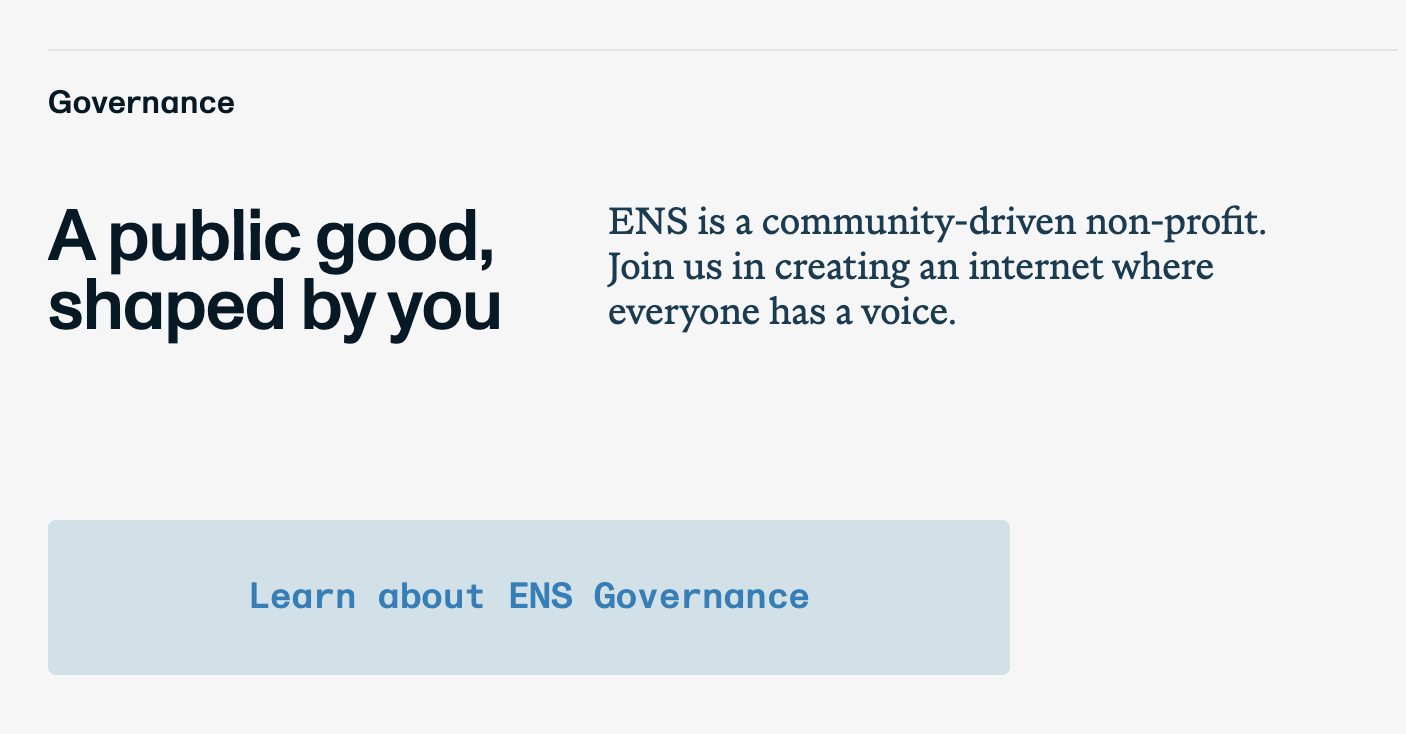
“ENS is a community-driven non-profit. Join us in creating an internet where everyone has a voice.”

This is an insincere statement if the extent of that voice is simply choosing the company that actually has a voice. Yes, non-technical people should not be making technical decisions but we can iterate on processes to resolve this - a technical working group where engineers from ENS Labs and other teams constructively collaborate to make decisions on technical direction for example.

Essentially the DAO should (in my opinion) choose and pay people with technical competence to make these high level decisions about technical direction. It could be a ‘board’ that makes these choices, but that board does need a level of impartiality otherwise it’s just bureaucratic indirection i.e. a facade.

6 Likes

This thread is circling a real problem but the framing of the initial post slips us into a false binary.

We all agree (and the retro by MetaGov + the recommendations draft @mikemetagov shared in the PG call last week show this) accountability is weaker than we want, coordination is messy, governance is overloaded. The instinct to introduce a stronger operational layer is totally valid.

But the move from that to collapsing the working group layer into a board feels like a classic austerity pattern: remove the visible complexity and assume the underlying work disappears with it. It doesn’t…

What we’re calling “overhead” is mostly coordination capacity: intake, review, prioritisation, budgeting, contributor continuity, accountability. If those functions are still required (and they are), they don’t actually go away, they just get rebuilt somewhere else, usually in a more internal and less legible form.

So many great arguments presented in this thread highlighting the need for a body that has the capacity to actually hold entities accountable and is impartial as well as the realities that when you move capital allocation you’re shifting where power actually sits and the broad implications of that. SPP, Labs, ecosystem & PG funding will still require distinct structures so they will simply be recreated by another name. Practically this isn’t simplification, it’s mere recomposition.

Bernard Lietaer talks extensively about the tradeoffs between efficiency and resilience. In his work he’s explicit that “too much efficiency leads to system crash” and that sustainable systems require balancing both forces. He also writes that efficiency tends to come from reducing diversity yet resilience comes from increasing it. I have spoken about this in the context of DAOs (his work focuses on monetary systems but the parallels are highly relevant).

A small board technically increases coordination and speed but it also reduces diversity of actors, compresses decision making and highly concentrates flows of capital and influence.

Two references here that capture the above well:

Also, reducing the number of decision makers doesn’t remove politics, it concentrates it. Influence becomes cheaper, alignment more social and decision making becomes more dependent on a smaller set of relationships. This all feels less like removing bureaucracy and politics and more like compressing them into a smaller surface.

Are we trying to actually improve the system by simplifying or just make it look simpler because what we have is imperfect at this moment in time? Because if this is a beneficial adjustment toward efficiency that’s fine but will it come with a real trade: less visible structure, less distribution of power and influence and realistically less resilience.

3 Likes

We must confront a fundamental reality: any governance stance—no matter how conservative or inefficient—can find perfect support within the vast sea of organizational theory. If we continue to rotate within these all-dimensional theoretical loops, we will only produce more elegant rhetoric rather than tangible progress.

To move ENS forward, we need to anchor our discussion in three distinct, objective facts:

  1. The Growing Risk of “Execution Debt”: While pursuing long-term protocol stability is a shared goal, stability must not come at the expense of execution. In the rapidly shifting Web3 landscape, inaction or delayed response is itself a massive systemic risk. If we cannot remain agile in the current competitive environment, all visions for “decades from now” will lose their foundational relevance.
  2. Dilution of Accountability through Structural Complexity: Our current model, while striving for procedural comprehensiveness, objectively results in blurred lines of responsibility. This structural inertia turns governance into an endless cycle of social coordination rather than the achievement of specific milestones.
  3. The Need for Differentiated Decision-Making: We must recognize that not all decisions are created equal. Subjecting minor operational tasks to the same level of complexity and weight as major protocol changes is counterproductive to the facts on the ground. This “one-size-fits-all” governance approach not only drains the community’s energy but also obstructs the efficiency of professional workstreams.

:backhand_index_pointing_up: I have a deep understanding of this point.

6 Likes