Note: This was originally posted on my blog here: Tracking the ENSv2 Rollout on ENSWhois
TL;DR: ENSv2 is deployed but not yet live. ENSWhois.com now indexes the ENSv2 smart contracts alongside v1 and every .eth name page now shows its v2 status as well as associated v2 events.
Additionally, there are three new standalone pages:
- A rollout tracker that checks each stage of the Activate ENSv2 proposal on-chain.
- A readiness page that compares every live v1 name against its ENSv2 reservation status.
- A pricing calculator for the new registrar.
ENSv2 has been deployed on mainnet since early October. Every active or in-grace v1 .eth name has been reserved on the new .eth registry, and ENS Labs runs a daily sync that carries new registrations and renewals across.
The Activate ENSv2 proposal executes various necessary on-chain actions and outlines what must happen afterwards for v2 to go live.
There are a lot of moving parts, most of it happening (and thus visible) on-chain. I wanted to be able to see it at a glance, so I built it into ENSWhois.
The Rollout Tracker
ensv2/rollout follows the five stages outlined in the proposal.
On-chain actions are verified directly and ticked off once they have occurred. Steps that depend on several things are broken down, and every contract is linked to Etherscan.
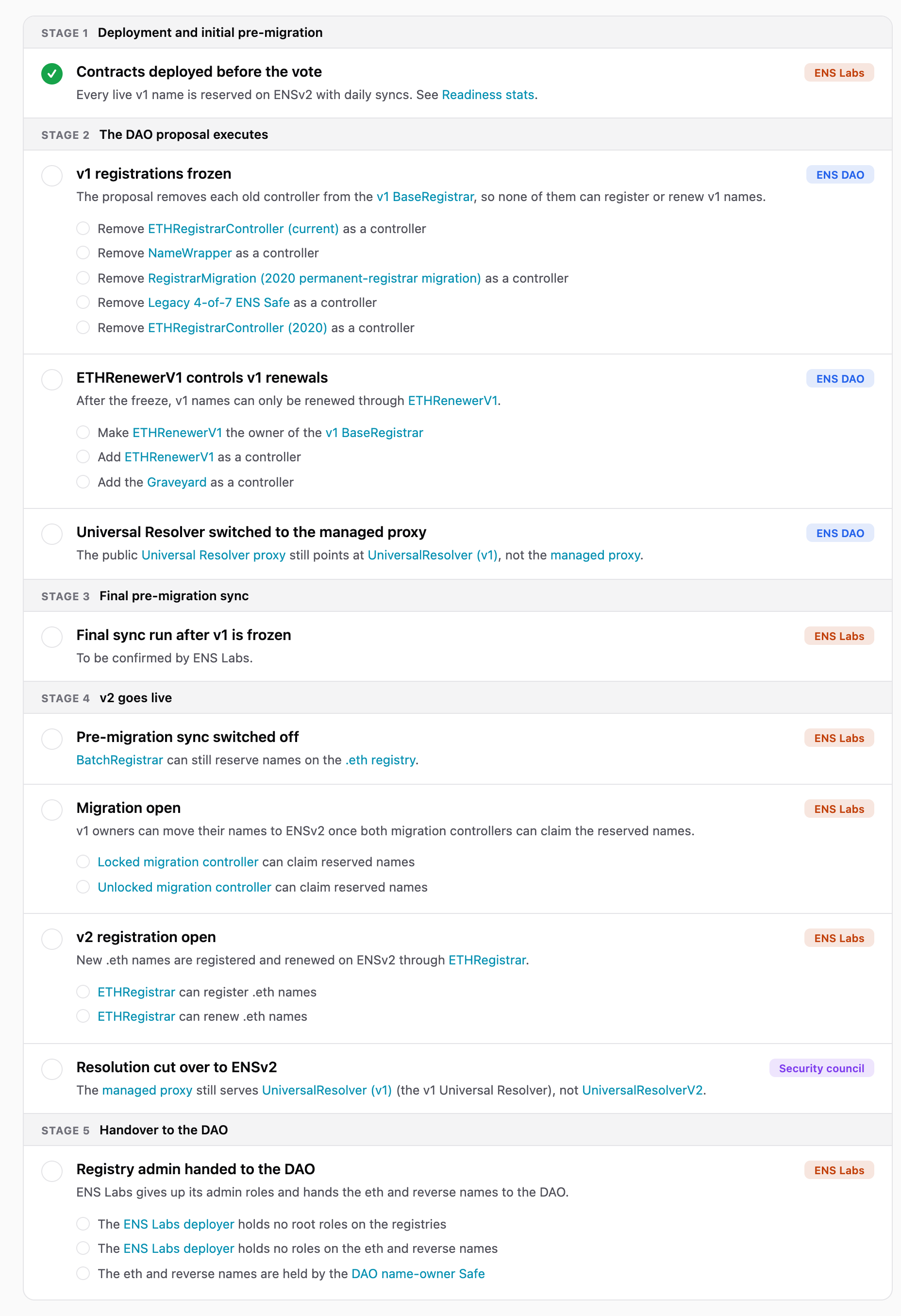
The rollout checklist on ENSWhois, grouped by the proposal’s five stages, with each step’s on-chain checks.
Steps with no on-chain receipts will be manually updated once confirmed completed by ENS Labs.
New Registries
The page also shows who controls the new eth and reverse registries.
ENSv2 uses Enhanced Access Control, which I have written about before. Permissions are roles held on resources rather than a single owner - this allows for flexible, fine grain control of individual things.
The Control tab lists every address holding a root role on each registry. Important role related considerations are flagged.
Until the handover, the ENS Labs deployer holds the eth and reverse names with every role on them, which means it can point .eth at a different registry. That is expected mid-deployment but after the handover this will not be the case.
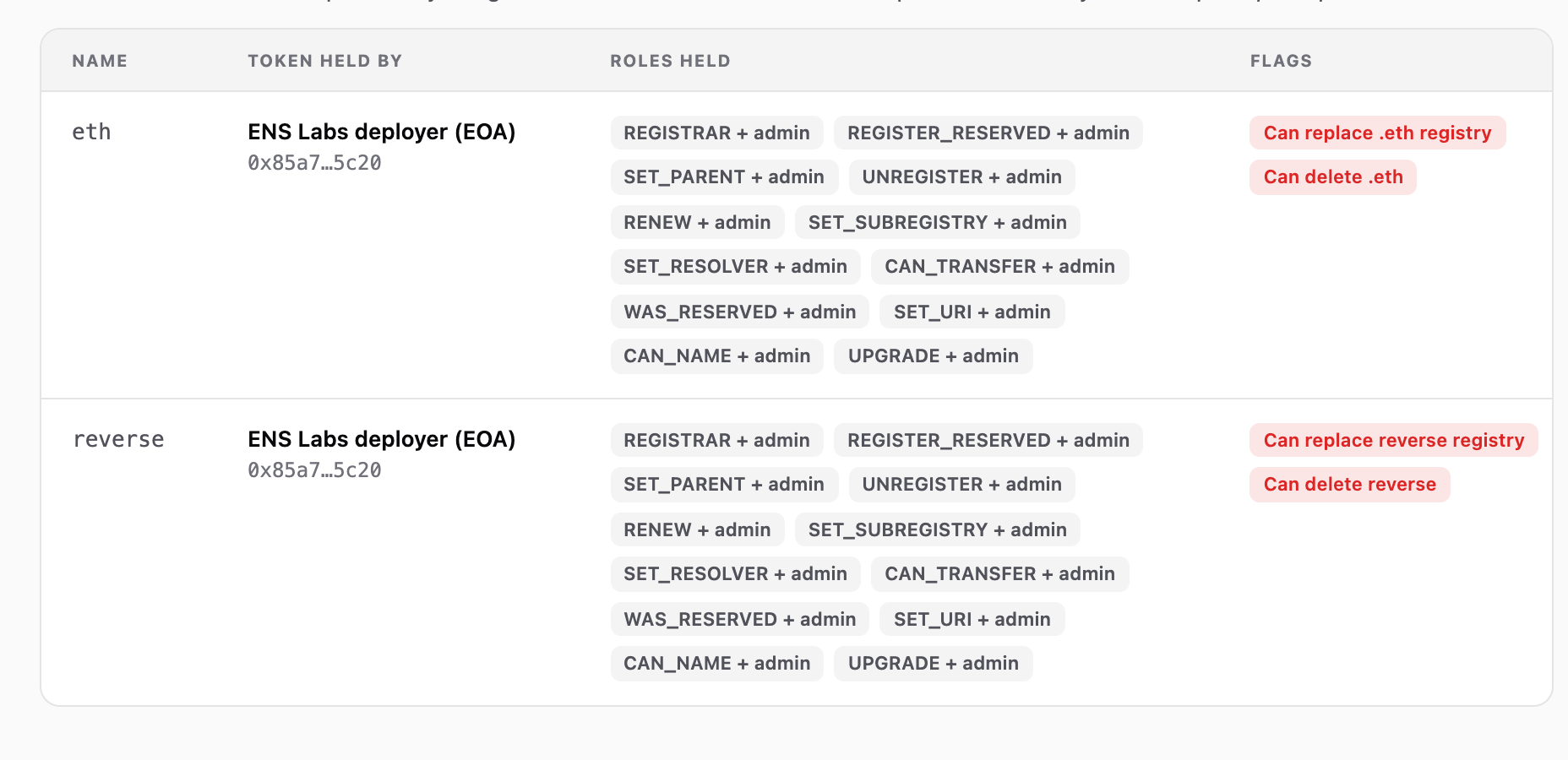
The Control tab: the roles held on the eth and reverse names, with flags where appropriate.
The tracker will show when that changes, and a Permission changes tab lists every grant and revocation as it happens.
Readiness
ensv2/readiness checks every live v1 name against its ENSv2 reservation, using ENSWhois’s own index of both registries. It updates every 30 minutes.
As of 21 October:
- 95.2% of the roughly 905,000 live v1 names are reserved on ENSv2 and in sync.
- 43,198 names are in the last 28 days of their v1 grace period, so their v2 reservation has lapsed and they don’t resolve through ENSv2. Before the resolution cutover they still resolve through v1, so nothing is broken today.
- 40,607 reserved names will stop resolving through ENSv2 within 30 days unless they are renewed.
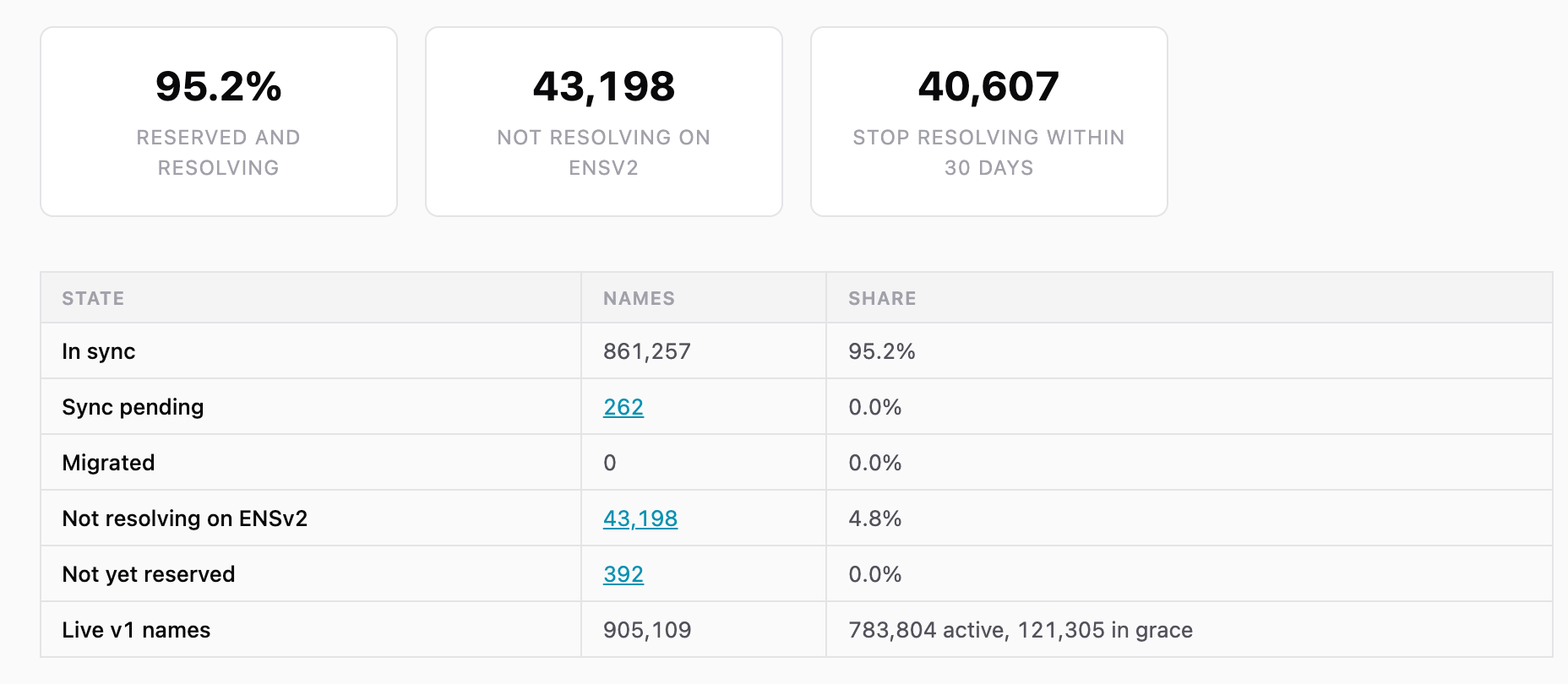
Coverage of live v1 names on ENSv2.
Every one of those counts links to the list of names behind it. The page also shows each day’s pre-migration sync run, with its transactions and the names it reserved or renewed.
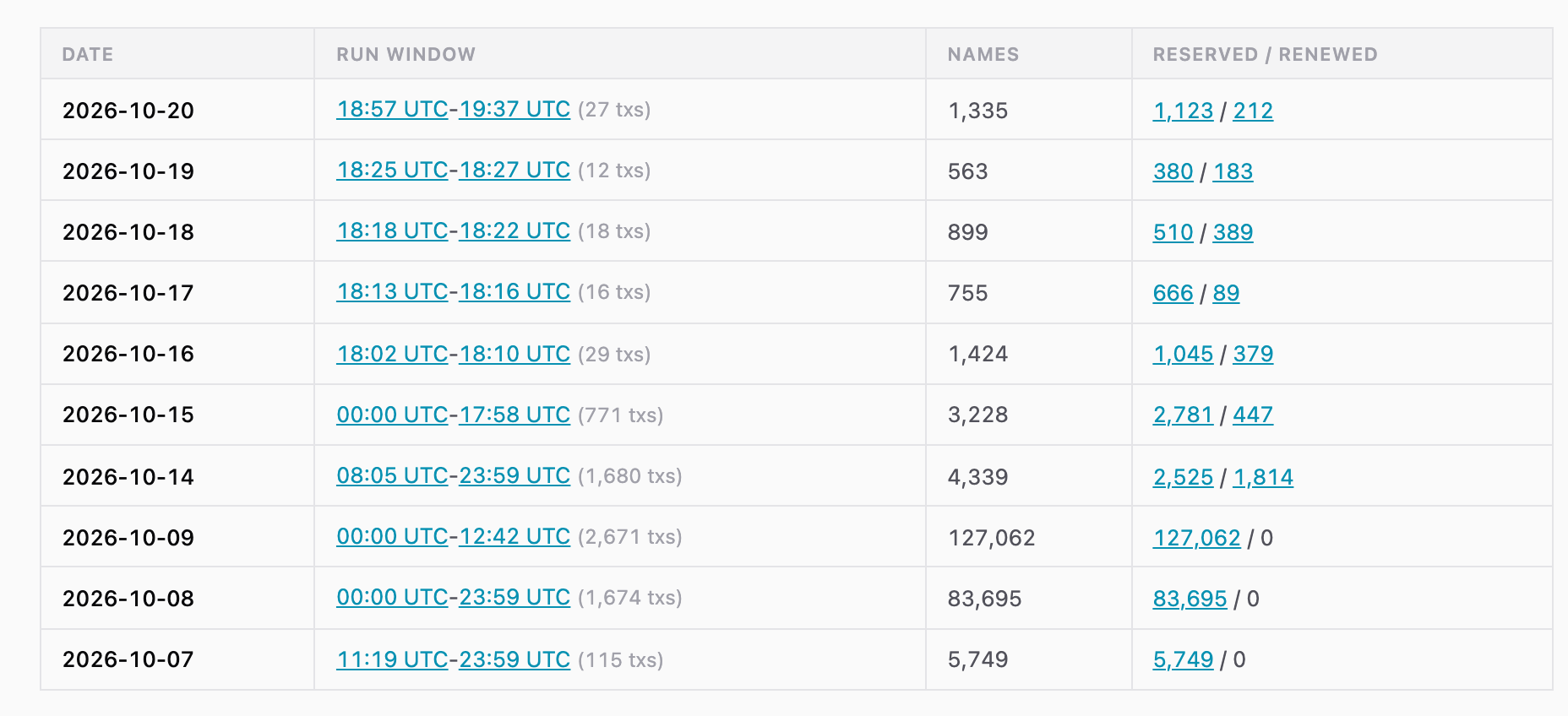
The last 14 days of pre-migration sync runs, including the bulk reservation from 7 to 9 October.
A v2 reservation runs to the name’s v1 expiry plus 62 days . ENSv2 then gives 28 days of grace, such that the name is released on the same day it would have been on v1.
A name renewed on ENSv2 keeps those 62 bonus days - it is a generous margin, applied by ENS Labs in its pre-migration sync, so that no owner loses out in the move. At ENSv2 prices those free days are worth about $1.8m across current reservations.
Pricing
ensv2/pricing is a calculator and chart for the new registrar. It runs the same calculation as the deployed price oracle, and shows the ENSv2 price for any name and term alongside what v1 charges today. ENSv2 prices are in USD, paid in USDC or DAI.
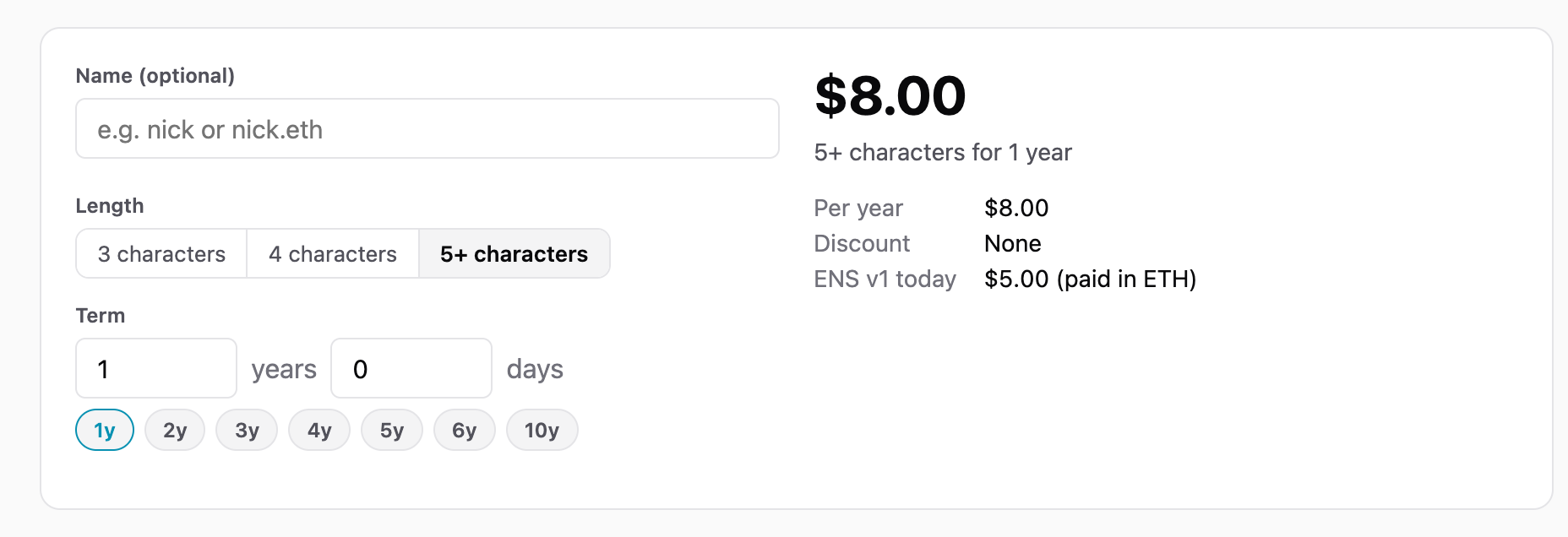
The ENSv2 pricing calculator.
In building this tool I noted a seemingly unobserved intricacy to the pricing mechanism passed in EP 6.43 - it is possible with the current Oracle to pay more for a shorter renewal. The chart shows this phenomenon, and I have written up a temperature check to discuss this further.
Every Name
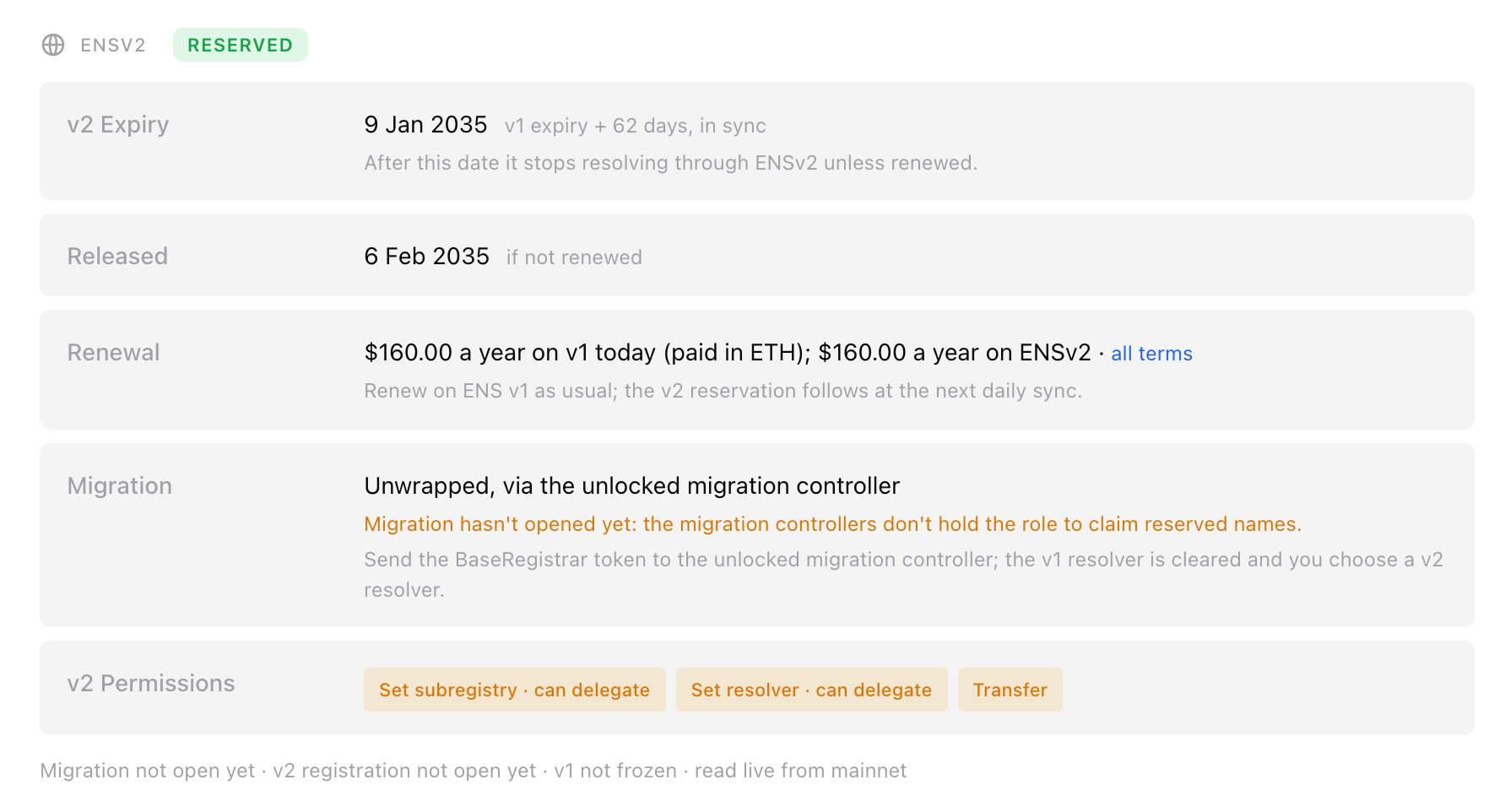
Each .eth name page on ENSWhois now has an ENSv2 section that outlines:
- Whether the name is reserved and in sync
- When it stops resolving through ENSv2
- When it is released
- What a renewal costs
- The migration path for the name
The last point depends on whether your name is wrapped or not, and consideration must be given to the fuses burned on wrapped names. The page shows which migration path applies, the roles the name ends up with, and anything that would block it.
ENSv2 events also appear in the name’s history alongside its v1 events.
For Developers
All of this is available through the ENSWhois API:
GET /domain/:name/ensv2returns a name’s ENSv2 status, read live.GET /ens-stats/ensv2returns the readiness figures, with the name lists behind them.GET /ens-stats/ensv2/rolloutreturns the rollout checklist and role holders.
The ENSWhois MCP server has an ensv2_status tool as well, so an AI agent can ask where a given name stands.