[Draft] [Executable] Next Era of ENS DAO: Empowering the ENS Foundation
| Status | Active |
| Votes | Cactus |
| Author | katherine.eth |
| Temp check | [Temp Check] Next Era of ENS DAO: Empowering the ENS Foundation |
Abstract
This executable proposal establishes the ENS Foundation as an operating foundation, led by a full-time Executive Director and staff, and governed by a five-seat board ratified by the DAO, as set out in the temp check posted June 19. It follows public discussion of that temp check and tightens the scope of the Foundation’s mandate in several areas in response to community feedback: the DAO’s ENS tokens stay under tokenholder control, the operational wallet stays where it is, and Endowment transactions gain a timelock with Security Council oversight.
Main changes from Temp Check in detail:
(1) ENS tokens stay exactly where they sit today, under the same onchain mechanism and the same tokenholder control they are subject to now, and this proposal transfers no general authority over them. There is one exception: a single transfer of 1,000,000 ENS, restricted to Foundation employee compensation to support the Foundation in funding future employee compensation as the Foundation matures. Any future use of DAO-held tokens beyond this transfer, including for ecosystem programs, will be decided by the DAO as its own proposal through the standard governance process.
(2) The operational wallet (wallet.ensdao.eth, approximately $16 million in ETH and stablecoins as of July 2026), which the temp check proposed delegating, stays with the DAO in its current place, with existing streams continuing to draw from it.
(3) Treasury management is implemented with a dedicated security layer: the Foundation Board, acting through approved signers, assumes administrative control of the Endowment Safe (endowment.ensdao.eth, approximately $65 million in ETH and stablecoins as of July 2026), with all Endowment transactions passing through a timelock by default, and an ability for the Security Council to cancel any timelocked transaction.
Tokenholders will retain protocol control along with the authority over appointment and removal of Foundation directors. Every modification made from the original temp check moved in the direction of was done in consideration of maintaining tokenholder control and security.
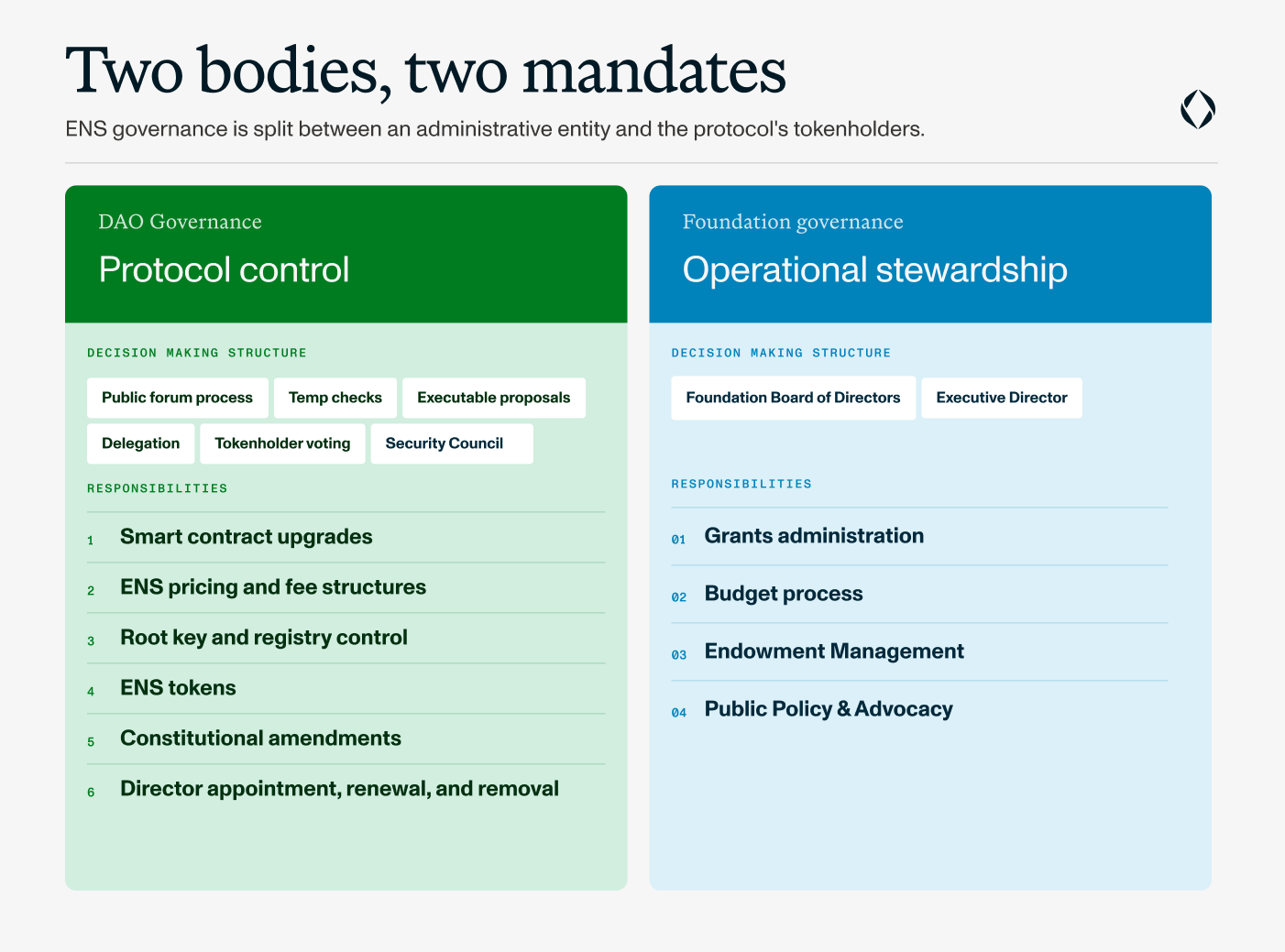
This proposal addresses Foundation governance and operational stewardship only. It does not transfer protocol control. For clarity, Foundation governance means the Cayman foundation company’s board, Executive Director, staffing, grants administration, budget process, and Endowment stewardship. DAO governance means the public forum process, temp checks, Snapshot votes, executable proposals, delegation, and tokenholder voting. Protocol control means smart contract upgrades, ENS pricing and fee structures, root key and registry control, DAO-held ENS tokens, constitutional amendments, and director appointment, renewal, and removal. Protocol control remains exclusively with ENS tokenholders.
Motivation
The full problem statement, the research on comparable open-source foundations, and the reasoning behind this structure are in the temp check and its discussion thread. Onchain tokenholder governance is best suited for protocol-level decisions, constitutional authority, director appointment and removal, and other matters requiring broad legitimacy. Day-to-day operations, budgeting, staff management, grants administration, policy engagement, and vendor oversight require accountable execution within a legal entity that remains answerable to tokenholders. This proposal maintains protocol control, ENS tokens, and director appointment and removal with tokenholders, and moves operational and budgetary stewardship into a Foundation that remains structurally accountable to the DAO.
For the sake of clarity, ENS Labs remains a separate Singapore-based entity with its own leadership and board. Participation by ENS Labs personnel in developing this proposal does not grant ENS Labs any governance right over the Foundation, the Endowment, DAO-held ENS tokens, protocol upgrades, fee structures, or director appointment and removal.
The Foundation Structure
The ENS Foundation becomes a fully operational foundation, led by a full-time Executive Director and staff, stewarding the ENS mission and values. The Foundation will hold the ENS trademarks, brand assets, and other intellectual property. ENS Labs continues to operate independently under its own leadership and its own board, with the Foundation licensing the ENS trademarks to Labs and funding Labs through the existing grant relationship. The Foundation is responsible for its mission, grants program, and stewardship of the protocol’s revenue and Endowment.
The Foundation represents ENS where policy and standards are made: active participation in ICANN, IETF, W3C, and adjacent forums, pursuit of recognition and stewardship of the .ens TLD at ICANN, regulatory engagement on policy questions affecting ENS and decentralized naming, the institutional and legal-process counterparty role for the protocol layer, and trademark and brand enforcement. The full advocacy mandate is described in the temp check. Staffing needs will be projected once the Foundation is stood up, and job applications will be made public.
Protocol Control Remains with Tokenholders
Protocol control such as smart contract upgrades, ENS pricing and fee structures, root key and registry control, the DAO’s ENS tokens, and constitutional amendments remain exclusively with tokenholders. The Foundation has no role in protocol governance decisions. Director appointment, term renewal, and removal also remain with tokenholders, under the Foundation’s Articles of Association, unchanged by this proposal.
Foundation Leadership and Board
The Foundation Board has five voting seats:
- One voting seat for the Founder of ENS, Nick Johnson, with succession to a designated ENS Labs representative in the event of the Founder’s resignation or departure from the Board.
- One voting seat for the Foundation’s Executive Director.
- Three voting seats for independent directors.
The Executive Director (ED) is a full-time Foundation employee and voting Board member who leads Foundation operations and the grants program, with day-to-day authority subject to Board oversight, approved budgets, conflict-of-interest requirements, and the onchain controls in this proposal. The ED cannot unilaterally transfer Endowment assets, alter protocol control or ENS token permissions, or bind the Foundation outside approved authority. The Board holds exclusive authority over the ED’s employment, with compensation set annually by the three independent directors, the ED and Founder recused. Independent directors serve two-year terms renewable by the DAO and are compensated at 40,000 USDC per year, donated to a non-profit or public good of their choosing if declined.
Following a search process led by the existing ENS Foundation Board with input from ENS Labs leadership, the proposed inaugural slate is:
- Executive Director: Alexander Urbelis
- Director: Nick Johnson
- Independent Director: Kartik Talwar
- Independent Director: Brett Sun
- Independent Director: Anthony Leutenegger
Bios for each nominee, including baseline disclosure of material affiliations requiring recusal, are in the temp check.
Furthermore, this proposal adds a documented process for exercising Director removal authority so that removal is legible and follows a clear process. The Foundation’s bylaws will set out a standard process for tokenholder removal petitions: (i) a petition states the grounds for removal with supporting evidence; (ii) the petition is filed with the Foundation Board, which has a defined window to respond before a tokenholder vote is called; (iii) a 30-day period applies between petition and vote; and (iv) the director under petition may publish a written defense alongside the petition. These steps are designed to create notice, a documented record, and a fair opportunity to respond. They do not condition or limit tokenholders’ removal authority under the Foundation’s Articles: a removal vote validly conducted under the Articles is effective whether or not this process was followed, and no Board action or inaction under this process can delay or prevent it.
Conflicts of Interest
The Foundation will adopt, as Exhibit A to this proposal, an interim Conflict of Interest Policy effective upon adoption of this proposal. The interim policy requires written disclosure of actual and potential conflicts, recusal from deliberations and votes where appropriate, public recording of disclosures and recusals, and independent-director approval for ENS Labs funding. Within 90 days, the Executive Director will present a refined policy for Board approval and public publication.
Revenue and Treasury
Stewardship of the DAO’s operating capital, meaning the Endowment and the Endowment Manager relationship, is delegated to Foundation governance consistent with Article III of the DAO Constitution. This proposal changes administrative control of the existing Endowment Safe so the Foundation Board, acting through approved signers and subject to the timelock and Security Council cancellation right described below, oversees execution of Endowment transactions. This means no ETH or stablecoins are transferred by this proposal; the assets remain in the existing Endowment Safe at the same address.
Alongside this change, a timelock is added to all Endowment transactions by default, and the Security Council can cancel any timelocked transaction. The Security Council cancellation right is included as a technical safeguard against unauthorized, erroneous, malicious, or mandate-inconsistent Endowment transactions. It is not a general governance veto over Foundation policy, Board judgment, approved budgets, or ordinary implementation of a ratified DAO proposal. The Security Council’s cancellation function over Endowment transactions is conferred by this proposal and the Safe configuration, and does not amend the Security Council Charter.
The Endowment Manager’s existing investment-management permissions remain unchanged. Any permission to transfer funds from the Endowment Safe to the Foundation multisig without timelock will be limited to approved budget funding and subject to recipient restrictions, Board approval, public reporting, and any technical controls specified in the Transactions section. The Foundation will not receive any general, uncapped, or discretionary non-timelocked withdrawal authority. The DAO operational wallet remains in its current place, with existing streams continuing to draw from it.
The Foundation will receive no operating funding under this proposal until the Executive Director has presented a projected budget to the Board and a high-level version has been published to the DAO forum. Pending that publication, aggregate transfers from the Endowment to the Foundation may not exceed USD 500,000, covering standup costs only. The first annual budget will be published within 60 days of adoption, and annual Foundation spending thereafter is bounded by the published budget.
The ~54.6 million ENS tokens the DAO owns stay under the existing onchain mechanism and tokenholder control. The single exception is the 1,000,000 ENS transfer for Foundation employee compensation, administered under a Board-approved compensation framework published before any grant is made: multi-year vesting, independent-director approval for any grant to the ED or a director, annual public reporting of aggregate token compensation, and reversion to the DAO treasury of any tokens ungranted at wind-down or recalled by DAO vote. Pending grants, the tokens will not be voted, delegated, lent, pledged, transferred to ENS Labs, or used to compensate ENS Labs personnel. Any other use of DAO-held tokens comes to the DAO as its own proposal through the ordinary governance process.
For the avoidance of doubt, this proposal does not transfer beneficial ownership of ETH, stablecoins, or DAO-held ENS tokens to any director, officer, employee, ENS Labs, or other private party. The Endowment remains dedicated to the ENS mission and subject to the Foundation’s obligations, approved budgets, reporting commitments, technical controls, and tokenholder-retained protocol authority.
Grants & Working Group Transition
Any grant-making is consolidated under the Foundation’s Grants program, focused on public goods and core infrastructure benefiting the ENS protocol and the broader Ethereum ecosystem. The Foundation works alongside the SPP Committee on SPP3, and going forward, SPP is absorbed into the Grants program, and reporting requirements for SPP recipients do not change. Existing stewards, active streams, and current-term commitments are honored through their natural conclusion, with a transition plan covering SPP3 disbursements, Endowment Manager continuity, and the working group wind-down developed collaboratively with all parties once the Foundation is stood up. No existing stream, award, or current-term commitment may be reduced, paused, or re-conditioned except per its own terms or with the recipient’s consent.
Specification
The only ENS token transaction in this proposal is a single one-time transfer of 1,000,000 ENS to the Foundation, restricted to Foundation employee compensation. No other transaction moves, delegates, or re-permissions ENS tokens held by the DAO.
Transactions
Edited 08/03/2026 to add in contract addresses:
We’ve deployed new instances of two existing audited contracts:
- OpenZeppelin’s Timelock Controller to
0x0bcC3dA6aD796F59288C0961602675E88A2B406C - Blockful’s Security Council to
0x0A9387643ce6291f8C545286675D76bCd0Ba3EdD
The new Security Council contract is owned by the existing Security Council Safe at 0x7101B78638e34444F0a5AdE9e1149fbEeC029931, and targets the new Timelock Controller listed above.
This proposal updates the signer of the existing Endowment Safe at 0x4F2083f5fBede34C2714aFfb3105539775f7FE64 to be the new Timelock Controller. The Timelock has a 9 day delay, during which the Security Council can veto the Foundation’s proposals to the Endowment. The exception is existing permissions approved by the DAO in previous proposals.
Separately, this proposal transfers 1 million ENS tokens directly to the Foundation Safe. These are not subject to the Timelock delay.
Calldata below:
Target: 0xC18360217D8F7Ab5e7c516566761Ea12Ce7F9D72 (ENS token)

Function: transfer(address recipient, uint256 amount)

Arguments:
- 0x9C7dB6B1085ec4D07f75c0BD91AD3FcD368fA19E (Foundation Safe)
- 1000000000000000000000000

$ cast calldata "transfer(address,uint256)" 0x9C7dB6B1085ec4D07f75c0BD91AD3FcD368fA19E 1000000000000000000000000
Target: 0x4F2083f5fBede34C2714aFfb3105539775f7FE64 (Endowment Safe)

Function: execTransaction(address to, uint256 value, bytes data, uint8 operation, uint256 safeTxGas, uint256 baseGas, uint256 gasPrice, address gasToken, address refundReceiver, bytes signatures)

Arguments:
- to: 0x4F2083f5fBede34C2714aFfb3105539775f7FE64 (Endowment Safe self-call)
- value: 0
- data: 0xe318b52b0000000000000000000000000000000000000000000000000000000000000001000000000000000000000000fe89cc7abb2c4183683ab71653c4cdc9b02d44b70000000000000000000000000bcc3da6ad796f59288c0961602675e88a2b406c (swapOwner calldata)
- operation: 0 (Call)
- safeTxGas: 0
- baseGas: 0
- gasPrice: 0
- gasToken: 0x0000000000000000000000000000000000000000
- refundReceiver: 0x0000000000000000000000000000000000000000
- signatures: 0x000000000000000000000000fe89cc7abb2c4183683ab71653c4cdc9b02d44b7000000000000000000000000000000000000000000000000000000000000000001

$ cast calldata "execTransaction(address,uint256,bytes,uint8,uint256,uint256,uint256,address,address,bytes)" 0x4F2083f5fBede34C2714aFfb3105539775f7FE64 0 "$(cast calldata "swapOwner(address,address,address)" 0x0000000000000000000000000000000000000001 0xFe89cc7aBB2C4183683ab71653C4cdc9B02D44b7 0x0bcC3dA6aD796F59288C0961602675E88A2B406C)" 0 0 0 0 0x0000000000000000000000000000000000000000 0x0000000000000000000000000000000000000000 0x000000000000000000000000fe89cc7abb2c4183683ab71653c4cdc9b02d44b7000000000000000000000000000000000000000000000000000000000000000001
Exhibit A:
Interim Conflict of Interest Policy
1. Purpose and status
This interim policy takes effect on adoption of this proposal and governs the ENS Foundation Board and Executive Director until the Board approves the detailed Conflict of Interest Policy contemplated within the first 90 days. That later policy refines this one; it does not replace it with anything weaker. Any material change to this policy is published before it takes effect.
2. What counts as a conflict
A conflict exists when a director’s or the ED’s personal, financial, or professional interests could reasonably appear to influence their judgment on a Foundation matter. This includes, without limitation: a current role, employment, or compensation at an entity that receives Foundation funding; a financial interest in a grant applicant, service provider, or counterparty; a family or close personal relationship with any of the foregoing; and any matter concerning the person’s own compensation, employment, or removal. Appearance matters: if a reasonable community member would question the person’s impartiality, it is treated as a conflict.
3. Disclosure
Each director and the ED discloses actual and potential conflicts in writing: (a) on appointment, as a baseline disclosure of material affiliations; (b) at each Board meeting, as to any agenda item; and (c) promptly when a new conflict arises. Disclosures are recorded in the Board minutes and published with them.
4. Recusal
A conflicted person does not vote on the matter and does not participate in the Board’s deliberation of it, beyond answering questions the non-conflicted directors ask. Recusals are recorded in the minutes and published. The following recusals are standing and automatic:
· Any director or the ED, on any matter involving an entity in which they currently hold a role, employment, compensation, equity, or other financial interest.
· The Founder seat, on any matter concerning ENS Labs funding, for so long as the seat carries succession to an ENS Labs representative.
· The ED on all matters concerning the ED’s own employment, compensation, or performance.
· Any director on their own compensation, renewal, or removal.
Prior roles or employment that have ended are disclosed in the public register under Section 6 but do not by themselves require recusal.
4A. Related-party decisions
Any decision concerning ENS Labs funding, in addition to any Board majority, requires the affirmative vote of a majority of the independent directors voting on the matter.
5. Quorum and decision on conflicted matters
A matter on which one or more members are recused is decided by majority of the non-recused directors, provided at least two non-recused directors participate. If recusals leave fewer than two, the matter is deferred until the Board has obtained independent advice on the matter, and the advice and the ultimate decision are recorded in the published minutes.
6. Public record
All disclosures, recusals, and votes on conflicted matters are recorded in the minutes and published. The Foundation maintains a public register of each director’s and the ED’s material affiliations, updated at least quarterly.
7. Gifts and personal benefit
No director or the ED may accept any gift, payment, or benefit offered to influence a Foundation decision, or use Foundation position, information, or assets for personal benefit. Gifts above a nominal value connected to Foundation business are disclosed and declined or surrendered to the Foundation.
8. Attestation
Each director and the ED signs an annual written attestation of compliance with this policy, published with the Foundation’s annual reporting.