The ENS Ecosystem Working Group holds bi-weekly calls. The calls are open to community members and the general public.
The ENS Ecosystem Working Group calls are led by the lead steward of the working group. The current lead steward is Donnie (@don.nie). If you need to get in touch with Donnie, please message him on the forum.
How to Add to Weekly Agenda
If you have items that you would like to add to the weekly agenda please message any of the ENS Ecosystem stewards (@don.nie, @slobo.eth, @dylanb) through the messaging feature on this forum.
How to Use this Thread
Agenda will be posted along with call summaries. Please do not post in this thread unless requested by one of the Stewards.
Unruggable team is working on Interoperable addresses within the Ethereum ecosystem.
The IP is considered close to being final after a few iterations.
It addresses gaps in specifying chain-specific addresses within CAIP (Chain Agnostic IPs), specifically CAIP-2 and CAIP-10.
The goal is to allow users to send money (e.g., USDC on Base) using an address that specifies the network, ensuring it goes to the correct chain without extra instructions.
The goal is to support cross-chain messaging and interoperability with other ecosystems, including Solana, using one standard for addressing intents across all blockchains.
The project aims to create a specification for storing metadata on ENS
Working on ENSIP and will publish it in the future
It introduces two new general text records:
Class record that defines an ENS name as a person, org, agent, treasury, etc.
Scema record allows people to put in a URI pointing to a JSON schema, which explains what additional metadata attributes, more importantly, context-specific attributes, could be added to that node as well to make it discoverable programmatically.
Community feedback is being gathered.
One use case could be putting Delegate Statements onchain, also conflict of interest can be published for different DAOs, creating a decentralized registry of delegates and their positions.
Marcus discusses the ENS x AI TG group chat started by Cap and Premm.
Shared a post from the National Institute of Standards Technology regarding securing AI agent systems and an AI agent standard initiative.
NIST sets cryptographic and identity standards used across government and enterprise.
Aligning with the NSIT positions ENS as a credible bridge between decentralized identifiers and regulated identity systems.
The CTA is to align on a minimal ENS agent profile and discovery pattern, and publish it as a draft as reference architecture, and submit it as an input to these RFIs that the NIST is opening up discussion for.
Organizational metadata standard is mentioned as a solution promising standardization of how to express all metadata about ENS names and what they identify.
Work in the ENS x AI chat so far has been working with everyone and defining a specific direction when things become clearer in AI agents and crypto.
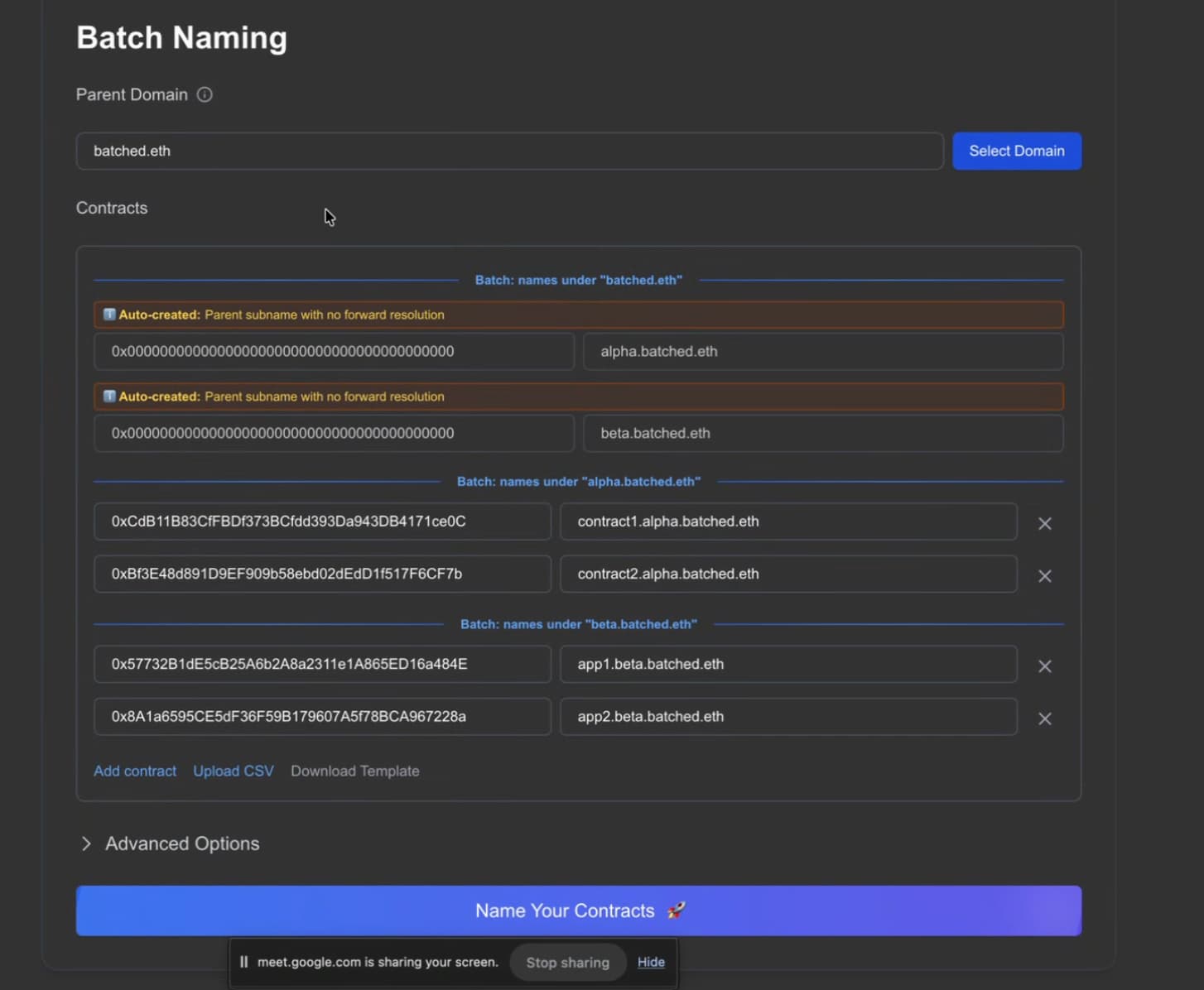
ENScribe widget on Blockscout explorer in the contract details page
It displays the identity score for that particular contract
ENScribe has added an AI agent to simplify the usage of its app
The AI agent can name a contract
The AI can answer questions about ENS-related stuff
3. Review Upcoming Events
ETHMumbai (Labs and Namespace teams will be there)
ethCC (more announcements soon)
4. ENSIP Updates
ENSIP-25 was recently merged
Allows for verifying the ENS name of an agent using the 8004 registry
ENSIP-26 brief overview
It’s about unifying multiple registrations of an agent across multiple chains
Uses a single text record called Agent context
Integrating ENS and payments into Clawdbot would be a top priority
ENS provides a neutral, decentralized, verifiable platform for agent context
ENS is the premier solution for creating decentralized agents, eliminating platform risk
Ethereum and ENS can be the home for a neutral platform for agent identity
5. Space for Service Providers
5.1. Justaname
Jaw ID is a smart account infrastructure built on top of JustaName infrastructure.
It gives builders the tooling to deploy onchain accounts with ENS from the start.
Integration can be done via the WAGMI connector or in a headless mode.
It can issue reusable wallets across platforms or app-specific wallets tied to the app’s domain.
Uses passkey signing.
Users can pay gas fees with stablecoins like USDC.
All signing is done via passkey, verified onchain.
The permission system enables advanced workflows, allowing users to authorize AI agents or servers to perform actions on their behalf.
Users can set spending limits and approve specific contracts and functions for agents.
This system can facilitate DeFi strategies or subscription models that are difficult to implement with regular accounts.
When coding with AI agents, the system uses smart routing to provide only necessary context.
The wallet is designed for tradfi companies entering web3, providing onchain accounts with a Web2-like experience (biometrics, ENS names, USDC for gas).
The goal is to enable these companies to issue onchain accounts for their users while maintaining self-custody.
Q: Is there a Subname label data internal database maintained by the ENS Labs, because the ENS app displays subnames registered on L1, but the graph and ENSNode lack label data.
No internal database; the data is stored locally in the browser’s local storage.
The Manager app saves a mapping of the string to the hash.
The ENSNode may provide a way to contribute labels.
Over 200% delivery rate between proposed and delivered work
Launched ENS Omnigraph API, which supersedes the legacy ENS subgraph.
EnsDB: enabling it as a new category of integration point for projects building on ENS
ICANN has officially approved participation in the upcoming new gTLD program
They are excited about the new TLD application, which is highly ENS and Ethereum aligned.
The Applicant Support Program waives up to 80% of the total application fee
6. Open Space for Additional Topics
Service providers should open a pull request on the ENS DAO SPP GitHub to keep information updated and help with accountability (displayed on Anticapture website)
There is a major discussion happening around empowering and forming a larger board in the ENS foundation to make service providers and working groups accountable.
Stewards elections: It’s not clear when the steward elections will be rolled over.
MetaGov calls will be weekly again for the next few weeks due to ongoing discussions.
Building ENS Node as a Full Stack Development Platform
Apps can integrate with ENS Node to be ENSV2 ready at launch.
Current Methods for Apps to Get ENS Data
ENS resolutions generally go straight to RPCs, using libraries like Viem.
Index DNS data requires querying indexed ENS data.
When a CCIP read gateway is involved, apps query off-chain resolver records to CCIP read offchain gateway servers.
In ENSv1 people used Graph Node to index the data, producing the ENS subgraph data model inside a database.
This caused complexity and bugs for developers.
ENS Subgraph was a single chain only, and left data from other chains unindexed.
For example Basenames, Lineanames, ccip-read offchain subnames, etc.
ENS Node is composed of multiple services, including ENS Indexer and ENS API
ENS Indexer is a multi-chain indexer that unifies name tables across multiple chains into a single, backwards-compatible ENS subgraph data model.
ENSv2 indexing
ENSv2 doesn’t replace ENSv1; both will coexist
The data model for ENSv2 names is different from ENSv1.
ENSv2 data model is referred to as “name graph”.
ENS Indexer has a new plugin called the Unigraph Plugin
The Unigraph Plugin unifies name tables and name graphs into a single data model for both ENSv1 and v2.
ENS API exposes the Unigraph data model as the ENS Omnigraph, an API-level data model.
ENS Omnigraph API exposes resolutions for ENS, allowing users to query all ENS state through one API.
There’s also ENS SDK (TypeScript client) and ENS Kit (React library) for faster implementation.
ENSDb
ENSDb is an open standard for building custom services on top of ENS
ENS Analytics and API are being built on top of ENSDb.
ENS Engine will be built on ENSDB
Built to be extensible with ENS indexer plugins so anyone can create their own custom plugins which creates their own custom state models and their own extensions to the Omnigraph API.
It takes a massive amount of RPC calls that costs a lot of time and money to fully build an index of ENS.
There is a close relationship with the ENS Labs team, with regular sync-up calls.
6. Open Space for Additional Topics
A proposal for a new working group structure will be published based on feedback, with a tight timeline.
The current plan is to have a single working group with an extended mandate
Significant effort is put into ensuring ecosystem readiness for ENSv2, including smooth resolution of names and data from new registrations, and improved support for offchain and non-ETH TLDs.
ETHConf is coming up, and the ENS Labs team will be there
ENSv1 and ENSv2 will exist in parallel, necessitating a new data indexing solution
The existing ENS subgraph does not support resolution and is blind to ENSv2, leading to applications “breaking their ENS resolutions” and requiring developers to manually combine data from different APIs.
Raw resolution APIs are too complex for most developers, often resulting in errors in decoding, validating, and normalizing resolver records.
The ENS Omnigraph API unifies ENSv1 and ENSv2 into a single state model and API, addressing current resolution issues.
It provides an abstraction layer to simplify resolution queries and responses for 99% of use cases, eliminating the need for developers to handle complex details like coin types or specific record keys.
The API intelligently decides whether to query RPC nodes or use cached index data for resolutions and offers “RAW records resolution” for specialized use cases.
ENS Node is designed for easy self-hosting and features an architecture that decouples the index data model from API exposure using ENSDb and ENS Node plugins
Edge & Node is invited to contribute by building a better, faster implementation of the ENS Indexer, specifically an ENSDb writer aligned with the ENS Unigraph index data model to ensure compatibility with the ENS Node stack.
6. Open Space for Additional Topics
The grants program status remains TBD
It depends on decisions regarding the future of the working groups.
 New Meeting Link and Schedule for 2026