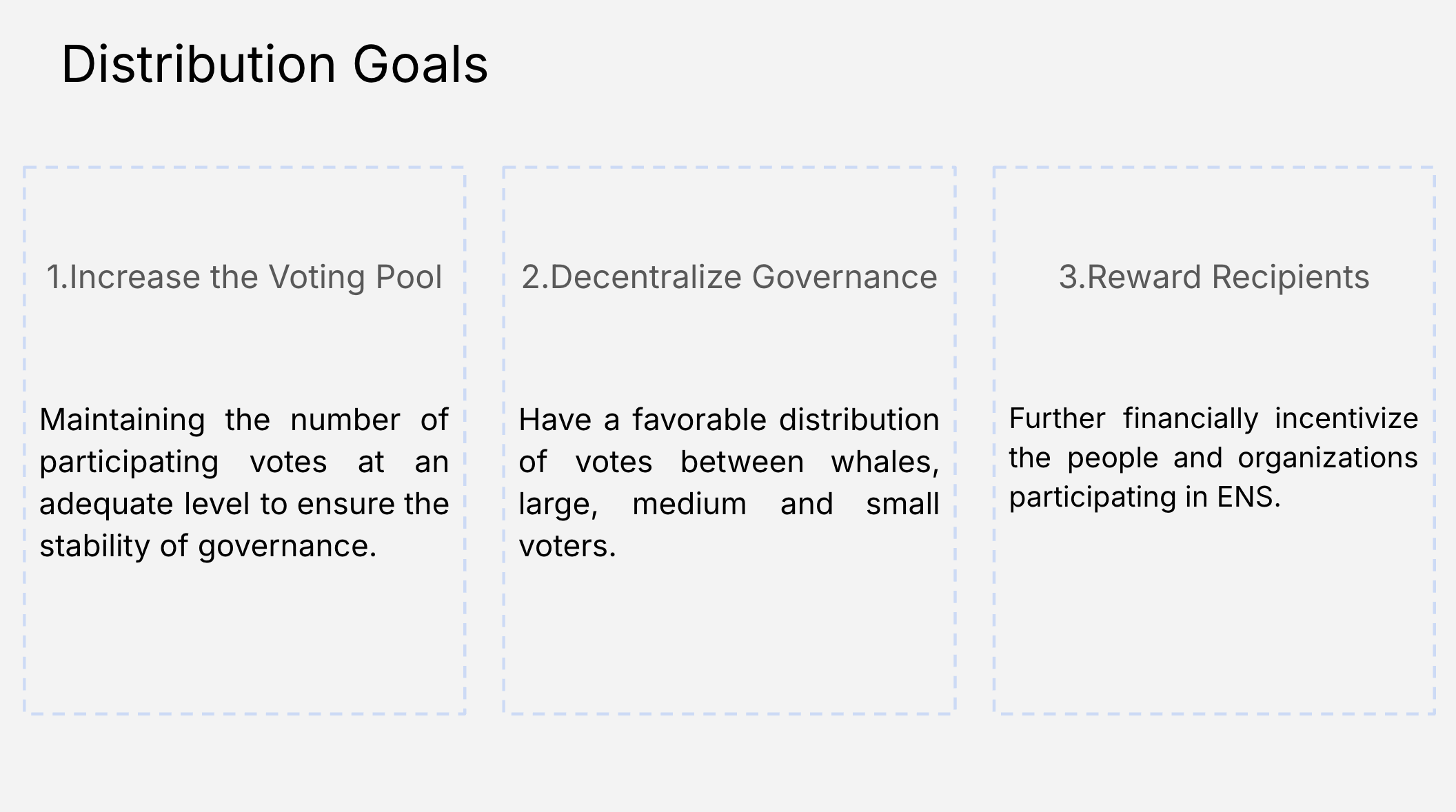
In the last year and a half, since the first distributions conducted through Hedgy, an average of 88,000 votes were added to each vote, representing 6.5% of the total number of votes.
13 new voters were added with a combined voting power of 48,000
High inactivity among EP [5.19] distribution recipients was identified.
ENS is doing a good job of distributing tokens, generally speaking.
All distributions in ENS could be made using a vesting format if you want to not only reward participants but also retain votes in the pool.
Move to a format where the cliff occurs only after delegation or even after the first voting in order to also increase the involvement of recipients in ENS governance.
The DAO needs a general statement on token distribution
A move towards a little increase in centralization was a byproduct of people delegating to existing large delegates.
Data metrics were verified from Dune (cross-validated using Etherscan).
Consider changing the token allocation ratio for service providers.
Service provider distribution has the highest quality because about 70% of tokens are used in voting.
Language vs. mechanics: ENS’ constitutional language about not infringing name-owner rights can sound like “perpetuity,” even though the mechanics are term-limited with expiry. That messaging gap alone is triggering policy anxiety.
Dispute resolution parity: Without a built-in, binding UDRP-style pathway, brands and rights-holders lack a familiar, enforceable mechanism to recover abusive registrations. That’s a notable divergence from ICANN norms.
Governance priorities: "Integrate with DNS without sacrificing decentralization” is philosophically sound for web3, but for ICANN it raises the question: When these values collide, who yields?
More to be discussed in the upcoming Weekly Public Goods call.
A group was formed with WG stewards and Labs to discuss retrospectives.
The idea is to do a retro on all SPs and WGs to look at what was aimed to be achieved, what the goals were, and how the goals were addressed.
The proposal might push back WG elections and the SPP by 3 months.
Different levels of reporting and accountability across the WGs and SPP.
Standardizing the levels of accountability across the working groups would be a good outcome, and see what working groups are already doing and what still needs to be done.
There is concern about changing the election cycle so close to the election.
SPs may have feedback but are not yet involved in the group discussions.
The idea is to retrospectively look at how spending, activities, and outcomes have been listed.
It might be decided that it’s important enough to reschedule elections so that the results of the retro could be taken into account before those elections happen.
One clear outcome is improving the SPP vote process.
Another outcome is a more built-out version of the ENS year in review.
A third outcome is having a single place to look at all the different programs and initiatives that the ENSDA has achieved.
The goal is not to scrutinize working group work but to use it to take things to the next level.
The overall intention is to have some sort of mechanism or routine for evaluation and to keep the DAO accountable.
There is a question of whether the evaluation should be done independently, in-house, or a combination of both.
A feeling that changing rules with short notice creates disruption and instability.
There will be a session at DevConnect where delegates and working group leads can continue the discussion.
The discussion will also be held publicly on the forum soon.
Marcus discussed the basic site to adopt a decentralized approach.
Built using Autark – a command line interface that lets people deploy decentralized websites and manage them through a safe.
Delegate its updates to MetaGov stewards to approve each change.
ENS Retro
A retrospective on ENS is being discussed, which involves pausing elections and potentially SPP.
James and Arnold were excited to have ENS set an example for the industry by doing a DAO retro in practice.
The spirit of what is trying to be accomplished is important.
The North Star is how to improve the DAO.
The plan is to come up with a formal proposal about how it would all work.
It should cover the economic, governance, and social aspects of the DAO.
General sentiment is that DAO is evolving and needs to keep evolving, and challenging systems in place openly, every time it yields positive results.
The retro idea is a component of pushing the d/acc movement forward.
Thomas’s post about SPs was a key motivator for the retro idea.
SPP discussion
It was observed that there seem to be two different objectives within the SPP: vendors with a one-year expectation and teams with the intention of continuous funding.
These objectives may need to be separated and considered differently due to their different requirements.
The funding is a significant portion of the service providers’ revenue, and turning it off would be very impactful.
Existing SPP providers who have delivered on their promises should have an easier path to continued funding.
Funding should be tied to specific deliverables or ongoing costs.
It’s important to differentiate between a stream and a grant.
This session will be our Delegate All-Hands, which takes place during the first MetaGov Meeting of each month.
These meetings feature a curated agenda and a broader presence of delegates, enabling deeper discussions, faster coordination, and more effective progress for ENS governance.
Users can generate a referral link and share it to qualify for a share of a $10,000 prize pool.
The program is focused on distribution channels through products with large existing audiences, such as wallets and block explorers, to incentivize them to prioritize .eth name registrations and renewals.
ENS Holiday Awards are an experiment to discover how to structure referral programs, intending to present a tested proposal to the DAO later.
Referrals consider both registrations and renewals.
Scoring is based on referral years, not the quantity of referrals.
ENS Manager app implemented the referrer parameter on the link.
A retro is proposed to provide industry leadership.
There has been discussion about the structure of the retro on the forum.
Changes to the Retro proposal:
Initially, the retro was to be led by James, Thomas, Arnold, and Metagov.
The retro will now be led independently by Metagov to avoid bias.
There will be a proposal to extend the working group term until March next year, until the retro is finished.
If one working group steward wants to step down, the other 2 can continue.
If all 3 working group stewards step down, the working group will pause, and multisig funds will be returned to the DAO.
More clarity has been added around how the budget plans are to be developed, primarily around the specification section.
The first proposal is for immediate action with a budget of up to 4 months.
The second proposal involves a snapshot vote to signal DAO support
Followed by refinement by Metagov for clearer scope, budget, and goals.
The budget will be tied to deliverables, timeline, and scope.
Data discovery is a big part of the retro, and it would be good to understand what data is already fully qualified.
Specific deliverables, proposal scope, and budget breakdown will be presented by Metagov.
The idea is to extend until March, complete the retro, and gather more data from DAO contributors before deciding on the next steps for SPP, working groups, or other structures.
Eugene from Metagov will be present on a call to discuss the proposal, possibly during a MetaGov working group call or at an independent time.
7. Open discussion
7.1 Woof
Woop offers ENS to use the streamer for streaming yield-bearing tokens.
Woop’s streamer product is free, audited, permissionless, and immutable, allowing streaming of native and yield-bearing tokens.
By using the streamer for streaming yield-bearing tokens, ENS can potentially earn around $400k to $500k in profit annually.
Currently streaming around $9.5M for OpenZeppelin, Tally, Gauntlet, and themselves.
If the proposal doesn’t pass, the steward election for term 7 will proceed.
Nominations will be posted by tomorrow, and the election will start on 15th.
General sentiment is that the conversation about Retro should continue even if it doesn’t pass now.
The biggest counterpoint to the retro seems to be the working group amendments.
Most delegates and stakeholders seem to be in favor of a retro.
General shared sentiment on a couple of things:
Feels like the discussion has “lost the plot”.
The focus shifted from fixing spending and other high-level issues to who attends calls or dissolving working groups.
Extending the elections is a toss-up with pros and cons to both.
Thomas’s post mentioned, and people are encouraged to comment.
Nomination and dissolving working groups suggested to be separate votes.
Retro idea and Eugene
Eugene’s involvement stems from stakeholder analysis and conversations about the DAO’s evolution.
The general intention this year is to focus on genuine decentralization.
The retro idea combines a financial review of spending with stakeholder analysis to understand problems and tie them to operations.
A big challenge for most DAOs has been output tracking, let alone outcome and impact tracking.
Evaluation breaks down into stages: money spent to produce outputs, outputs leading to outcomes, and outcomes leading to impact.
DAOs need to become more rigorous when it comes to spending
Formalizing a retro with stakeholder analysis can signal a unique depth of understanding.
It’s crucial to define who will receive the findings and what their plan is.
The goal is to provide an unbiased view of problems and potential solutions, which should then be acted upon by the community.
There’s excitement about exploring creative ways for the wider ENS community to engage in the process, such as anonymous forms or signaling based on .eth name or token holdings.
Qualitative data from working groups and the SPP side is valuable, and further exploration is desired.
The aim is to reorient, propose different structures, and move forward productively.
A retro and full stakeholder analysis with community interaction cannot be done in less than 3-4 months.
If the timelines are unacceptable, the minimum viable version of getting the answers needed should be figured out.
The Dissonance in DAOs
Dissonance centers on the mission, vision, and values of major stakeholders in an ecosystem.
DAOs have a trilemma: labs with a clear vision and product roadmap, and a foundation/DAO that does “question mark relating to that.”
Many DAOs “wander off to crazy town” and don’t do anything relevant for the protocol, just “having fun, vibing in the corner, doing a community thing.”
Important to understand how aligned or misaligned stakeholders are on the DAO’s purpose in the context of the Labs’ / ENS’s mission.
Need to determine the DAO’s committed mission, vision, and purpose, around which concrete strategic goals and KPIs can be set.
Proposed Action Plan
Immediately start scheduling 1 on 1 stakeholder interviews and anonymous feedback forms.
Determine what ENS DAO is trying to accomplish, why it exists, and where it wants to be in 12-24 months.
Assess whether the community has roughly 80% consensus on the answers to these questions.
Speed run realignment in January-February; if that doesn’t happen, the project may need to be paused.
Measuring Success
Success will be measured by whether the analysis points towards the direction the DAO is trying to head.
The first phase is a 4-6 week sprint through interviews and data collection to determine community alignment.
If the community can’t clarify its goals, the results of the analysis won’t be useful.
Without alignment on the “why,” it will be hard to agree on potential solutions and prioritize them.
Tactical items need clarification: stewards, terms, comp.
Nick suggested removing comp from the executable.
There’s half a million dollars in working group wallets
Social proposal could clarify stewardship
Temp check: Continue paying stewards at the same rate
Constitution states there need to be three signers and one secretary
Need clarity on whether all nine stewards will continue into January
Break into 2 proposals:
Retro proposal: clarify, fund, execute in January.
Stewards and working groups proposal: clarify, fund, execute, but start with a temp check to clarify stewards, roles, dates, funding, and move onchain after.