NameHash Labs SPP2 Quarterly Report 3/4
NameHash Labs is excited to share our third of four SPP2 quarterly reports. This report covers our work across six workstreams: ENSNode, ENSRainbow, ENSAdmin, ENS Referral Programs, ENS TokenScope, and ENSAwards – including Bonus Deliverables we completed for the ENS community during this period.
Why SPP2 Quarterly Report 3/4?
This marks our third quarterly report for the SPP2 term. It documents all deliverables shipped by our team as of March 10, 2026. Throughout the SPP2 term we’re publishing four quarterly reports, each detailing our progress and contributions to ENS.
KPIs: Over a 200% delivery rate (once again!)
Our team continued pushing forward on core ENS infrastructure and ecosystem growth, meeting and exceeding the commitments outlined in our SPP2 Scope of Work (SoW).
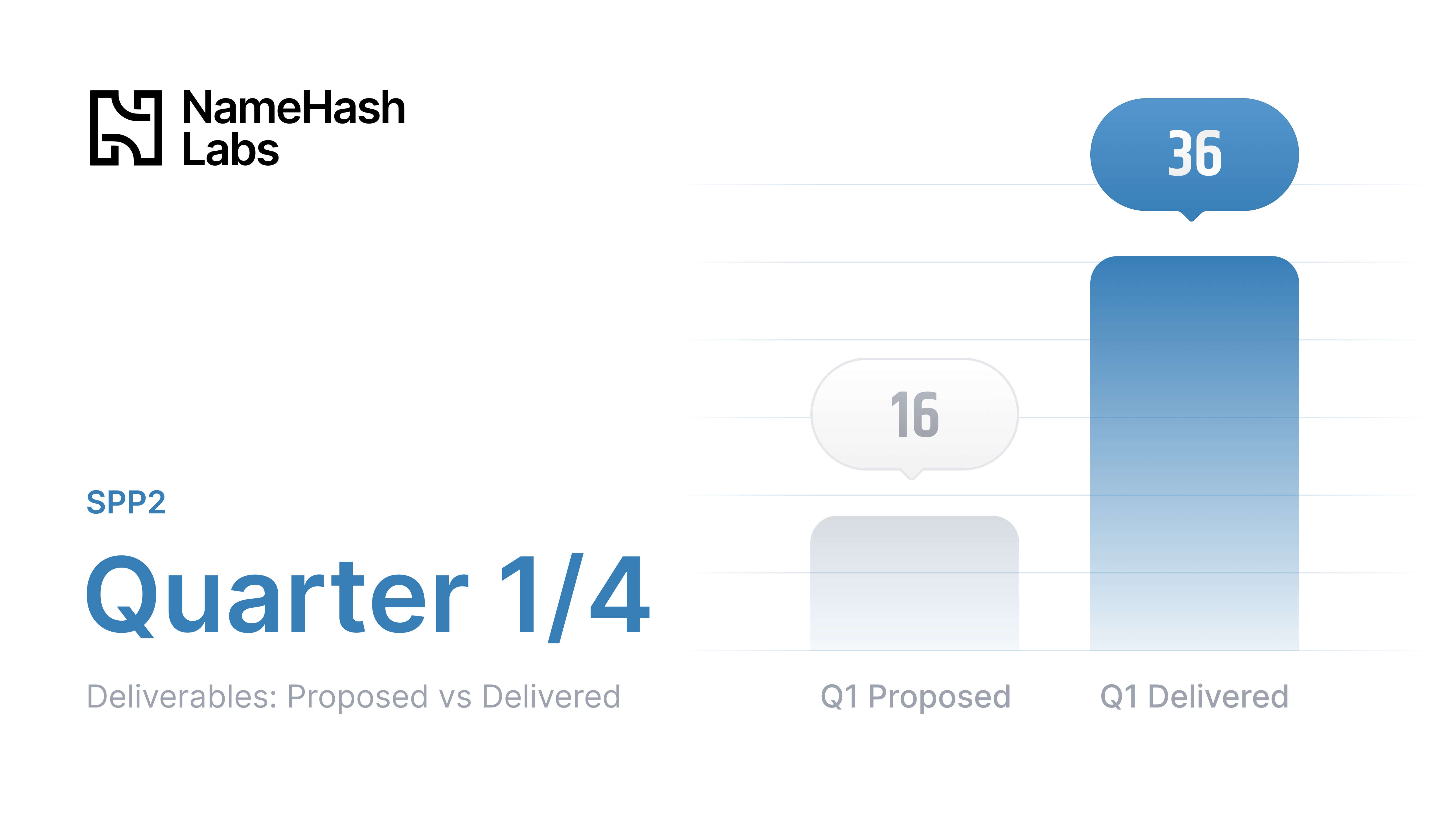
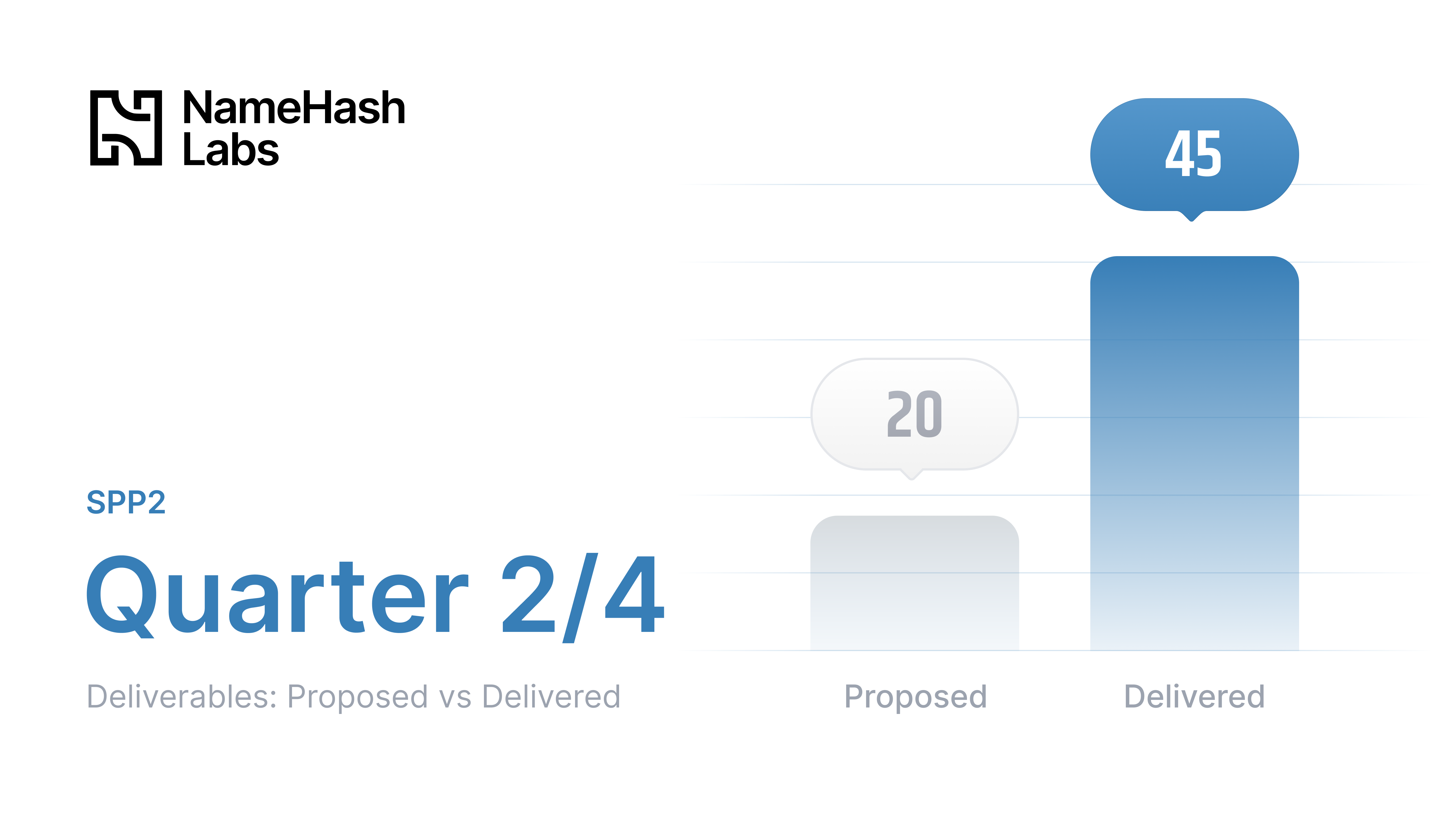
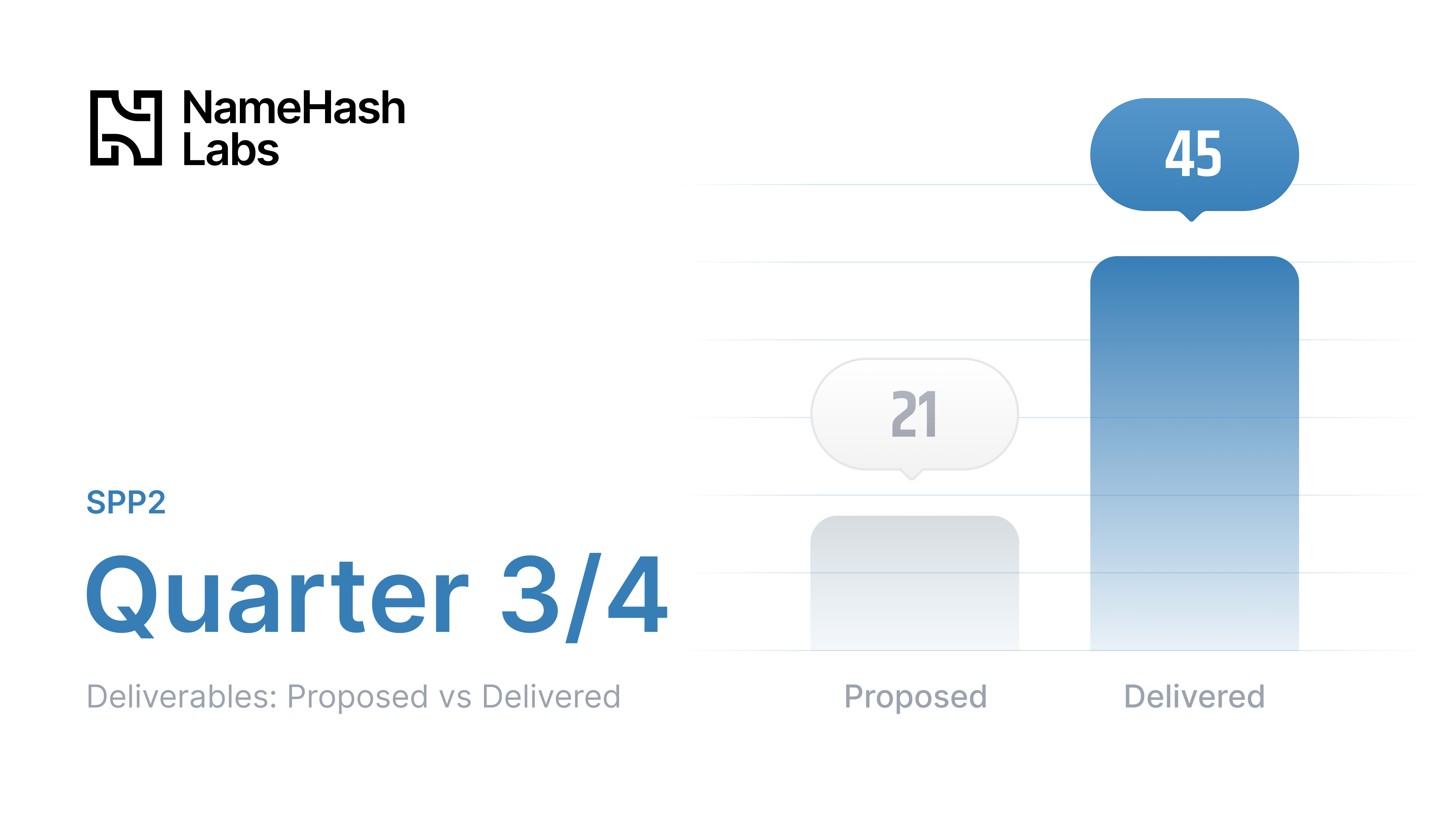
For SPP2 Q3, we committed to a 90%+ completion rate across 21 originally proposed deliverables.
Of these 21 deliverables originally proposed for SPP2 Q3, 5 were already completed in SPP2 Q1 and Q2 (see below for details). In addition, our team shipped another 45 high value deliverables this past quarter. This includes 24 bonus deliverables that go beyond the scope of our original SPP2 proposal.
The final tally: a 214% delivery rate (45 deliverables / 21 proposed), reinforcing our track record of overdelivering big value for the ENS ecosystem.
Completed Deliverables
1.1 ENSNode
- Supported growing adoption of ENSNode in the ENS ecosystem, examples include: the new ENSv2 Explorer from ENS Labs, Anticapture from Blockful, The ENS MCP Service from Namespace, and the ENS Metadata Manager (Organizational Metadata ENSIP discussion and related Temp Check and Kickoff) from Lighthouse.
- Shipped “v1” of “ENS Resolution Accelerator” technology, that includes:
- Support for accelerating a wider set of resolvers.
- Support for ENS names that haven’t migrated to the (new / current) ENS Root Registry with Fallback.
- Optimized self-hosting and DevOps to support stronger ENS protocol decentralization.
- Shipped preview React Hooks and UI component library for accelerated ENS social profiles.
- Shipped integrations of preview React hooks and UI component library for accelerated ENS social profiles (“dogfooding” on ENSAwards and ENSAdmin).
Beyond Scope “Bonus” Deliverables:
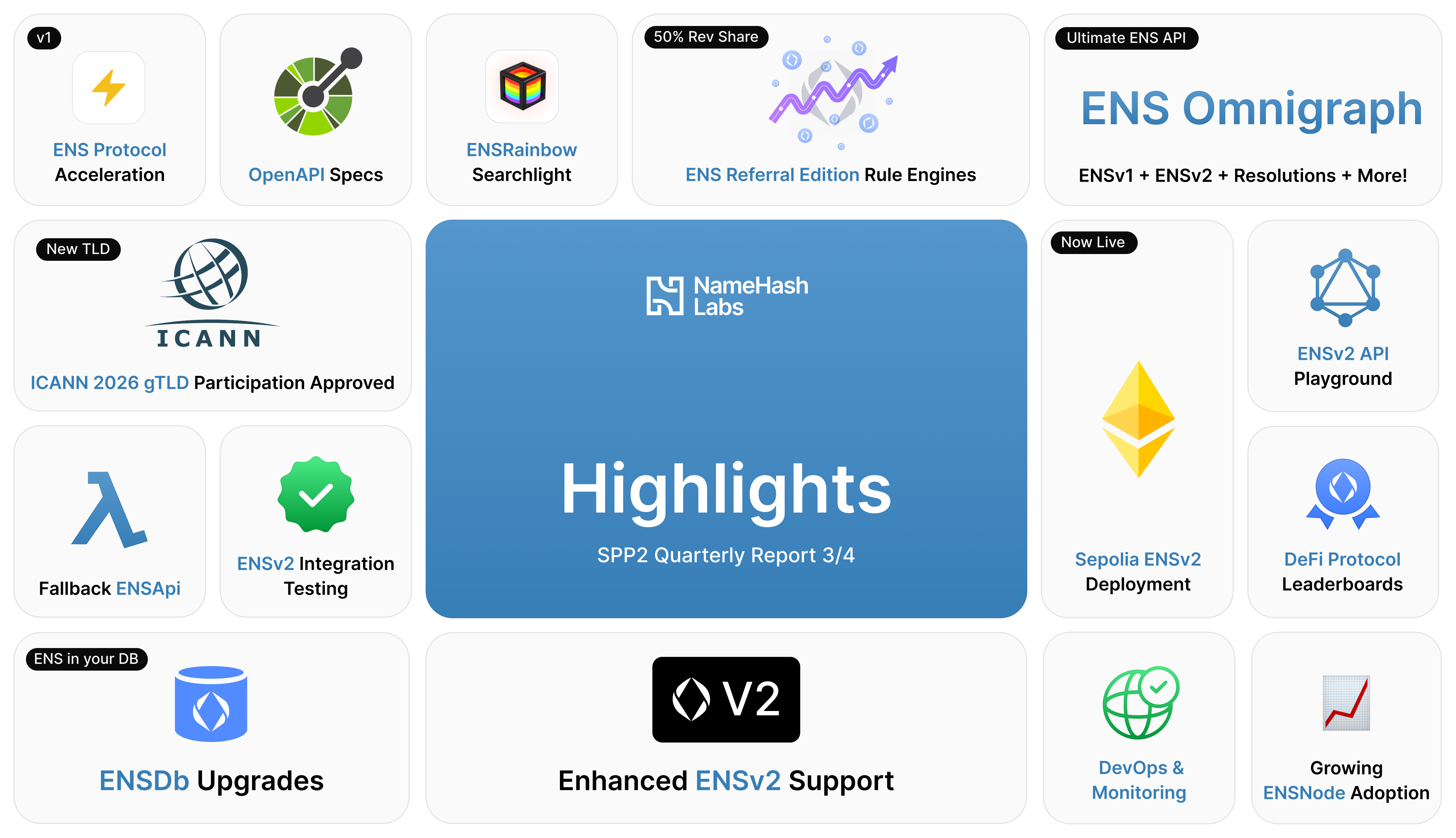
- Launched the new ENS Omnigraph GraphQL API which supersedes the legacy ENS Subgraph. This is not just another ENS API. It’s the “ultimate” ENS API that represents a transformative advancement for the ENS ecosystem (more info below).
- Delivered, through the ENS Omnigraph, a single, unified interface for querying both ENSv1 and ENSv2 indexed data (now shipped!), ENS resolutions (with integrated ENS Protocol Acceleration, coming soon), and ENS-adjacent protocol data (future plans include support for EFP, DNS, IPFS, account metadata such as linked accounts, and emerging protocols for payments and AI agents) all in a single GraphQL API request.
- This powerful new API supports the expansion of ENS into big emerging opportunities for growth, such as AI agents and new payment protocols going mainstream
- The Omnigraph is a leap forward in developer experience compared to the legacy ENS Subgraph GraphQL API which suffered from a number of “footguns” that significantly complicated building deeper ENS integrations. These long-standing integration barriers are now knocked down! Boom! Good riddance!
- We believe building on ENS should be maximally easy for devs of all experience levels with minimal surprise of unexpected edge cases.
- We also believe that developers building on ENS don’t want ENS edge cases and complexity to spill over into their app’s logic or to become their burden to solve. They don’t want to read a large collection of ENSIPs and manually figure out how everything relates. Instead they want ENSNode and the ENS Omnigraph API to take care of everything for them and “just work”.
- Shipped key architecture improvements over the legacy ENS Subgraph. All Subgraphs make use of a “dumb” auto-generated GraphQL API that is a direct representation of their associated materialized indexed data model. This significantly constrains what is possible. The new ENS Omnigraph breaks those constraints by building a fully custom and hand-crafted layer of GraphQL resolvers that perform any desired processing across both indexed and non-indexed data (which might be dynamically fetched through downstream RPC / API calls).
- Beyond the above benefits, this improved architecture is practically a necessity for implementing the “Nameforest” data model formed onchain by ENSv2 domains. Here there would be key issues attempting to proactively materialize the “Nameforest” into the “Canonical Nametree” as opposed to navigating the “Canonical Nametree” dynamically at resolution time, such as through recursive CTEs.
- We recognize how AI is transforming the way ENS integrations (and software more generally) will be developed. The new ENS Omnigraph is built to align with this. Every field in the ENS Omnigraph GraphQL API is strictly typed and documented for optimal adoption by AI-agents. By solving complexity and edge cases within this custom API-layer, we also unlock the development of top-tier ENS integrations in languages other than TypeScript which historically have suffered from weaker ENS integration support. We hope to see a lot more mobile apps (built in languages such as Swift or Kotlin) and backend apps (that might be built in languages like Rust, Go, Python, Java, etc..) building on ENS thanks to the ENS Omnigraph. Let’s support ENS’s growth into new environments!
- Unlocked ENSv2-readiness before ENSv2 launches for wallets, exchanges, and other key apps making ENS integrations. Specifically, the new ENS Omnigraph GraphQL API supports both ENSv1 and ENSv2 in a unified data model. This enables integrating apps to fully launch their ENSv2 readiness before the launch of ENSv2, such that at the moment ENSv2 launches, all ENS features in their app continue working perfectly without interruption. This is very important as we are working to ensure the launch of ENSv2 doesn’t cause important existing ENS integrations to break.
- Shipped support for a single ENSNode instance to concurrently deliver a legacy ENS Subgraph API with a new ENS Omnigraph API for seamless backwards compatibility during this important ecosystem transition to ENSv2. This means we didn’t remove ENSNode’s fully backwards-compatible ENS Subgraph API support. ENSNode continues delivering this!
- Enhanced ENSDb into a completely new category of integration point for building on ENS. ENSDb is the name we give to a PostgreSQL database following our carefully crafted set of schema designs, rules and constraints. You can think of ENSDb as getting the whole onchain state of ENS… in your db! ENSDb is building an open standard for a bi-directional ENS integration point. It is bi-directional because any app following the standard can perform the write operations to produce an ENSDb, and any app following the standard can perform read operations against an ENSDb. The first implementation of a writer is ENSIndexer. The first implementation of a reader is ENSApi. This strategy unlocks anyone in the ENS ecosystem to build custom APIs, CLIs, event-based engines, data analytics pipelines, dashboards, and more! Build new products on ENS using any programming language that can talk to PostgreSQL (which is practically every programming language!). ENSDb also opens the door to a number of new capabilities in our roadmap, including the ability to create and publish “snapshots” of an ENSDb. These “snapshots” can then be used by anyone to save hundreds to thousands of dollars each month on RPC calls, and days of waiting for ENS indexing historical backfills. All these adoption barriers will be eliminated by acquiring an up-to-date ENSDb snapshot which can be freely completed within minutes. We’re also exploring R&D for an ENS sync engine that would layer onto the write-ahead-log of an ENSDb instance to unlock a large array of additional powerful ENS primitives such as event notifications (ex: the state of an account or transaction changed, or a name transitioned to a new state in its registration lifecycle, etc..), cache invalidations, continuous syncing of one ENSDb instance from another without any need for RPC calls or running your own ENSIndexer or ENSRainbow instance. These capabilities also make possible far more powerful ENS dashboards and ENS analytics capabilities than what is possible on platforms like Dune. ENSDb, through PostgreSQL, also enables effectively infinite scalability to services that build on top of ENSDb through a number of strategies (ex: any number of ENSApi instances can connect to a single ENSDb instance, and ENSDb itself can scale horizontally through replication). Key ENSDb capabilities delivered this past quarter include:
- A new and reusable ENSDb client, supporting a new integration point where any developer can begin building custom apps directly on top of ENSDb.
- Database operations that will be useful in multiple contexts are being transitioned into a distinct layer of responsibility.
- ENSApi is now decoupled from ENSIndexer, enabling improved scalability, reliability, and developer experience.
- A new “ENSNode Metadata Schema” provides a foundation for many useful utilities on our roadmap for routine operations and monitoring of ENSDb instances.
- Shipped a new ENSv2 plugin for ENSIndexer.
- Released indexing support for the new sepolia-v2 ENS namespace.
- Created a fallback-ensapi service to enable infrastructure-level API fallbacks for optimized service availability.
- Enabled the creation of special “snapshot” and “preview” releases of ENSNode’s many apps and packages, optimizing change management for integrators.
- Introduced tooling for automated generation of OpenAPI specs and the automated generation of interactive API docs, including special DevOps processes for change management and quality control.
- Indexed both ENSv1 and ENSv2 state into a unified indexed data model.
- Created a
ponder-sdk package for improved integrations with Ponder.
- Implemented a large volume of integration tests for our ENS Protocol Acceleration Resolution APIs (validated identical resolution results for a large volume of test cases for both accelerated and non-accelerated ENS Resolutions powered by ENSNode vs viem).
- Shipped ENSv2 Integration Tests (including with the ens-test-env and the ENSv2 devnet).
- Deployed new hosted ENSv2 Sepolia ENSNode instances for free public use.
- Completed R&D for a new “name relations” API.
- Released new
/realtime API enabling improved monitoring and DevOps across all services in an ENSNode deployment.
- Shipped many performance optimizations, including reduced RPC usage.
- Optimized architecture for a “Local Ponder Client” and Indexing Status Builder.
- Shipped many indexing status refinements, including improved data models, APIs, client libraries (ENSIndexerClient), and UIs.
Originally scheduled for Q3 but already delivered in an earlier quarter:
- Already delivered in Q1: Expand multichain indexing support to 1-2 additional chains.
Deprioritized deliverables postponed for the future:
- Preview release of Offchain ENS Name indexing.
- Release “v2” of tokenized DNS name indexing.
- Release “health check” capabilities to identify improperly configured resolver records (R&D already in progress, but not released yet).
2.2 ENSRainbow
- Released “ENSRainbow Searchlight”, which uses a variety of strategies to expand the set of healable labels that would otherwise be unknown.
Beyond Scope “Bonus” Deliverables:
- Introduced
convert-csv command for converting CSV files to .ensrainbow format.
- Multiple additional feature enhancements, including:
- Optimized ENSRainbow config management.
- Normalization of unnormalized labelhashes.
2.3 ENSAdmin
- Shipped “ENS Protocol Inspector” for “ENS Resolution Accelerator”.
Beyond Scope “Bonus” Deliverables:
- Released documentation for the new ENS Omnigraph GraphQL API.
- Shipped interactive playground for the new ENS Omnigraph GraphQL API.
- Shipped visibility of realtime indexing status snapshot and projection for enhanced monitoring.
Originally scheduled for Q3 but already delivered in an earlier quarter:
- Already delivered in Q1: Expand the ENS integrator library of important ENS resolution test cases by 2 or more.
- Already delivered in Q2: Ship “ENS Protocol Inspector” support for 2 additional ENS resolution scenarios.
2.4 ENS Referral Programs
- Shipped targeted outreach campaigns to more than 20 wallets and apps, educating ecosystem partners about the ENS Referral Program’s opportunity for a recurring revenue model and supporting their integration planning.
Beyond Scope “Bonus” Deliverables:
- Implemented new ENS Referrals APIs that provide support for multiple ENS Referral Program editions and multiple distinct referral program rules engines, including:
- Support for custom referral program data models for each rules engine.
- Edition-based leaderboard queries.
- Dynamic configuration of referral program editions.
- Forward-compatibility for ENSReferrals clients to gracefully deliver backwards-compatibility when new rulesets are introduced across time.
- Tracking the lifecycle status of each edition.
- Calculating each referrer’s revenue contribution metrics.
- Consolidated ENS Referrals business logic into the
ens-referrals package for use across the ENS ecosystem.
- Implemented a new
rev-share-cap rules engine for the next ENS Referral Program Edition. Key new mechanics include:
- A “race” mechanism that guarantees the sequential processing of each referral to support rules where the order referrals occur can influence resulting awards.
- Customizing a revenue sharing rate for referrals.
- Calculating the “base revenue” of a referral (excluding short-name premiums and recently released temporary premiums).
- Enforcing a floor on the referral outcomes required to become a qualified referrer.
- Disqualifications for rule violations that can be applied retroactively.
- Launched ENS Referrals Live Feed.
- Distributed awards for ENS Holiday Awards (including detailed reporting).
Originally scheduled for Q3 but already delivered in an earlier quarter:
- Already delivered in Q2: Ship indexer and live reward tracking dashboards for ENSv2 Referral Programs launch.
- Already delivered in Q2: Deliver ENS integration support to apps and wallets expressing interest to participate in ENSv2 Referral Programs.
2.5 ENS TokenScope
- Shipped integrations of ENS TokenScope (ENSAdmin and ENSAwards for initial “dogfooding”).
Beyond Scope “Bonus” Deliverables:
- Specialized indexing and API support for tokenized ENSv2 registration and renewal events.
- Optimized handling of “logical registrar actions”, including:
- Enhanced indexed data models, including distinctly representing the “rootRegistryOwner” from the “tokenOwner” of a domain.
- Improved API support, including new filtering capabilities and stateless APIs.
- Refined price data models in APIs and libraries.
Deprioritized deliverables postponed for the future:
- Ship support for updating the status of buy orders based on wallet balance changes.
2.6 ENSAwards
- Completed detailed benchmarks of additional ENS integrations, including Nouns DAO, Cork, Liquity, and Giveth. Produced detailed reports. Enscribe is leading the promotion of Smart Contract Naming Season awards on social media.
Beyond Scope “Bonus” Deliverables:
- Shipped support for navigating multiple referral program editions, each with their own rules, data models, and leaderboards.
- Added contributor tracking to give social credit for each data contribution to ENSAwards (promoting community contributions).
- Launched "ENS Advocate” detail pages.
- Released new “DeFi Protocol” leaderboard.
- Optimized data models to support streamlined data contributions from the community, including optimized data models for representing ENS best practices, apps, protocols, projects, and benchmarks.
Deprioritized deliverables postponed for the future:
- Refine key metrics and tests used to evaluate and award ENS integrations.
2.7 ENS Advocacy
Beyond Scope “Bonus” Deliverables:
- Received official approval from ICANN for participation in the upcoming New gTLD Program: 2026 Round, the first gTLD round since 2012. NameHash Labs was the first organization in North America, and one of only five organizations globally, to receive full approval in the initial Applicant Support Program (ASP) evaluations.Through this achievement, our organization will be positioned to apply to acquire a new DNS TLD that will be open for public registrations. Goals for this new TLD including contributing to the growth and expansion of ENS through a flagship integration between ENS and DNS. We also see this as an opportunity to produce a new revenue stream for the ENS DAO beyond .eth names.
- Attended Consensus Hong Kong in February, advocating new integration opportunities for ENS.
2.8 Service Provider Reports
- Published this quarterly report.
Community Engagement Highlights
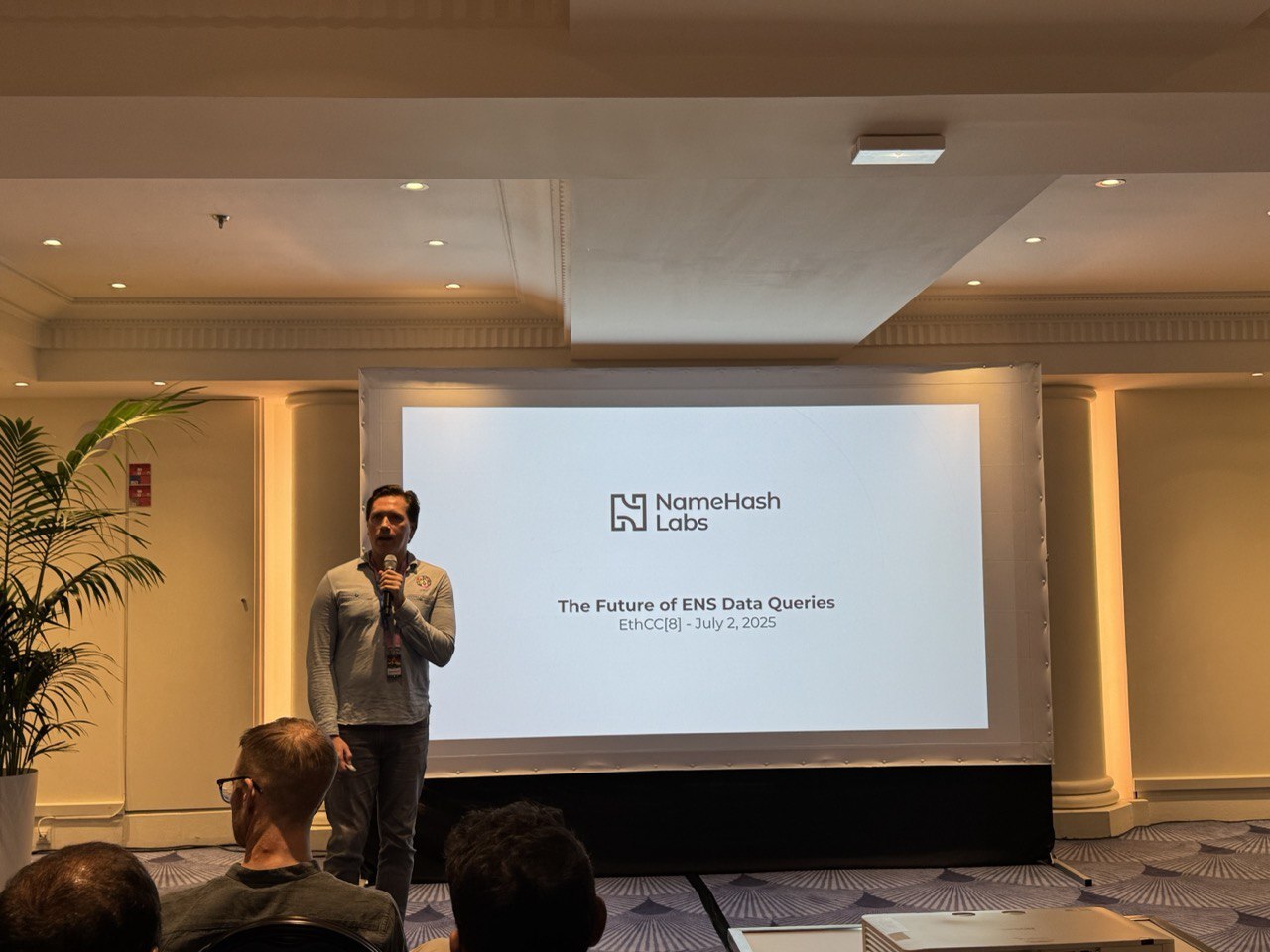
This quarter we maintained our commitment to IRL engagement with the ENS and web3 community through strategic event participation. To this end, we attended Consensus Hong Kong, focusing on promoting new integrations for ENS. We also met with the JustaLab team, and other ecosystem partners to explore collaboration opportunities and expand ENS adoption across the Asia region.
Financial Report
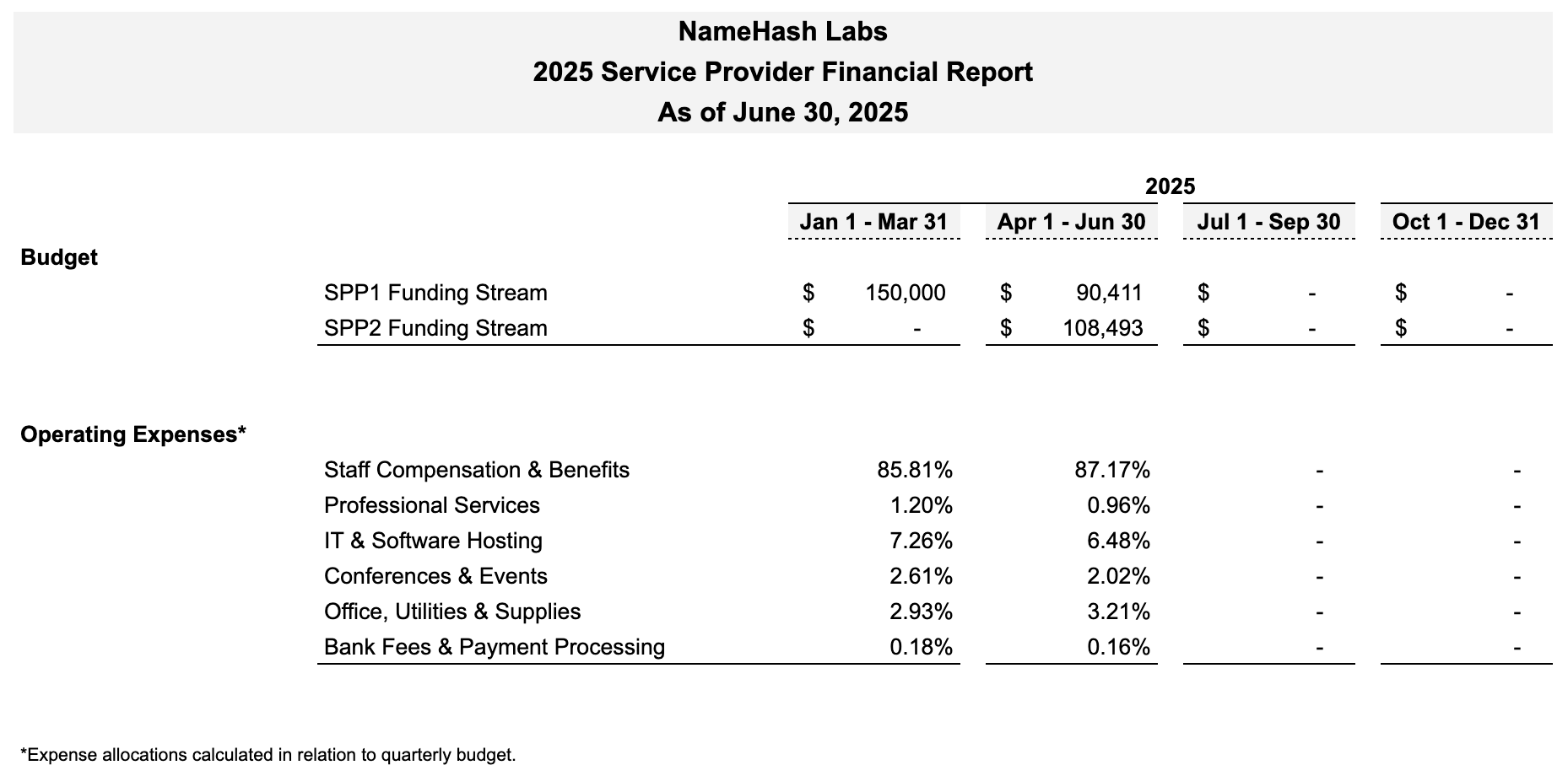
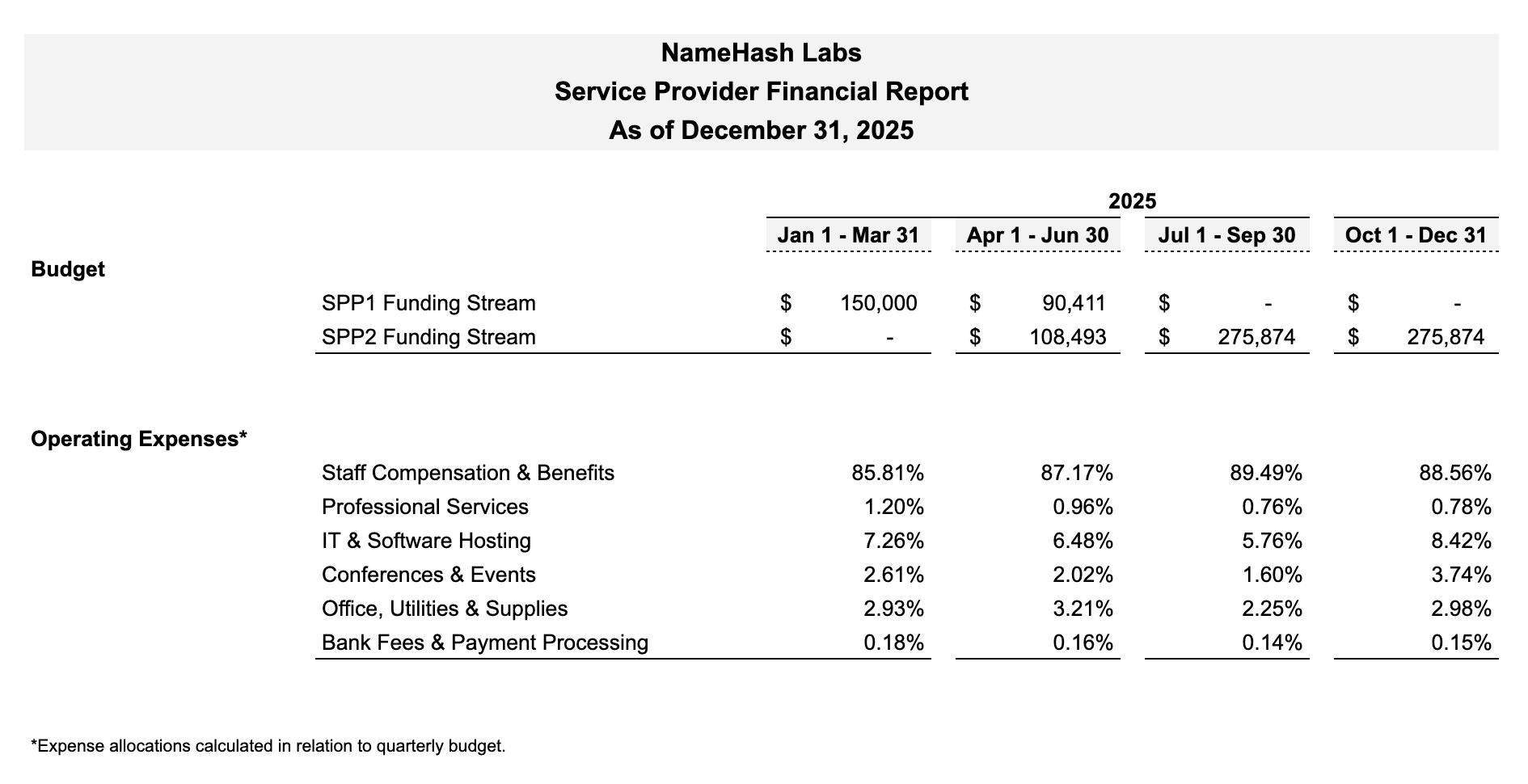
The report below summarizes financials for NameHash Labs through December 31, 2025.
This SPP2 Quarterly Report 3/4 is produced from data through March 10, 2026; therefore, complete Q1 2026 calendar year financial data will be included in our SPP2 Quarterly Report 4/4.
Links
NameHash Labs
Our Workstreams
Looking Ahead
Our team delivered 45 impactful deliverables this quarter, maintaining focus on ENSv2 infrastructure readiness while expanding ENSAwards and the ENS Referral Program. Over a 200% delivery rate against our KPIs once again!
As we enter the next quarter, ENSNode, including the new ENS Omnigraph API, ENSDb, and other related components of the broader ENSNode stack, is positioned to support the ENSv2 launch and serve as the Ultimate ENS Development Platform for the next chapter of ENS.
With ENSRainbow we’re targeting to launch a new public API enabling anyone to heal discovered labels and have all healed labels automatically propagate to all decentralized ENSNode instances.
With ENSAwards we’re taking steps to scale the ENS Referral Program. We’re also building up a catalog of ENSv2-readiness best practices and acceptance tests that we will publicly promote to give some healthy social pressure and social awareness on important ENS integration upgrades that are needed.
We’re also building additional key services that build on ENSNode and the new ENS Omnigraph API to form the ENS Development Platform, including enssdk, enskit, enscli, and ensskills. More on these soon!
And we’re working to further scale ENS into DNS through our upcoming ICANN application to acquire a new DNS TLD. For now the “string” for this new TLD needs to be a secret, but it’s highly aligned with ENS and the Ethereum community. We can’t wait to announce it!