Q3 (2025) Namespace Service Provider Report
Apologies for the delay in our report.
Technical updates
Our work remains centered around offchain and onchain subnames, developer tooling, and frontend apps for them, AI agent-related work, along with working on custom solutions for high-value partners.
Offchain Subnames (prev. Dev Portal)
Kept improving our Offchain manager. Now has more granular access control and production-grade reliability, making it easier for large partners to issue subnames safely and at scale with different permission levels.
- Added a scope-based authentication service to our Offchain manager that allows API keys to be created with different permission levels for:
-
- individual domain name or
-
- wallet address containing a lot of domain names.
-
- Enhanced security and reliability by refining integration and E2E tests.
- Introduced enhanced API rate-limiting and monitoring dashboards for partner projects (in testing).
Onchain Subnames (prev. Namespace App)
The V2 app was initially planned for release earlier, but we decided to undertake a full rebrand (early view) to better align with Namespace’s mission and direction. This decision extended the launch timeline slightly but will result in a more cohesive and long-term product identity.
- The V2 app is closely connected to the UI Component Library below.
- Working on the new most requested features, such as revenue sharing, gas sponsorship, multi-token payouts, etc.
- Launch expected this quarter.
UI Component library
We continue building modular UI components which will be used for the V2 app, and launched the initial version of our component library to further decentralize the usability of our front-end app and make the subname UIs reusable by other teams working with names/subnames.
- There are 3 main Modals we use internally and could/will be used by others:
-
- OnchainRegistrationForm (coming soon)
-
- OffchainRegistrationForm (coming soon)
DevX (SDK/API)
Signifant effort has gone in the last 3 months to improve developer experience.
- Published New Docs – Announcement.
- Published at: https://docs.namespace.ninja/
- Major updates to SDK and API.
- Introduced How-To Guides
- LLM-friendly – Build with AI.
- Launched Integrations page: Ready-to-use integration examples and starter kits to simplify subname registration implementation.
- RainbowKit starter kit announcement.
- Privy and Openfort are launched.
- More coming soon.
- SDK updates:
- Moved under our organization @thenamespace/ and improved the DX.
- Deployed and improved:
- Check the Changelog for activity and all updates.
- Deployed an improved Metadata service.
Infra/DevOps
- Implemented an alerting system for component failure.
- Introduced a mature observability (monitoring and logging) system-wide.
- Built a disaster recovery system around most sensitive system components.
- Major tooling upgrades to the latest version.
BD / Partnership / Integrations
Namespace team has been actively engaged in business development and partnership discussions throughout the past quarter. We’ve explored new strategic opportunities, refined outreach strategies, and collaborated on several promising leads with the ENS ecosystem. Our BD efforts represent a mix of long-term prospects we’ve nurtured over the past few years and newly emerging ones.
The most significant (and biggest) ongoing collaboration and initiatives are with a major L2 network, where we developed (and launching soon) a custom chain-wide identity solution, similar in nature to Basenames. In parallel, we’re in early discussions with the Pakistan Crypto Council, a government-led initiative exploring how to strengthen their participation in the Ethereum ecosystem, and under our advisory, considering ENS as the starting point of onchain identity.
Most of the interest we’ve received this quarter has come from L1 chains, followed by L2s, and a few wallet teams. We’re also evaluating the best strategic approach to engage Wallet-as-a-Service (WaaS) and Rollup-as-a-Service (RaaS) providers, given their growing role in Web3 infrastructure and user onboarding.
As always, it’s important to note that while there is strong interest in ENS, most companies ultimately prioritize direct user growth and revenue. As a result, adding ENS premium support (resolution and subname registration) often ranks lower on their immediate roadmap; thus, sales cycles are easily prolonged.
Clients
Namespace continues to power some of the most innovative and widely adopted subname integrations across the ENS ecosystem. Below are some diverse clients we decided to highlight from this quarter:
- PinMe: Decentralized pinning services for immutable websites.
- 150k subomains from pinme.eth, 5M resolutions, 640 GitHub stars
- Making it one of the most successful open-source subdomain projects that enables decentralized, permissioned, censorship-resistant websites.
- Published a Case Study, wrote a Twitter thread, and hosted X space.
- Fun fact: PinMe.eth is widely used by individuals in restrictive regions like China to share censored or forbidden content, like websites, books, and knowledge, freely.
- Nouns Identities: NounsDAO Community Identity Layer
- Subname service launched under .⌐◨-◨.eth
- Hosted at noggles.domains (“Nounify Yourself!”)
- 530+ Subnames minted on Base chain.
- Polygon Accounts (by Unicorn): Identity for Polygon Ecosystem
- Partnership between Unicorn, Polygon, and Thrive Protocol.
- 700+ Subnames issued from polygon.ac domain.
- POAP: Proof of Attendance Protocol
- Successfully completed migration of POAP subnames and began minting through Namespace’s SDK.
- 4,300+ subnames minted on onpoap.eth, poap.xyz, and withpoap.eth.
- Divvi: Growth incentivization protocol through KPI-based funds distribution.
- 1,800+ subnames from divvi.xyz domain.
- Used as onchain profiles to give an identity to builders during registration.
- Subnames help with transparency, communication, and feedback.
- BookOfEth: Ethereum-aligned and ENS supportive memecoin community.
- 220+ unruggable Ethereum subnames under booe.eth – announcement.
- Community members collectively generate millions of impressions by using their .eth names across social platforms, promoting ENS-native identity and culture.
Custom solutions
Interest in using ENS as an identity layer continues to grow. We’re currently in talks with several L1 chains to explore how ENS can serve as the foundation for native, chain-wide identity built directly on their networks.
In parallel, we’ve begun discussions with one naming service on establishing bi-directional interoperability — enabling names from different systems to be linked, creating a more unified cross-chain identity layer.
Additionally, we’re exploring custom integrations for immutable, decentralized frontends with a leading social network, aiming to achieve greater unruggability and censorship resistance for user-owned content.
ENS BD Arm
Slowly delivering on the goals outlined in our SPP2 application, specifically around building an independent BD arm for the ENS ecosystem to enhance growth, coordination, and strategic outreach (primarily focused on Resolution support and Subname registration implementation).
Our goal is to create a shared BD coordination layer that reduces overlap, increases transparency, maximizes the outcomes of our collective efforts, synchronizes outreach across teams (ENS Labs, Service Providers, and other Ecosystem projects), making it more efficient, and ensures every integration opportunity receives proper attention.
Over the past quarter, we’ve focused on building an in-house team and infrastructure to support this. The next step is to launch a pilot version and open access to a small group for initial testing and collaboration, with the long-term goal of making it public to the ENS ecosystem builders.
AI agents
Our original SPP2 application proposed work on Agents.Domains — experimental project designed to give AI agents (launched as tokens) their own .eth subnames.
Since then, the AI agent ecosystem has evolved dramatically, prompting us to adapt our direction. Rather than pursuing simple subname assignment without clear utility, we’ve adjusted focus toward building foundational infrastructure that ensures ENS is natively compatible with emerging AI agent standards and frameworks. This required extensive market research, collaboration between Service Providers and the Ethereum ecosystem, and technical alignment — a necessary pivot to build something meaningful and future-proof.
To that end, Namespace, together with Unruggable and JustaName, initiated the ENS x AI Group.
- The group’s goal is to ensure ENS is included across AI standards, frameworks, protocols, etc.
- Hosting weekly calls to bring together key leaders from across the ENS, Ethereum, and AI ecosystems.
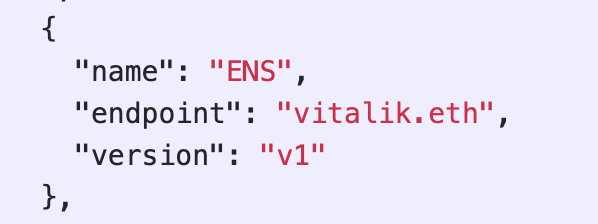
- The group advocated for ENS support in ERC-8004, which was officially included in the final spec (shoutout to Premm for leading this effort).
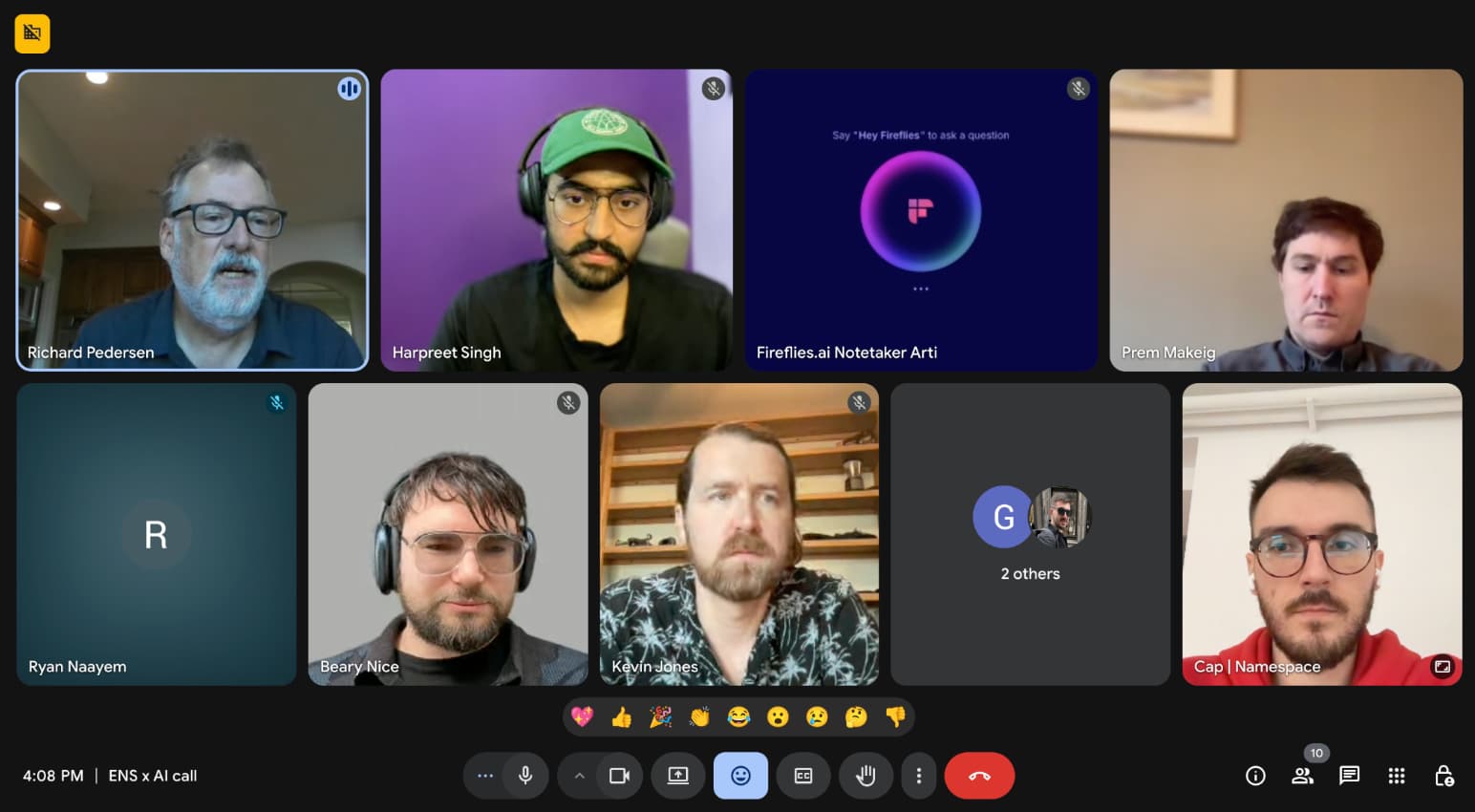
- Current efforts include developing an Agentic Trust Layer, initially built by Rich, and in collaboration with Beary (Namespace), Prem (Unruggable), and Kevin (The Graph), aimed at establishing verifiable, onchain identities and trust primitives for autonomous agents, along with AgentScan and AgentLauncher.
- Further considerations include building task-specific agents instead of building infrastructure and tooling, as many choose to do.
- The pic from one of the calls.
Stats
- 180k+ subnames (100% increase from last quarter)
- 5M+ resolutions (257% increase from last quarter)
- 221 Names(paces) activated (10% increase):
- 155 issuing subnames on Ethereum
- 52 issuing subnames on Base
- 14 issuing subnames on Optimism
- 76 L2 registries deployed:
- 3k Base subnames (260k resolution requests, indicating usage)
- 343 Optimism subnames
- 700 Ethereum subnames
- 88 API keys generated for offchain subnames
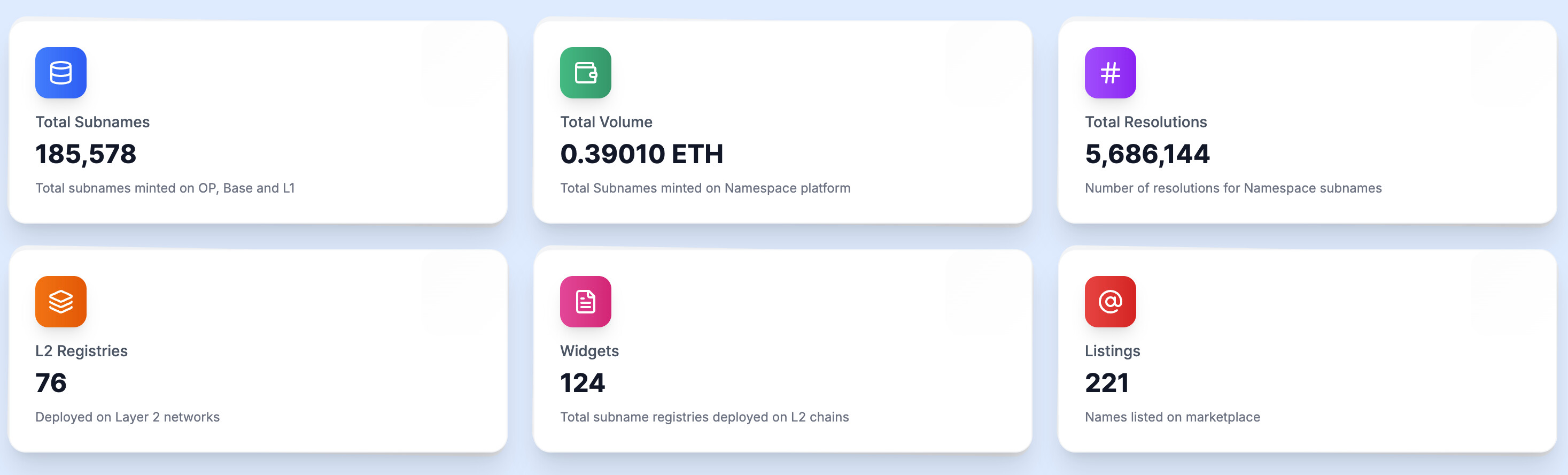
We’re currently expanding the data dashboard to include more metrics.
TLD
We’re excited to share that Namespace will participate in the upcoming ICANN TLD auction and apply to acquire and operate its own TLD. 
Over the past several months, we’ve dedicated significant time to researching the DNS and ICANN world — its structure, regulations, and the opportunities it presents for bridging Web2 and Web3. Throughout this process, we carefully evaluated whether operating a TLD would serve as a complementary extension to the ENS protocol and DAO, or if it could risk diluting ENS’s core value. This consideration was the main reason we were proceeding with caution.
However, after extensive research, ideation, consultations with industry experts and various ecosystem parties, and particularly following the Doma x ENS partnership, we’ve concluded that pursuing a TLD represents a major step forward for the growth of our entire ecosystem. It’s an opportunity to strengthen ENS’s position in the global naming landscape, expand its reach and influence beyond Web3, and even create new revenue opportunities for the DAO.
We’re currently going through the Applicant Support Program and preparing for the next stages of the process.
Ecosystem / Community
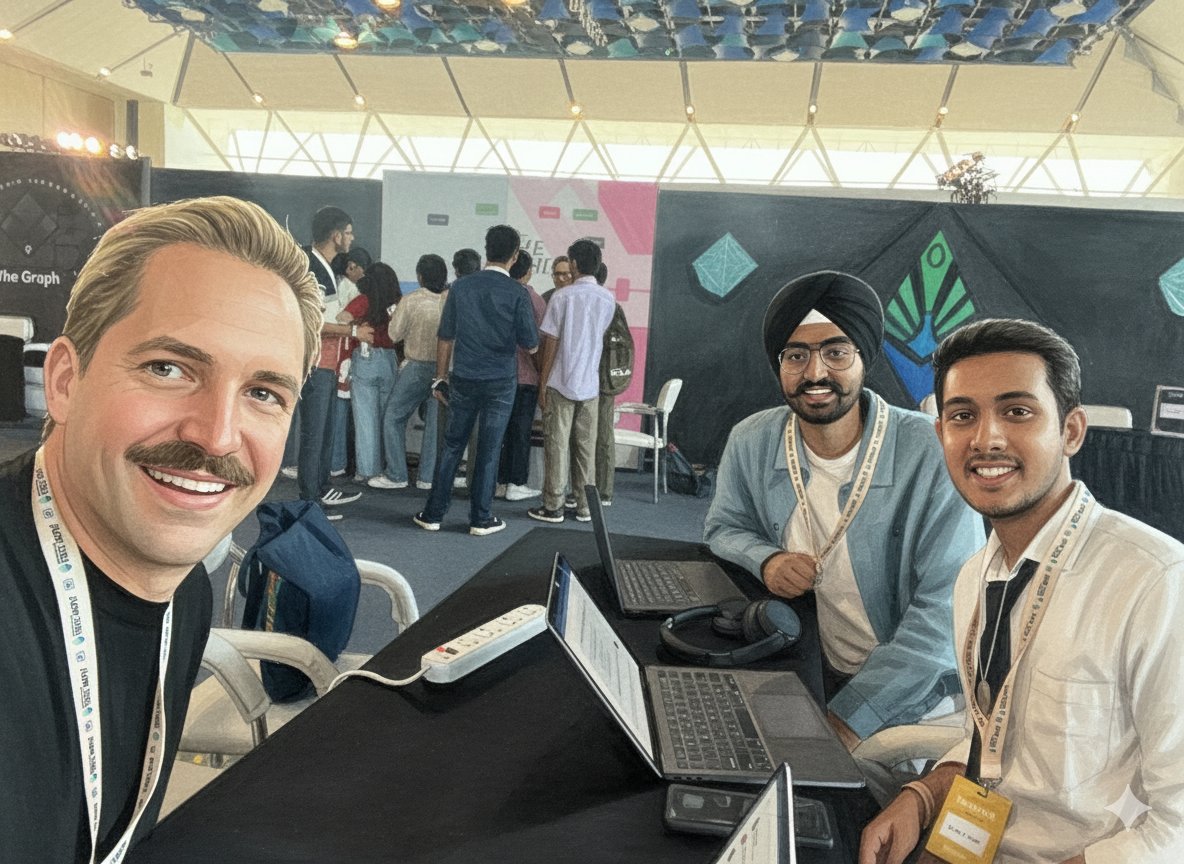
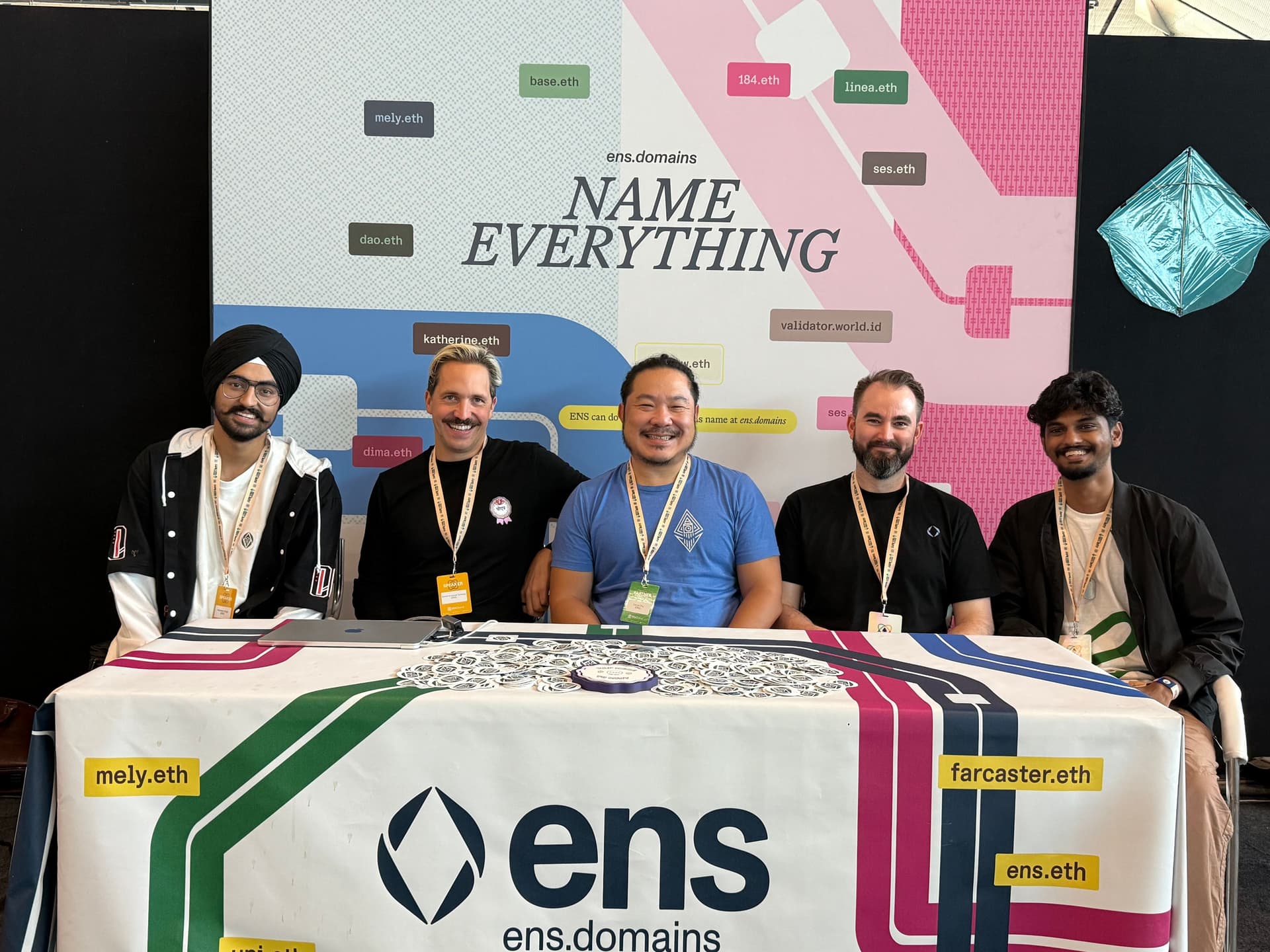
- Harpreet, our DevRel, was present at ETHGlobal India as an ENS partner.
- Harpreet gave a talk about Subnames.
- Articles published:
- Raised a small PR for displaying Celo address on the ENS manager app.
- It’s beautiful seeing ENS represented through SPP merch “.eth > 0x”
- Cultivating a developer community around Subnames (community demo)
- Farcaster miniapp.eth community build.
- Happy customers importing domains and issuing subnames.
- Twitter space with Victor from NameFi.
- Community-built Farcaster leaderboard + subnames claiming portal.
- Advocating in favor of immutable, permissionless frontends built with ENS.
- Namespace Builders TG group reached 99 members.
- Users creating offchain subnames with the Dev Portal.
Team updates
- The hiring continued from the previous quarter.
- Hired 4 more people.
- Current team size: 10 people
- 6 full-time, 3 part-time, 1 design company.