Unicode (non-ASCII) .eth registration/renewal pricing

I’ve come across a profound realization… so much so, that I’ve concluded that 99.99999999906186% of all potential 3-character length .eth registration price of $640/year, is backed by no logical reasoning.

But how did I come to this realization? How did I get that exact percentage?

Let’s start with a simple comparison: .com versus .eth

When we think of 3-character length .com domains, we think of scarcity.

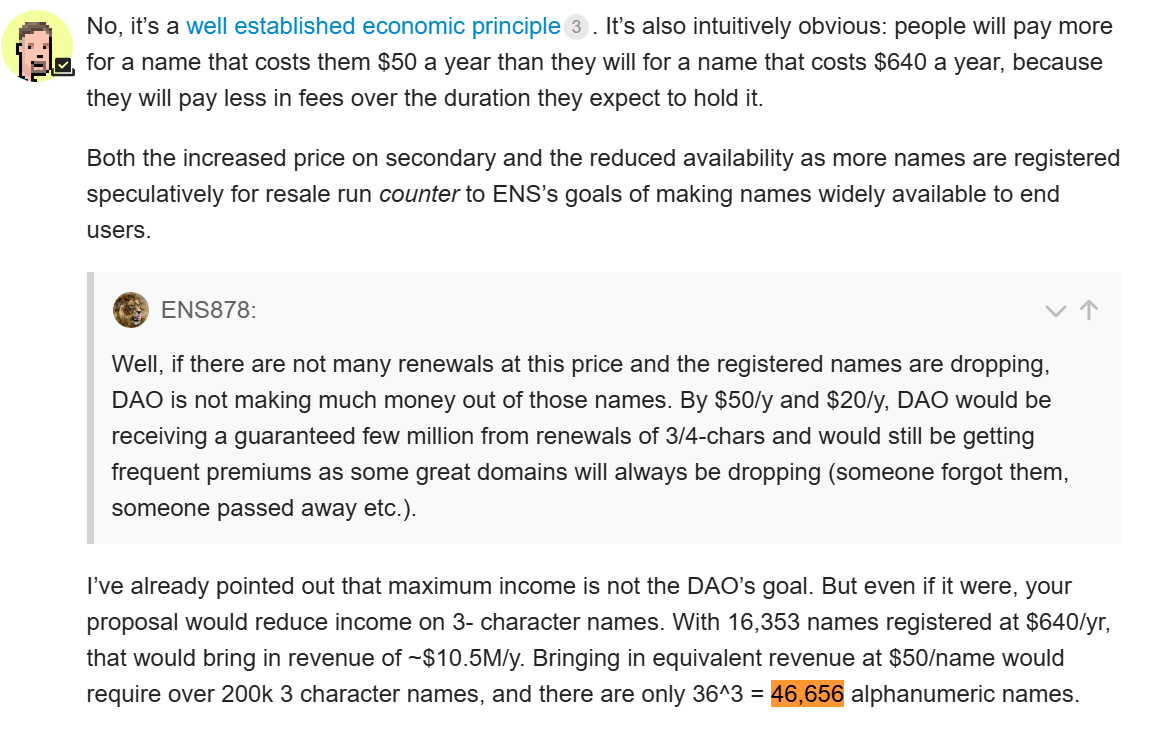
This is because .com (and ALL DNS TLDs) only allows usage of characters A-Z and 0-9, which means there are only 46,656 potential 3-character combinations total. (excluding (-) hyphen)

Nick.eth uses the same logic below for .eth domains citing alphanumeric combinations, and he’s correct.
However .eth domains aren’t limited to ONLY alphanumerical characters like DNS.
This is where the conversation pivots to a profound realization.

Since .eth is not limited to using only alphanumeric characters, then how many potential 3-character combinations are there outside of A-Z / 0-9 aka Unicode Characters?

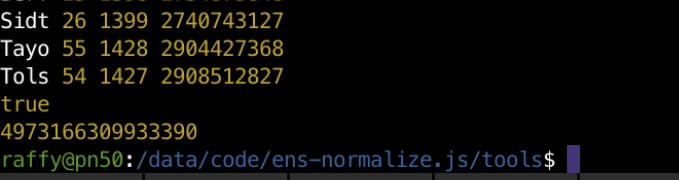
4,973,166,309,933,390…

You read that right, the number of 3-character .eth combinations that are valid/working per the normalization standard is:
Four quadrillion nine hundred seventy-three trillion one hundred sixty-six billion three hundred nine million nine hundred thirty-three thousand three hundred ninety.
(Source: Raffy.eth)

I will give you a moment to soak that in.

Now that we know that there are over 4.9 quadrillion total 3-character .eth combinations that are valid (working .eth domains) it’s time we make one thing clear:
3-character .eth domains are not scarce.

However, this is the time now we make a clear distinction. As I said above, Nick was correct on saying there are only 46,656 TOTAL alphanumerical character combinations.
”Why is this number important after you just told us there are 4.9 quadrillion possible combinations bro?”

It’s very important because those 46,656 ASCII .eth domains will resolve 1:1 (ENS Integration:Usability) 100% of the time.

That is inherent scarcity + usability which give A-Z / 0-9 valuable/unmatched properties.

Now, on the other hande the 4,973,166,309,933,390 UNICODE combinations will NOT resolve 1:1 (ENS Integration:Usability) 100% of the time.
Not only do they lack scarcity, they aren’t usable 1:1 upon ENS Integrations (like how the ASCII character A-Z / 0-9 inherently are) which makes it lack logical reasoning to why UNICODE character .eth domains should carry a $640/year registration fee.

This Unicode includes EMOJIS.

There is no inherent scarcity (new emojis drop every year) and Emojis are not resolvable 1:1 upon a ENS Integrations the same way A-Z / 0-9 are, 100% of the time.

THIS IS THE DISTINCTION THAT GIVES A-Z / 0-9 INHERENT VALUE.

Why I’m here:

Do I think 3/4 character A-Z / 0-9 ASCII Characters should have cheaper renewals?
Yes, but that’s not what this particular post is about. This post is intended to cover the Unicode aspect (outside of ASCII).

With everything I have layed out, I believe that ALL 3/4 Character Length (PURE UNICODE/ HYBRID UNICODE/ASCII) should be pegged to the Registration/Renewal cost as a 5+ character .eth domain which today is $5/year.

If people agree with this approach, backed by my logic, I would be open to putting this to a vote, ideally going into effect with the release of ENSv2 if passed. I’m also open to combining this approach within a future vote in regards to ASCII 3/4 character changes to pricing structure (which I have seen lots of discussions for on other posts).

But overall, the logic I have presented is sound. This is why I believe 99.99999999906186% of all possible 3-character Unicode .eth domains lack logical reasoning for being priced at $640 year when they lack any form of scarcity, while also inherently lacking 1:1 usability from those who integrate the ENS Protocol which makes previously used logic to justify a $640/year registration, not apply to Unicode Character .eth domains.

If we utilize the approach of lowering all registration costs for 3/4 character Unicode names to $5/year, it will passively EDUCATE people on why some will be cheaper because of the lack of 1:1 usability across all ENS integrations, while COMPOUNDING the value of the A-Z / 0-9 with the inherent 1:1 utility A-Z / 0-9 has across all ENS integrations, that Unicode Names lack.

Backed with this logic can we cannot feasibly justify Unicode Names 3/4 character names being $640/160 a year any longer. This is in everyone’s best interest and will passively educate those on both spectrums of Unicode and ASCII, of the underlying properties while recompounding faith in ASCII A-Z / 0-9 with justifiable logic and reasoning backing both ASCII/Unicode cost of registration.

Conclusion: 3/4 character length Unicode .eth domains should be pegged to the cost of 5+ character .eth domains (currently $5/year) for their lack of scarcity (4.9 quadrillion 3-character combinations) + their lack of 1:1 usability within ENS Integrations.

I would appreciate all thoughts, perspectives, opinions on how we can find an agreement moving forward of how Unicode (outside of ASCII) should be treated with everything considered.
4 Likes

I didn’t realize there were nearly 4 quadrillion unicode characters. Curious what your data source is on that?

Just googled and once I started getting into the discussion of “planes” realized I was a little over my depth.

Is another point your making that non-Latin characters (like Chinese, Japanese, and Korean names for example) shouldn’t be $640 a year because most full names are three characters?

1 Like

Source of the 4,973,166,309,933,390 per Raffy.eth
He did the calculation.

As far as “non-Latin characters,” yes, that’s another valid point, but let me clarify why it actually reinforces my argument rather than creating an exception.

You’re right that many real, meaningful full names in CJK languages are exactly 3 characters long. At first glance, someone might say: “Well, if a 3-character Chinese name is meaningful and scarce in a cultural sense, shouldn’t it be treated like ASCII?”

But here’s why that doesn’t change the core logic:

  1. Scarcity isn’t cultural. It’s mathematical.
    Even if only .5% of the 4.9 quadrillion Unicode combinations are valid CJK characters, that’s still 49 quadrillion possible 3-character Unicode strings. That’s not scarce. No individual 3-character CJK .eth domain is mathematically rare in the way a 3-character ASCII .com or .eth domain is (46,656 total).

  2. Usability is about protocol-level resolution. Not human meaning.
    A meaningful 3-character Chinese name is still a Unicode string. ENS integrations (wallets, dApps, browsers) do not guarantee 1:1 resolvability for Unicode the way they do for A-Z / 0-9. Some integrations will fail and not support input methods for CJK characters. ASCII works 100% of the time, everywhere. That’s a technical fact, not a value judgment.

  3. Pegging to $5/year doesn’t prevent registration of meaningful CJK names, it just prices them logically.
    If a 3-character CJK name is valuable to someone, they’ll still register it at $5/year. Lowering the price doesn’t diminish its personal or cultural significance, it simply removes an unjustified $640 barrier that was originally based on ASCII style scarcity, which doesn’t apply.

So to answer directly: Yes, the fact that many real CJK full names are 3 characters long is an additional reason to lower the price, not because those names lack value, but because their value comes from cultural meaning, not from the artificial scarcity and universal resolvability that justified the $640 price tag for ASCII… Resolution is the KEY difference in what sets ASCII and Unicode apart.

It’s not 4,973,166,309,933,390 UNICODE CHARACTERS.

It’s 4,973,166,309,933,390 3-CHARACTER UNICODE CHARACTER COMBINATIONS that are valid and pass ENS Normalization. :eyes::thinking:

I posted this last year comparing dictionary word lengths across multiple languages.
Creating new registrars for specific region/scripts with huge discount would increase revenue and user base across globe, hope ENS DAO will revisit this for v3 design..

2 Likes

Thanks for sharing this @0xc0de4c0ffee :+1:

I like the idea of creating new registrars for specific region/scripts.

As @jamesbeck was saying, many Chinese names/words are 3-character based on how their language structure works. We need to be open-minded to these nuances while retroactively aiming to accommodate this reality.

ENS has grown and evolved, and with its evolution we must reconsider our approach (especially with the 2023 Normalization Update) which influences people globally of all languages to be able to utilize .eth in their native language.

Since these native languages do not resolve 1:1 across all ENS integrations the same way ASCII (A-Z/0-9) does, it adds friction and becomes a huge uphill battle for other countries to to even utilize this potentially POWERFUL property that .eth uniquely enables. In order for us to see global adoption of these while also persuading growth by ENABLING these different languages to resolve across different apps, we must lower the price to entry for Unicode Characters universally as they lack the 1:1 integration that makes ASCII Characters A-Z / 0-9 so powerful in contrast.

This could be a HUGE STRENGTH for .eth if we reconsider our approach to how simply lowering the cost to entry could bring forth adoption to .eth in a whole new way.

1 Like

UPDATE:

After doing deeper research and dialing in the combination equation, Raffy.eth concluded there are nearly 327,416,412,892,717 total 3-character Unicode Combinations.

This is dramatically less then 4.9 quadrillion and this transparency is important.

However, 327 Trillion is still a VERY large number of valid 3-character combinations, and my perspective on lowering the registration cost and renewal costs for non-ASCII Unicode still stands.

Would love to see more perspective on this revelation and how we can logically undergo finding a middle ground. Thoughts and opinions from @nick.eth and others would be much appreciated (if available for comment) on whether a new registration cost should be considered based on the lack of combinational scarcity + lack of 1:1 integration when contrasted with ASCII characters.

I’m supportive of more nuanced pricing - but pricing based on character set is an enormous can of worms, and to do it right requires more than a reflexive “everything with non-latin characters is $5/year”.

1 Like

Yeah, there are so many character sets and combinations with non-ASCII, that to create different prices depending on the exact Unicode Character (Chinese/Acrylic/Hindi/etc) set would not be a good idea because it’s all biased no matter what.

The reason why I believe there should be a universal price for these (though they are all different) is because they share one thing in common: They do not resolve 1:1 the same way ASCII characters do.

That in itself is enough in my eyes to group these together.

If we reduce the cost for these, we could see more global adoption of this unique ability to utilize these character sets for decentralized identity, and in turn can influence the push for platforms/apps/wallets to want to allow these to resolve.

This is a very unique ability that .eth allows and I believe this approach will help people from all walks of life to have a name in their native language while increasing the push for universal resolvability as much as we can for these non-ASCII character sets.

If we can get this adoption across the board with this approach, then in the future we could consider slightly increasing the price like we are considering with your recent post in regards to 5+/character registration increase.

This could overall increase ENS revenue in a huge and currently untapped way.
I believe we need to lower the cost to entry, for longterm adoption + resolvability.