Haha I use Apple Pages for my drafts so it converts double dash into em dashes automatically but again thank you for your “vigilance” today. And dissolving working groups constitutionally is not exactly what I was talking about in my reply but understand you read things from your intention to do so. We are technically all free to our perspectives in a well functioning DAO.
I was referring specifically to the funding public goods part of the Constitution given that ENS itself was funded in 2018 with a grant from the EF to continue development and building of the protocol.
“It adheres to the concept of the Infinite Garden. ENS is part of that Infinite Garden ethos, reflecting the “nurture and grow, but do not control”. The core team at ENS Labs was funded through grants, and had no VC investors.”
I appreciate the fact that this proposal brings a lot of important discussions that are needed.
Taking this action seems abrupt, it’s a huge change in the structure without a wider effort on evaluating what we can learn from and improve.
For me it would be more natural to evolve to current structure, and experiment with new rules that expand the contributor base, disincentivizes political behavior and etc.
The working group rules amendments was one tentative on that direction, in which you weren’t supportive of that. It’s curious to me that when a change is proposed, it’s such a dramatical one.
Working groups do a lot of good and make the DAO incredibly accessible. Yes, there are a lot of things to improve:
change culture to more easily change contributors when internal disruption is happening/not enough time available or effort for the role. Or perhaps a conflict resolution policy as @vegayp mentioned would be helpful.
setting clearer goals for WGs. But for that we also need DAO-wide goals and direction
more accountability and reports to the DAO
onboarding documentation
the amendments for me are a necessary step for increasing contributor base and disincentivizing political behavior.
If this goes live, I’ll be voting against. I could be in favor of changing the structure and dissolving the WGs, but after trying to improve them, assess and iterate more. We need to have shorter feedback loop and experiment more. Otherwise we only gonna change things to completely new structures, and learn nothing about it.
My opinion on the subject after having talked at length with the stewards at DevConnect
I think we can change the Working Groups but we still need to have an entity that is tasked with administrative and oversight tasks. Overseeing Service Providers and Karpatkey, organizing the elections, etc.
Whatever we call that group, it needs to respond to the DAO, probably with an annual DAO vote to select their members. This type of “politics” is inevitable in my opinion.
Some tasks done by working groups, like grants, events etc, might be either be done by a future service provider that proposes doing specifically that or absorbed by labs or other current service providers. After all, a budget is a budget, and when deciding the budget to give to grants or public goods, we should compare it with the option to giving that money to another developer doing other jobs and I think the SPP selection does that.
I think Labs should not be in charge of overseeing service providers or elections, as this muddles the difference between labs and the DAO.
I believe any big change like that shouldn’t be sudden. I think starting this conversation so close to when we should have the vote isn’t great. I suggest either we elect a working group that has the mission of doing a reform on working groups, or maybe we add this option on the election itself, by adding a DISSOLVE WORKING GROUP (or simply a NONE BELOW) option in a ranked choice vote.
As someone who has known and served alongside you over that time period, and also held the secretary role, I believe your opinion here is valuable. I think the intentions of this proposal are good; however, I’m not at the place where I would certainly vote for it.
I was initially very strongly opposed to the initial DAO retro because the motives were unclear (to me), it seemed hasty and I did not believe the oversight would be sufficiently neutral to be effective. After the discussions in Buenos Aires, and in the inclusion of Metagov (w/Eugene Levanthals involvement) I felt much better about this pathway.
I do believe the cost and time required to do a retrospective review of operations over the past four years could be beneficial to designing a new structure or organizational format to better serve the DAO in the future. It would also be an opportunity to set a positive example.
If a retro was progressed, I assumed you would be a critical person to take part in that process considering your secretary role.
To get me over the line for this temp check I need:
To be ensured this isn’t capture by another name/design. For example, what does a candidate for administrator look like and how are we mitigating CoI since thats a chief problem now?
More separation of Labs from the DAO finances. They shouldn’t oversee streams, the endowment or any DAO treasury multi-sigs based on principle.
To be better sold why we should be doing this now (and quickly) instead of after the retrospective? I’m not sure why skipping a pause + retro is advantageous. This temp check, as well as many other outcomes, post-retro could be viable.
I would support some combination of:
Full pause
Partial Pause
Retrospective
Temporary group to oversee review or reform
As someone who has been involved here since the start of the DAO, I very much want us to make improvements that curb ineffective spending, mitigate capture/mismanagement, but not in a way that feels like a race.
Wrap all WG ops under the Service Provider Program and establish a single, elected oversight/admin group responsible for SPP and broader DAO operations.
The ENS Retro would run in parallel, providing the accountability framework, performance measurement, and decision-making guardrails that the admin group uses to continuously refine and improve SPP execution.
The opinions and desired outcomes expressed here seem reasonable, but they are being pursued without first running a proper evaluation i.e. The proposed Retro ([Temp Check] ENS Retro: An ENS DAO Retrospective).
The base proposal to simply wind everything down runs counter to a growing body of research exploring new ways to address coordination challenges in complex, decentralized systems.
Moving towards centralization feels like a major step backward for the broader d/acc mission (this is a personal opinion):
If strong empirical evidence clearly supported winding down the working groups, I would be open to that conclusion. But in the absence of such evidence, this proposal feels extremely short-sighted.
I strongly suspect there is a middle ground here, one that preserves decentralization while improving efficiency.
I would hope that that the retrospective could yield clear, agnostic outputs that inform whether reform, restructuring, or sunset is actually warranted, instead of defaulting to a full teardown.
The DAO has a history of proposed administrative items viewed as The Solution. The code of conduct, DAO bylaws, and various frameworks all sounded amazing in theory but ended up unfinished or irrelevant. “Review and revise” is the same cycle, people will care much less in three months than they do today and we will get more of the same.
There will always be a reason to delay. Today it’s elections are too close, tomorrow it’s stewards are just getting started. If we wait for the perfect moment, we guarantee the status quo.
Those wary of centralization/capture:
There are currently 10 teams getting paid by ENS, if this proposal went through, there would still be 10. Additionally, the Panel is designed to have less discretionary power than Working Groups, so it definitionally can’t be a power grab.
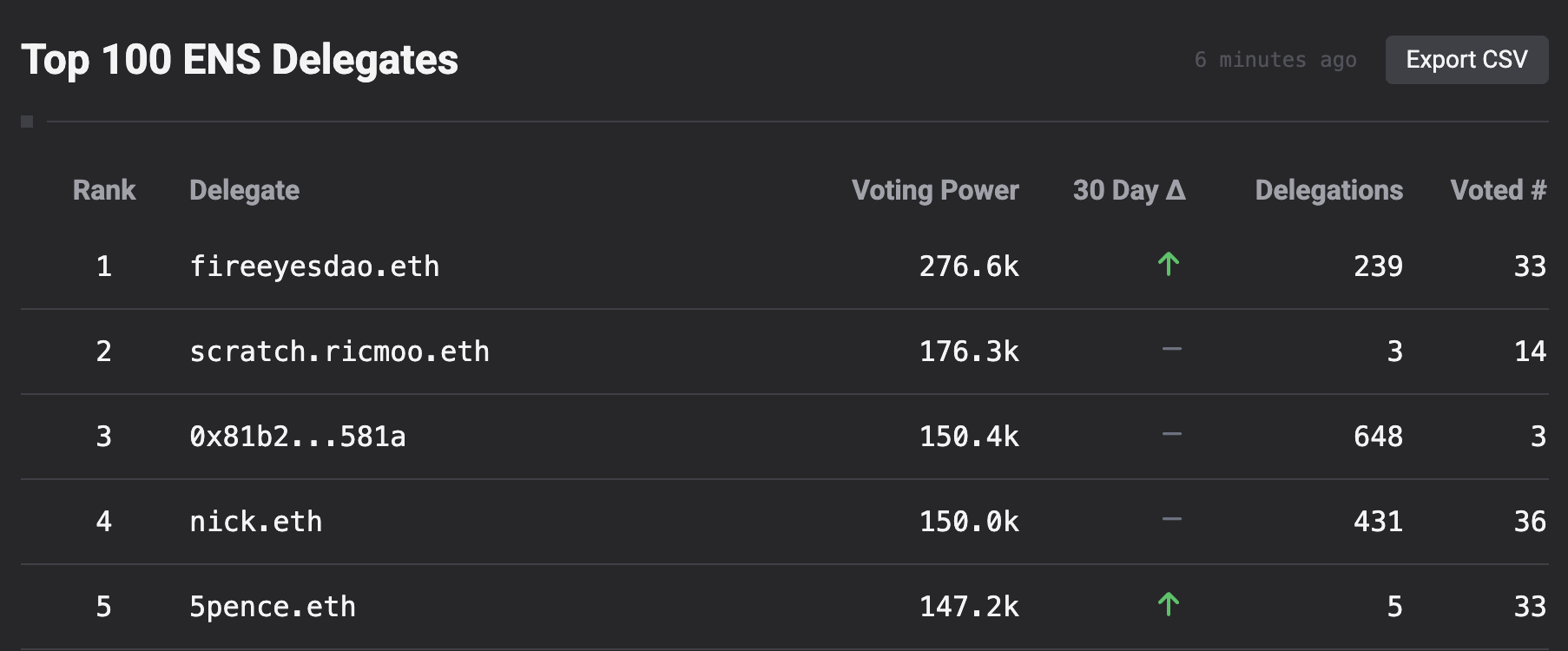
Centralization I would be worried about is the fact the top delegate has 277k votes. When measured with the last onchain proposal, which had 1.39m votes, that would make him ~20% of the active voting supply. Very concerning.
The constitution permits spending excess funds on grants; it doesn’t require it. Not issuing grants is still permitted by the constitution, though I agree it’s not a long-term strategy if ENS remains revenue-positive.
‘DAO’ applies to the organisation as a whole, not to individual components of it. If the proposed admin panel isn’t decentralized, then neither are the current working groups.
My largest concern going forward, as I’ve stated before, is our diminishing talent pool as more and more veteran contributors step down due to burnout and politics. I’m very concerned that this next election cycle may see the DAO electing from a very shallow pool of candidates, and thus result in it being inefficiently or poorly run.
It’s difficult to assess the risk of that in the abstract, though, without knowing who will be standing and who may be elected. Perhaps a more sensible proposal would be to amend the next WG elections to allow people to select ‘wind this WG down’ as an option when voting, with the result that we can evaluate the actual slates of candidates for viability rather than voting against a hypothetical.
This is an appropriate approach. The DAO should follow procedure and move forward with elections, including an option either to elect candidates or wind the WG down. The outcome of the election will inform the next steps. For example:
Scenario A
WG elections take place and new stewards are elected
Once seated, the Collective Proposal proceeds to a vote
After that vote, the DAO can:
Decide on future strategic direction
Conduct a retrospective/evaluation of the previous term
Implement any structural or organizational changes based on the evaluation
Scenario B
WG elections take place and the consensus is to wind down the Working Groups
WGs immediately return remaining funds to the DAO
An interim governance structure is adopted (per a temp check), e.g., an ENS Admin Panel
In either case, I don’t see why we couldn’t perform an evaluation — just… not for 100k
Centralising multiple attributes of the DAO back into Labs and an Admin panel creates heightened centralisation risk at minimum and a complete collapse of outside contribution at maximum. ENS DAO has led to countless contributions from across the ecosystem - Winding down working groups without even a clear structure of how this Admin panel would be chosen makes no sense. Limes has also signalled he wants to rush this proposal to a vote over coming days.
Luckily almost all delegates (not working at ENS Labs) have replied with similar energy, that this proposal is abrupt, rushed, sudden and doesn’t make sense to be pushed through.
Conducting a DAO wide retro on activities, spending and output (even with me completely out of this process if that makes delegates/the ecosystem more comfortalbe) before making any sudden decisions on structure makes complete sense and was resonated with at the IRL delegate all hands.
I would encourage readers and contributors to direct attention towards the ways we can focus on reflecting and being conscientious around next steps for ENS DAO, not rushing a reactive proposal through.
Completely agree with this - Thus why taking a step to reflect on what decisions have been made and to what end via a retro is so clearly the right step for the DAO here - Before we rush into decisions that will almost definitely reduce contribution and the talent pool for ENS.
The DAO needs to restructure how its contributors participate, but I agree with the dissenters here. This proposal would reduce DAO operations to a single administrator and several absentee signers—effectively making Labs the operator of the treasury by default.
The DAO still needs some form of working group, restructured to avoid conflicts of interest. Delegates need a small team of stewards to shepherd proposals and maintain context—administrative and facilitative, not directional.
Several people in this thread have raised COI concerns. It’s worth naming the dynamic: proposals to reshape governance are coming from people who’d benefit from the new structure, and calls to keep the status quo are coming from people who benefit from it. That’s not an accusation—we just don’t do a good job of naming these things, and most of the voices in the room have something personally at stake.
I’d vote “no” on this proposal. I believe we can build something leaner than what we have, but more robust than what’s proposed here. We need a small group with clear guardrails, focused on serving delegates and protecting the protocol’s long-term health.
I am strongly against this proposal. I believe it is poorly thought through and not in the best interest of the DAO. I am also sceptical of its underlying intent.
If you guys want ENS to be a DAO, whatever that may mean to you I am also strongly against this proposal.
On the other hand I never truly understood why ENS wanted to be a DAO and am quite bearish on DAOs in general so getting rid of it like Optimism does may not be a terrible idea.
Though I guess this is not what most people want and would also go against everything ENS has done since the constitution and becoming a DAO.
Vague accusation calling into question my integrity from someone who is on the ENS DAO Retro Working Group. Oh joy, I can’t wait for an unbiased review.
I have built software (for free) for DAO members to review transaction by transaction detail on SafeNotes.xyz. I have hand categorized and described every one of them. I have named all the working group multisigs so people could easily navigate them on ENSwallets.xyz. As secretary, I’ve prepared 9 quarterly spending reports.
I have also stated publicly and privately that I will help a review if voted for in whatever way I can.
So to suggest I have intent other than what I am stating is baffling to me when I have worked so hard to make this organization as transparent as I can.
I find this characterization reductive and presumptive. On what basis can we assert that these prospective signers would be absent? Is that informed by experience as a steward?
Paying Endowment fees is merely an administrative task, one a hypothetical Admin Panel would be well equipped to handle. It does not make it the operator of the treasury. kpk.eth has a fiduciary responsibility to the DAO and fulfills that through its monthly and quarterly reporting.
A role limited to executing pre-approved transactions does not carry discretionary control over funds. The de facto operator of the treasury endowment is kpk.eth, but only because the DAO authorized it.
Therefore, by transitive property, the DAO remains, and would continue to be, the operator of the treasury.
—
Yes, I think so too! Limes.eth pitched a scope, not a mandate. I’m big on reducing COIs, and frankly, there are many entanglements in existing WG structure that make the COI difficult to do.
Wrt facilitating props, everything needed is already documented at Governance Process | ENS Docs, and I think the onus of advocating for and informing the community about a proposal should be on the proposer, not on any designated individual.
—
I like this dialectic you’ve framed, but perhaps there’s a third secret thing?
—
I’ll go out on a limb and say it’s time to outgrow this nomenclature. We’ve been beholden to it for far too long, and it’s now doing more harm than good. I’m more interested in self-definition than aspiration.
If a review was to take place, my ideal version would be Eugene conducts it without oversight. Metagov’s reputation is strong enough so as to not need it.
Great feedback to add to the Retro forum post! I would presume that having some level of ENS context is important outside of just MetaGov, but super open to these ideas and the thoughts @eugene has here - Doing the retro is the important thing and pleased your aligned with that.