Appreciation
This proposal moves SPP forward in some notable ways, including:
1. Attention to market-oriented outcomes
I note how this proposal makes repeated reference to market-oriented outcomes. For example, the budget methodology takes DAO revenues into consideration and defines objectives that include growth in registrations, integrations, and revenue.
This is on target!
We share the call for ENS to put market outcomes at the top of its values and priorities. The adoption of ENS is still in its early days and is far from its potential. The ultimate success of ENS is not guaranteed. Momentum in market adoption feels to have slowed. It’s right for ENS to feel a sincere sense of urgency and to demand true market-oriented value creation.
2. Attention to SPP accountability
Noting how this proposal explicitly cites:
“A standing committee addresses (SPP) accountability gaps …”
and that SPP3 evaluation criteria includes:
“Prior delivery history …”
Happy to see this proposal demand high standards, proven results, and ROI.
3. New committee model
Highly supportive. This is a key step in the right direction.
Suggested refinements
Grateful to @Coltron.eth for all the work to champion the next steps on SPP3. This is a serious lift!
Having had some time to organize thoughts, here’s specific suggestions for improving the next steps on SPP.
1. SPP2 year-1 accountability review
The proposal correctly already calls out SPP accountability gaps. So far it’s been unclear exactly which body had the authority to solve this. Therefore, SPP accountability reviews continue not to happen.
This is changing now! For the first time, a SPP committee is being formed!
SPP2 year-1 accountability reviews are sure to be a high ROI for ENS. Past performance must be meaningfully critiqued and taken into account before deciding on SPP3. ENS has already invested millions into SPP2 year-1. Before millions more are invested in SPP3 we should complete this fundamental step.
It is recognized how the chief purpose of this committee is for SPP3. But it wouldn’t make sense for the committee to form judgements on how a SPP2 year-1 service provider might fit into the SPP3 cohort without first completing a structured accountability review for how that service provider performed under SPP2. Doing otherwise risks meaningful errors in how the committee might decide on SPP3 capital allocations.
Suggested SPP2 year-1 accountability review considerations include:
- Each provider’s deliverables relative to commitments
- Each provider’s quarterly reporting cadence and quality
- Notable successes, shortfalls, and lessons learned
- Value creation and ROI assessment
- Aggregate observations about SPP2 program design and execution
This accountability review serves to inform the committee’s strategies for SPP3 cohort selection (based on lessons learned from SPP2 year-1) as well as supporting the ENS DAO with optimizations to any / all future SPP seasons.
2. Committee ENS context building
ENS is on track to invest millions of dollars here. The better the committee’s mastery of ENS context, the better their cohort selection judgements will be.
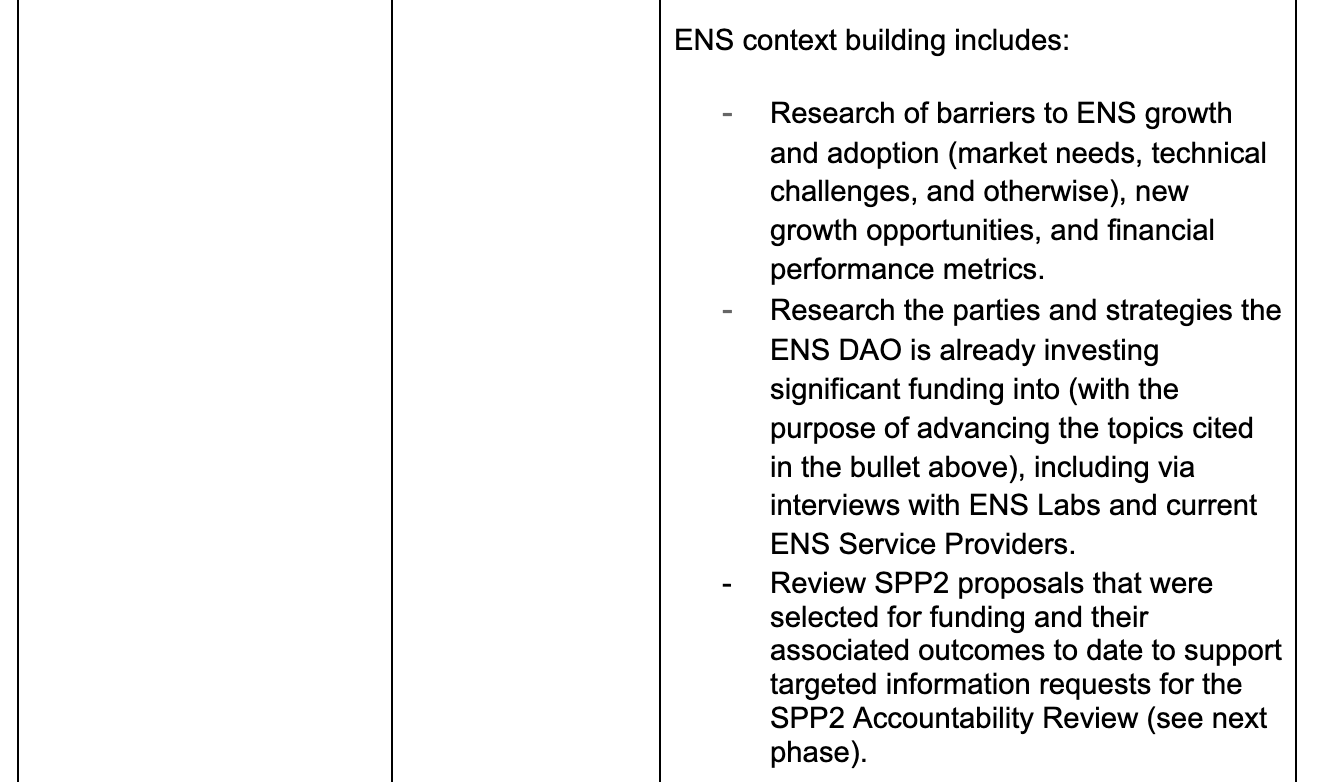
This calls for the committee to perform structured “ENS context building” to make better informed and more strategic judgments when the time comes for them to propose the cohort for SPP3.
Committee context building should include:
-
Research of barriers to ENS growth and adoption (market needs, technical challenges, and otherwise), new growth opportunities, and financial performance metrics.
-
Research the parties and strategies the ENS DAO is already investing significant funding into (with the purpose of advancing the topics cited in the bullet above), including via interviews with ENS Labs and current ENS Service Providers. What are they working on already? How is this work proceeding? What outcomes are being achieved?
Note how this is not suggesting that everyone in the committee become a technical expert in every nuanced detail of the ENS protocol. @gregskril is on the committee and will no doubt do an exceptional job at that. This is about the bigger context of affairs in ENS. A structured opportunity for all committee members to invest time into this study before SPP3 proposals are submitted is sure to be a high ROI for ENS.
3. New timeline proposal
The following is an enhanced timeline proposal for SPP3 with benefits that include:
- Prompt committee seating and an efficient transition into SPP3.
- Process harmonization with SPP2 milestones, including SPP2 Q4 service delivery that’s already in progress and due for completion on May 25.
- Time allocations for the committee to complete ENS context building and a SPP2 year-1 accountability review.
- Schedules the termination of all SPP2 1-year streams well before the exhaustion of their allowance.
- A bit more time for prospective SPP3 Service Providers to build maximally thoughtful proposals and therefore to create more value for ENS in SPP3.
- A bit more time for the committee to review proposals and negotiate the best possible cohort recommendation.
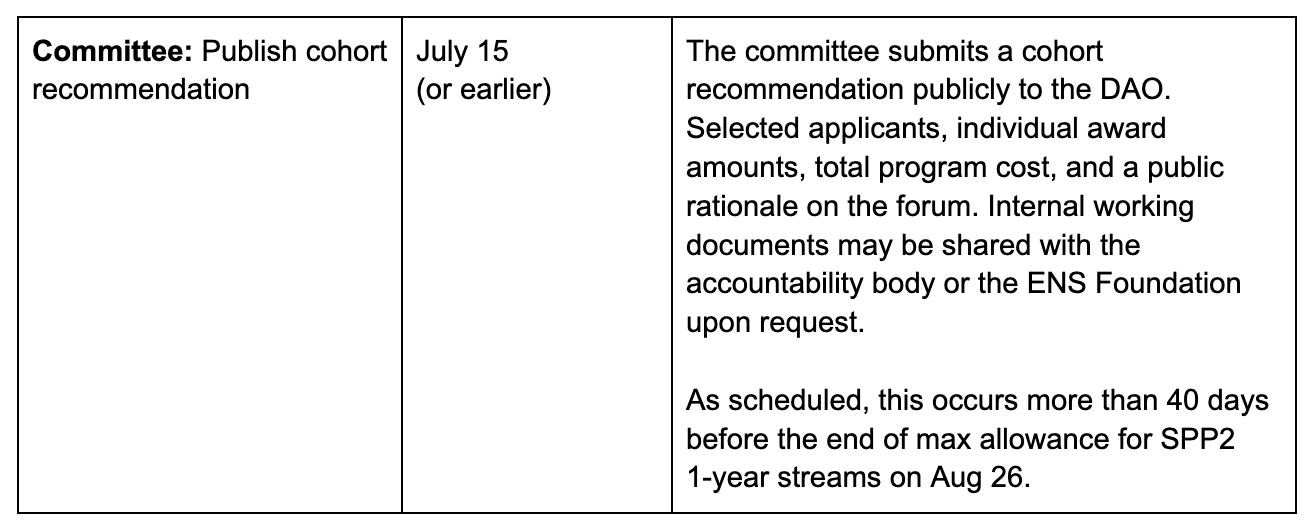
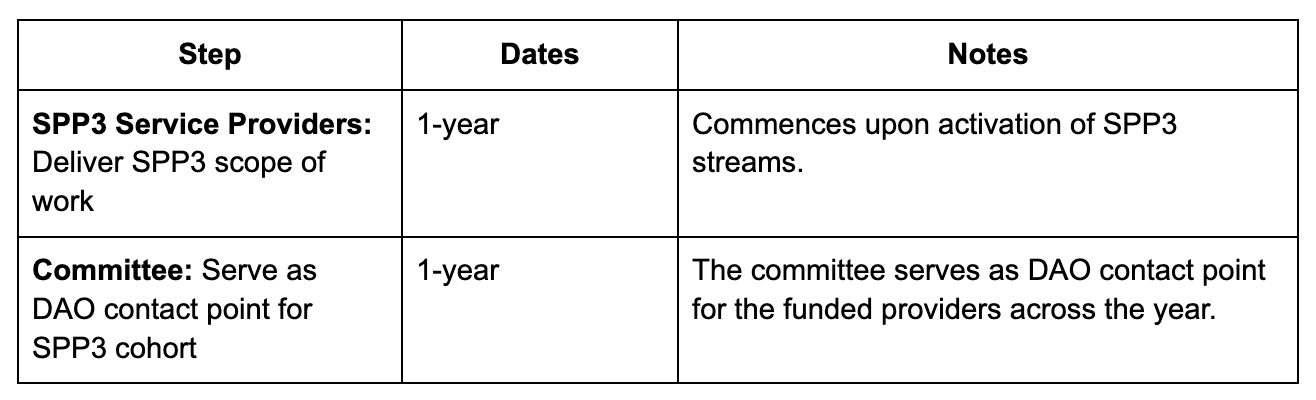
Markdown tables have their limitations, so I’ll share screenshots instead.
Phase 1: Seat Committee (ends ~May 14)
Phase 2: Committee ENS context building & SPP3 artifact prep (ends ~June 7)
Phase 3: SPP2 accountability review & SPP3 application prep (ends ~June 26)
Phase 4: SPP3 application review & cohort recommendation (ends ~July 15)
Phase 5: Ratify recommended SPP3 cohort (ends ~July 24)
Phase 6: Action SPP streams (ends ~July 30)
Phase 7: SPP3 Service Delivery (1-year period from ~Aug 2026)
Phase 8: SPP3 Season Closure (~Aug 2027)
4. Committee term and payment
The original proposal defines the compensation for committee members based on a 12-month scope of work. However, it’s actually a 15-month scope of work from the time the committee is seated (~3-months lead up to SPP3 ratification + 12 month SPP3 service delivery period, see timelines for details).
Therefore recommend that compensation for committee members is adjusted as follows based on this term that is 15-months, not 12:
- Chair: From $45,000 → $56,000 / cycle
- Member (compensated): From $35,000 → $44,000 / cycle
This added overhead would be deducted from the SPP3 budget.
It is also noted how the committee has a meaningfully higher workload in the first ~3 months. Therefore suggest adjusting their upfront tranche from 20% to 30% of their overall compensation.
5. Budget
The budget for SPP3 should be defined relative to DAO revenue, not protocol revenue (which excludes DeFi returns). What are ENS’s DeFi returns for if not to contribute to the growth of ENS?
The revenue source can therefore be the ENS DAO Quarterly Revenue Reports published by Limes) and anchored to the end of Q1, 2026.
This produces a budget cap of approx $4.03M for SPP3. After deducting the adjusted committee comp referenced in the feedback above, this leaves approx $3.85M available for service provider funding.
6. Program Authorization
Suggest that this proposal includes language such as the following to harmonize with efforts that @katherine.eth is leading related to the new ENS Foundation Board:
It is recognized that the DAO is currently considering updates to the ENS Foundation Board (per Katherine.eth’s temp check) with expanded responsibilities, potentially including unified oversight of major DAO-funded operations such as ENS Labs and ENS Service Providers.
At the moment the exact shape of responsibilities for an updated ENS Foundation Board is under discussion and has not been confirmed by the DAO. Simultaneously, the official 12-month cycle of SPP2 concludes soon on May 26, 2026. While SPP2 provides a stream allowance for 1-year SPP2 streams through Aug 26, 2026, timely clarity on SPP3 is called for. Therefore, this proposal serves to define next steps on SPP3 without waiting on decisions for the updated ENS Foundation Board.
The exercise of harmonizing the governance of any future SPP cycles after SPP3 with potential updates to the ENS Foundation Board is outside the scope of this proposal.
7. “SPP3 Outcome Alignment Incentive Program”
We have suggestions for an “SPP3 Outcome Alignment Incentive Program” that would provide committee members with a percentage of DAO net revenue increase achieved over the duration of SPP3 beyond a minimum floor and up to a max incentive cap of $100k USDC per committee member if DAO revenues scale by sufficient millions during the SPP3 service delivery period. The explicit objectives and evaluation criteria for SPP3 reference DAO revenue growth being a key north star for the program. The goal would be to incentivize committee members to meaningfully invest their efforts to align their cohort recommendations to this explicit “first-order” desired outcome for SPP3. A number of mechanic details have been planned out for how to execute this, including normalization of revenues for potential upcoming name price changes, etc. This reply I’m writing is already exceptionally long and therefore I’ve decided for now to cut the detailed writeup I made that proposes a framework for this. I may share another reply in this thread later with the details but didn’t want to distract from other key topics above at the moment.
8. Expand committee to include member with strong commercial background
All the named committee members look solid. Confident each has strong insight and wants to see that SPP3 achieves good outcomes for ENS.
At the same time, not having deep knowledge of the named committee members (and therefore just going off of short bios), I note the presence of public goods funding and technical backgrounds. What about a committee member with a strong commercial background? Someone who has proven judgement on what delivers successful market outcomes, go-to-market strategies, business development, sales, marketing, and other ROI-oriented capital allocation contexts?
For example, in the proposal above, I note use of the word “grants” in the following phrase:
Incomplete or abandoned prior grants are weighted negatively.
I disagree with a framing that funding for ENS Service Providers is a “grant”. I read that to suggest we are hopelessly detached from measurable market outcomes that contribute back to the bottom line for ENS, or perhaps that we are charity projects.
Each ENS Service Provider should be held to a high standard of accountability. ROI and value creation should be demanded. We are not here to play games or do academic research or build technical curiosities with no hope of real use. If the work a service provider delivers doesn’t drive market adoption for ENS (directly or indirectly), the work fails.
Getting back to the main point: Suggest expanding the named committee by 1-member with a strong business background.
9. Google Doc with Suggested Redlines
See this Google Doc with redlines of the exact suggested changes for easier diffing.
NOTE: The new “Timeline” section in the doc linked above has redlines representing a new writing of the schedule. This is a simplification for readability to avoid what would otherwise have too many noisy redlines. This new “Timeline” section provides a recommended process for SPP3 (matching the screenshots posted here to the forum) and consolidates ideas that previously were distributed across the “Pre-Submission Work”, “Process”, “Next Steps”, and “Timeline” sections.








 This proposal is now live for voting on