Greenpill Network fund presentation: Network funding focuses on securing sustainable funding and building partnerships that strengthen Ethereum’s cultural and technical foundations at the local level.
Open floor for all questions, proposals and other presentations etc.
Fabric is a nonprofit focusing on out-of-protocol infrastructure for Ethereum, with a shift towards in-protocol aspects.
Two main efforts: Fabric (based rollups and pre-confirmations, focus of the ENS grant) and Commit Boost.
Commit-boost is entirely grant-funded, aiming to avoid venture capital.
~30% or more of validators on Mainnet are running Commit Boost.
Teams are launching pre-confirmation protocols in production.
Commi-boost has significant adoption on the mainnet.
The main registry contract has undergone 2 audits.
Integrations are in progress across multiple teams.
The Fabric website compiles research on based rollups and pre-confirmations.
The focus was always on based rollups to heal fragmentation because of synchronous composability.
Realization: synchronous composability can be achieved without running a based rollup, as long as coordination with validators making pre-comp commitments is possible.
Goal: put together a testnet working with different teams for end-to-end pre-confirmations integrated with the based rollup.
Target date: DevConnect (cross fingers).
Continue pushing on synchronous composability research in and out of protocol.
Network funding focuses on securing sustainable funding and building partnerships that strengthen Ethereum’s cultural and technical foundations at the local level.
Turning Degens to Regens.
Weekly podcast with Kevin Owocki with leaders and founders.
262 episodes, 1.9k followers.
6 active local chapters across 9 countries.
Aims to build a transparent, community-driven capital allocation system.
Proposals raised by local chapters are reviewed, discussed, and voted on.
Proposed research (already passed and planning to execute):
Thailand: will set up environmental sensors to monitor air pollution, temperature, and noise.
Nigeria: will monitor water quality, course usage, and sanitation in a selected community.
South Africa: will turn waste into healthy components for a community garden.
Hopes ENS Small Grants can support at least 5 to 10 different projects.
Funding request: 2 ETH
8. Open floor for all questions, proposals and other presentations etc.
Third edition of Ethereum Mexico is being organized in late October.
Popup innovation hub: conference + hackathon + pitch day
Seeking potential support from the DAO
Reaching 1,000 people to join the activities, side events, and hackathon.
Looking for at least 250 hackers.
The event was awarded the “best and biggest event” last year.
Dev Guild Green Pill Network presentation: Squad Staking lets people collectively stake 32 ETH to run an Ethereum validator. By pooling resources, it lowers solo operator costs and risk. Obol (DVT), Dappnode, and Lido provide the software, hardware, and economic rails that make this model viable. Validator rewards can become a steady source of public goods funding, aligning individual incentives with collective benefit.
Zawadi Protocol presentation: Plug‑and‑play protocol for hackathon bounty payouts
Open floor for all questions, proposals and other presentations etc.
Squad Staking lets people collectively stake 32 ETH to run an Ethereum validator. By pooling resources, it lowers solo operator costs and risk. Obol (DVT), Dappnode, and Lido provide the software, hardware, and economic rails that make this model viable. Validator rewards can become a steady source of public goods funding, aligning individual incentives with collective benefit.
Impact Stake has been building staking infrastructure for easy donation, allowing people to donate, stake, and have yield go to public goods.
Plans: Next two workshops: onboarding with Dappnode (UI for staking) and deploying a squad to testnet or mainnet.
The ask: Cover the cost of 2 workshops, creating content, etc.
Example application: supporting microgrids in Nigeria by covering utility costs with node yield.
Partnering with Solar Village and Greenfield Nigeria.
Aiming to onboard 3-5 more squads in the next few months.
5. Zawadi Protocol presentation: Plug‑and‑play protocol for hackathon bounty payouts
Zawadi is a decentralized protocol for managing hackathon prize escrows. It enables organizers to create hackathons, whitelist sponsors, set up prize challenges, accept funding in ERC20 or native ETH, define winners and allocations, require dual approvals from organizer and sponsor, and allow self-service winner payouts
mevlog-rs - EVM transactions querying update: mevlog-rs is a CLI for querying EVM transactions
REEC (Rust Ethereum Execution Client) presentation: REEC is a lightweight, modular Ethereum execution client written in Rust, designed for embeddability and efficient operation on resource-constrained environments.
Open floor for all questions, proposals and other presentations etc.
REEC is a lightweight, modular Ethereum execution client written in Rust, designed for embeddability and efficient operation on resource-constrained environments.
Aims to decentralize Ethereum infrastructure in design and geography.
Goal: make Ethereum execution layer more modular, accessible, and resilient.
Ethereum’s core execution clients are concentrated technically and geographically
Making the Ethereum execution layer more modular
There are only a handful of heavyweight clients that are tightly coupled.
Geographically, execution clients are mainly built and maintained in Europe, North America, or Asia, with none being developed in Africa.
This creates a lack of diversity and limits participation in Ethereum’s critical infrastructure.
Reec is a new execution client designed to be modular and lightweight, built for a post-Ethereum future.
Client diversity strengthens Ethereum’s security.
Lighter clients will be critical for resource-constrained environments like mobile devices, browsers, embedded devices, and research tooling!
Hackatsuon wrapup presentation: we supported a two-week residency and hackathon in Kesennuma City, a rural port town of 60,000 people six hours from Tokyo, heavily hit by the 2011 earthquake. The team will present all the results and takeaways from the event
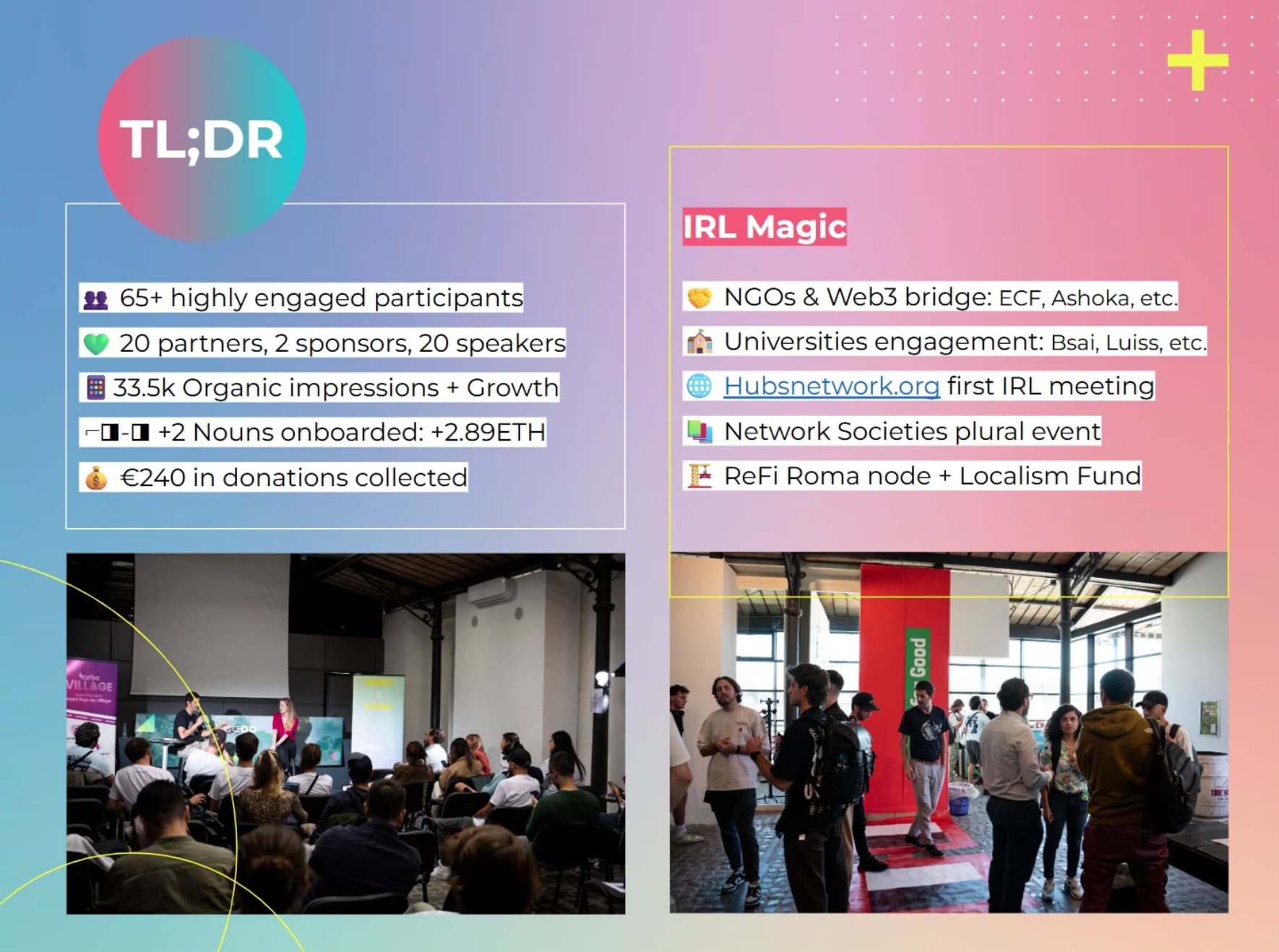
URBE Campus updates
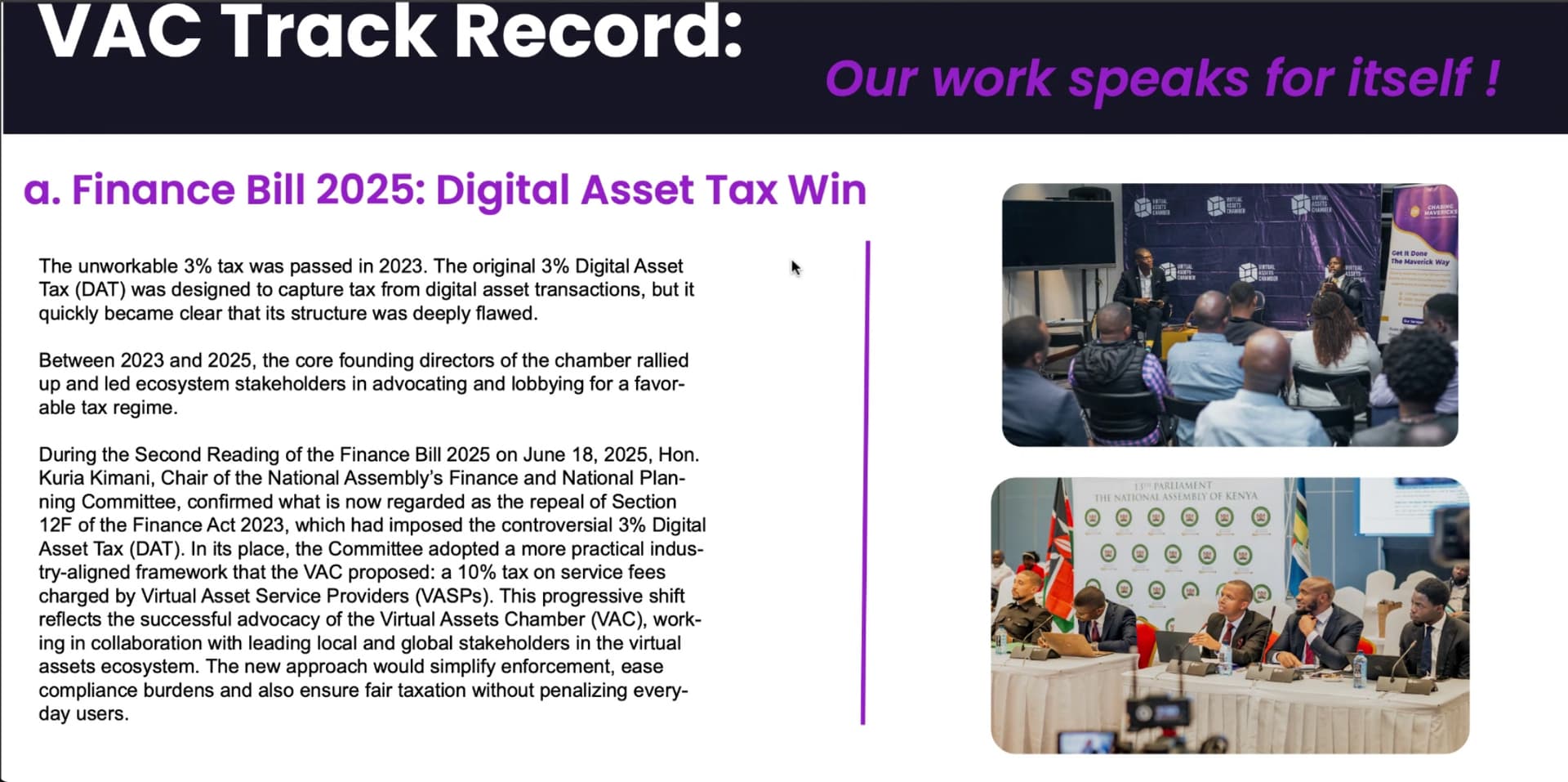
VASP Bill, 2025 passed in Kenya: A historic step for Kenya’s virtual asset economy was taken on 15th October 2025, as the Virtual Asset Service Providers (VASP) Bill, 2025, successfully underwent presidential assent and is now an act of parliament
Open floor for all questions, proposals and other presentations etc.
Budget for the October window for the Public Goods Working Group is up.
This is the last budget request before the end of the term.
It will stay on the forum for discussion and then move up for a vote.
Everyone is encouraged to comment and ask questions.
4. Hackatsuon wrapup presentation
“We supported a two-week residency and hackathon in Kesennuma City, a rural port town of 60,000 people, six hours from Tokyo, heavily hit by the 2011 earthquake. The team will present all the results and takeaways from the event.”
Residency program + hackathon in Japan.
Lots of partners and sponsors, including ENS, EF, Centrum, and others.
Worked with the local government on local challenges.
Purpose of workshops was to build directly with the local government.
15 developers from 8 countries came and worked on projects.
Worked with Curvegrid on developer tooling with hackers.
The first project was onchain voting system used at the public showcase.
The governor, despite limited crypto knowledge, successfully voted on-chain.
Builders continued working on projects after the hackathon, meeting with local officials to discuss implementation at the municipal level.
The core component was to build open source software with the community, aiming to implement solutions directly with the local government.
The hackathon made people inspired with the direct impact.
Local officials are very interested in the hackathon again next year.
A historic step for Kenya’s virtual asset economy was taken on 15th October 2025, as the Virtual Asset Service Providers (VASP) Bill, 2025, successfully underwent presidential assent and is now an act of parliament
Presenting next week
7. Open floor for all questions, proposals and other presentations etc.
Brief ICANN 84 AGM takeaways - full insights on next week’s call
VASP Bill, 2025 passed in Kenya: A historic step for Kenya’s virtual asset economy was taken on 15th October 2025, as the Virtual Asset Service Providers (VASP) Bill, 2025, successfully underwent presidential assent and is now an act of parliament
Hackatsuon project presentation: continued from last week post Hackatsuon wrap up (a two-week residency and hackathon in Kesennuma City, a rural port town of 60,000 people six hours from Tokyo, heavily hit by the 2011 earthquake)
Agentic Zero presentation: a one-day, in-person AI × crypto summit on November 20th, 2025, focused on open, permissionless rails for autonomous AI systems. The event will include keynotes, live demos, and panels from people building in the space.
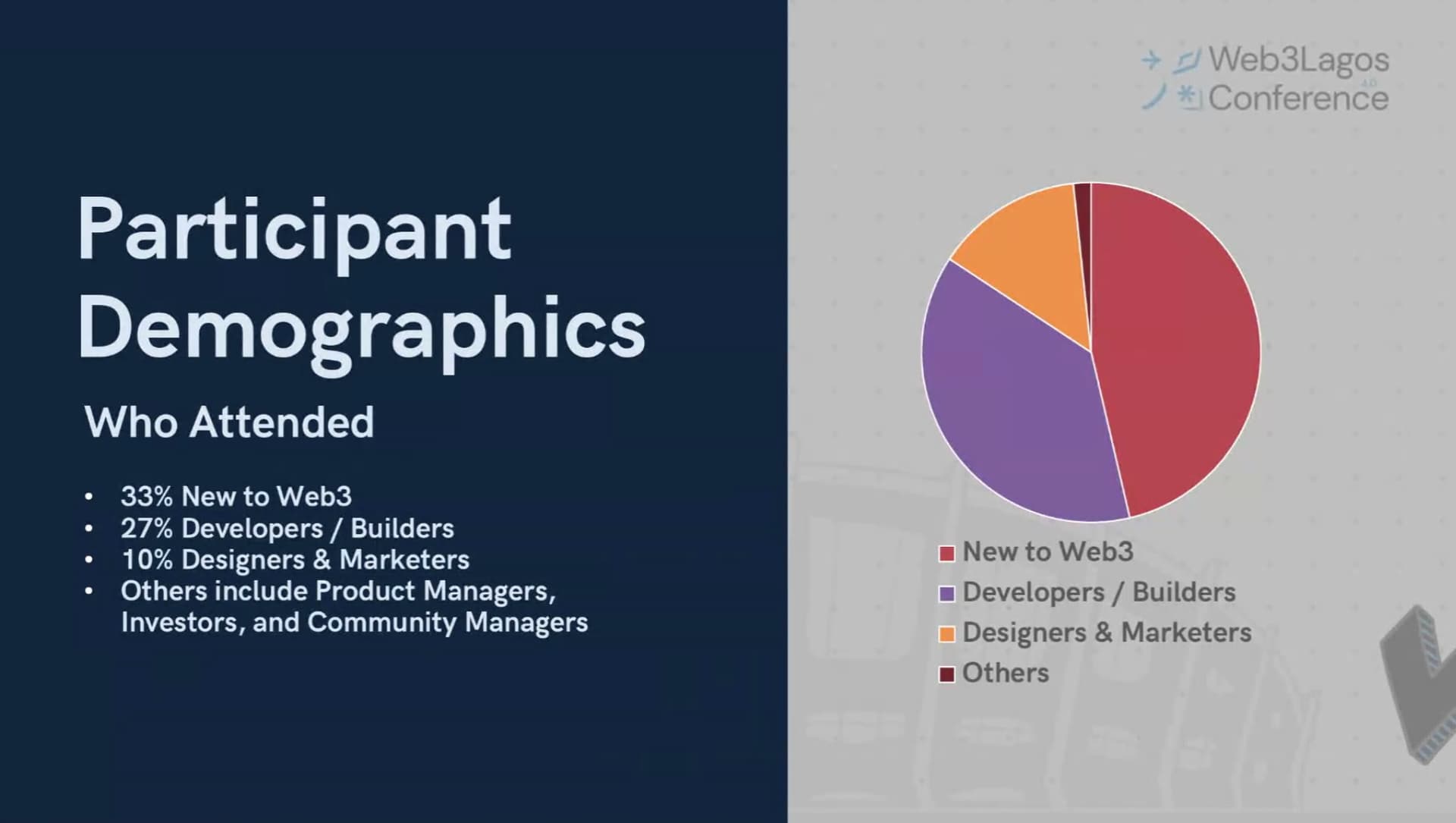
Web3Lagos presentation: conference wrap-up and impact report
Open floor for all questions, proposals and other presentations etc.
3. Brief ICANN 84 AGM takeaways - full insights on next week’s call
Full insights will be on next week’s call.
ENS Labs was in Dublin with PG WG.
Quick takeaways:
Very old school organization – Web1.
Big pushbacks: domains exist in perpetuity per the ENS constitution
Traditional domains can be registered for up to 10 years.
80-90% of domains are registered for 1-2 years.
No policy around the removal of the domain is an issue
Lack of a system for UDRP, IP infringement, etc.
Proposition for a solution:
Venn’s diagram of what will work for both parties.
4. VASP Bill, 2025 passed in Kenya
A historic step for Kenya’s virtual asset economy was taken on 15th October 2025, as the Virtual Asset Service Providers (VASP) Bill, 2025, successfully underwent presidential assent and is now an act of parliament
Continued from last week post Hackatsuon wrap up (a two-week residency and hackathon in Kesennuma City, a rural port town of 60,000 people six hours from Tokyo, heavily hit by the 2011 earthquake)
Voting platform presentation
A voting platform for people unfamiliar with crypto to vote on projects
Users downloaded a smart contract wallet with gas extraction, scanned a QR code, and connected to the app to vote.
The application is a 3D map capturing stories from the community.
Community members contributed stories and pictures to the platform.
The project resonated with the community and local government because it preserves stories in a place threatened by natural disasters and rural depopulation.
6. Agentic Zero presentation
A one-day, in-person AI × crypto summit on November 20th, 2025, focused on open, permissionless rails for autonomous AI systems. The event will include keynotes, live demos, and panels from people building in the space.
Agent Zero is a one-day AI and crypto summit focused on open and permissionless infrastructure for autonomous systems.
Hackatsuon presentation continued: chatting with the Chief of Kesennuma City Planning Division Usukura-san and Shoei-san from the Planning Division about their experience during the hackathon
ICANN 84 AGM takeaways - full insights from the ENS contingent on the ground and Emily Murray
Open floor for all questions, proposals and other presentations etc.
PG funding vote is up, along with MetaGov and Ecosystem.
4. Hackatsuon presentation continued
Chatting with the Chief of Kesennuma City Planning Division Usukura-san and Shoei-san from the Planning Division about their experience during the hackathon
Two officials from the city planning commission are joining the meeting to discuss their experience with the hackathon.
The city officials state that the purpose of the hackathon was twofold:
To address the challenge of limited access to cutting-edge and digital technology in rural governments in Japan.
To address the declining population in rural areas by inviting people from outside the area to sustain the community.
Hakkatson will continue next year.
The mayor joined the event and was onboarded to Web3.
Next Steps
Gather questions to send to the Hakkatson organizers.
Coordinate with Hikari to get those questions answered.
5. ICANN 84 AGM takeaways
Full insights from the ENS contingent on the ground and Emily Murray
D3 announcement was well-received and attended.
Invited to speak at another ICANN event in December in Nashville.
ICANN event in Dublin
Emily covered sessions remotely, attending 20 hours across 17 sessions.
Sessions focused on the new GTLD program, Governmental Advisory Committee (GAC) activities, ICANN Board activities, Generic Name Supporting Organization (GNSO) activities, rights protection mechanisms, and DNS abuse.
gTLD program
Program set to launch in April 2026
ICANN board approved the new gTLD Applicant Guidebook
Application window will likely run for 12-15 weeks
Base application fee is $227,000
Review process will take 14-19 months after the applications close
Applying for the same or functionally identical string as someone else will result in a contention set, which will likely go to auction.
Auctions can cost millions of dollars and negotiations are prohibited.
ICANN has an applicant support program covering 80% of the cost.
The community is enthusiastic about the new TLD program.
Concerns were expressed about technical readiness
It’s important to get the word out to other members of the Web3 world that this opportunity is happening in April 2026.
The stablecoin legislation has passed, the regulatory environment has very much evolved, and a lot of the traditional finance organizations are interested in being able to integrate with the world of Web3 as well.
This puts ENS right at the center of this changing universe, which is great for ENS and means lots of new integrations for ENS on the horizon.
People were surprised but happy to see ENS representatives at ICANN.
ENS is being accepted into the ICANN community, evidenced by invitations to DNS abuse and new gTLD program meetings.
DNS abuse was a major topic at ICANN 84, with ongoing opportunities for policy engagement.
ICANN is moving towards a formal policy development process, offering opportunities for participation and public comments.
ICANN is exploring ways to combat DNS abuse.
Advocate for continuing priorities, potentially developing a UDPR-like system for Web3.
Next steps:
Emily’s report will be released on the forum first.
Thomas and James are preparing their own write-ups, which will be shared next week.
Participate in the public comment period on string similarity
Monitor the registration data request service public comment opportunity
Closely examine the final new gTLD Applicant Guidebook
Plan for ICANN 85 next year.
Education is key to addressing confusing pushbacks!
6. Open floor for all questions, proposals and other presentations etc.
multisigned - Credibly Neutral Passkey Infrastructure for Ethereum presentation: multisigned is open-source key infrastructure that lets any developer host their own passkey-based authentication for Ethereum applications. Built for the social side of Ethereum where users want seamless login. The innovation: client-side encryption means developers can run their own infrastructure without being able to read users’ keys or hold them hostage. This eliminates vendor lock-in while keeping setup simple.
European Decentralisation Institute updates
Open floor for all questions, proposals and other presentations etc.
The ICANN report put together by Emily post Dublin has been shared.
The report contains information discussed in the call and more.
All reports will be added to the thread for visibility.
5. multisigned
Credibly Neutral Passkey Infrastructure for Ethereum presentation: multisigned is open-source key infrastructure that lets any developer host their own passkey-based authentication for Ethereum applications. Built for the social side of Ethereum where users want seamless login. The innovation: client-side encryption means developers can run their own infrastructure without being able to read users’ keys or hold them hostage. This eliminates vendor lock-in while keeping setup simple.
Convenient, trustless pro-privacy wallet.
Traditional wallets (Metamask, Rabi) – safe, self-custodial, but hard to set up.
New wallets (Rainbow, WaaS like Privy, social wallets like Farcaster):
More user-friendly, but less safe, less self-custodial, and sometimes dysfunctional.
Some wallets are becoming extractive.
Regulatory capture is a concern, especially for wallets hosted in the US.
None of these wallets embrace privacy.
Multisigned Aims to combine the best aspects of both types of wallets.
“Chromium of Crypto Wallet” - open source, collaborative, and with good UX.
Generates an Ethereum seed phrase in the browser and encrypts it with a passkey-derived PRF encryption key.
Why Multisigned?
Safe: Keys are segmented by domain/app.
Easy to set up: No need to switch apps; passkeys are widely available.
Neutral: Funded as a public good; all code will be open source.
Beautiful UX: App developers can customize the code.
Privacy-focused: Supports privacy natively.
Not regulatory capturable: Open source project.
No extractive behavior: Run as a public good.
Standard compliant: Can be used in any common web browser or app.
The European Decentralization Institute started in April this year and has a team of almost 20 people.
The institute is a think tank dedicated to advancing decentralization as a strategic foundation for Europe’s society and economy.
The first roundtable was held in Brussels two weeks ago to discuss digital sovereignty and decentralization.
Digital sovereignty is a huge topic in Europe, with governments concerned about dependency on big tech.
The goal is to create a next step in self-sovereign digital identity, making it more private and decentralized than current proposals like the European Digital Identity Wallet.
Opportunities exist to influence policy, especially in the UK, where discussions are ongoing about government-issued digital identity and the wallet’s design.
The aim is to provide solutions and engage with policymakers and regulators, using examples from countries like Switzerland.
The goal is to create a model based on successful examples that can be applied to other countries in Europe and beyond.
The policy cycle will evolve to allow input and lobbying, similar to the DRC’s efforts in the U.S.
The proposal suggests streaming yield-bearing USDC instead of pure USDC for payments to vendors and NS Labs.
This could potentially generate a cashback of $400k for the DAO, based on an average yield of 5%.
The streamer supports volatile assets and has slippage protection.
It also has a termination functionality that terminates the streams.
The smart contracts have been audited by OpenZeppelin.
Currently developing a Dapp for claiming streams.
There is $10M under the Streaming / TVL.
4.2. Marcus Interoperability Research Proposal
The grant was approved.
The discussion is about the direction of the research proposal.
Deliverable discussion: Having a specific deliverable at the end that could be a resource for developers interested in building on ENS.
The deliverable could be a report or a platform of knowledge.
Suggested starting with what others have built and where they stopped, highlighting the difficulty of achieving universal resolution due to the challenge of fully decentralized and trustless resolution and interoperability.
4.3. Hackathon Update
Mexi posted the video and will update milestone number two on the webpage for the grant.
The report is expected to be finished later this week
Mexi would like to present findings and details in another session
Review of the work the DRC has done since receiving the grant.
Presented by:
Tony: Co-founder of the DRC, strategy and operations.
Kyle: Head of policy, based in D.C.
Last year, received a grant from the EF for advocacy work.
Recognized that legislation/regulation work in D.C. was primarily done by centralized entities.
Spent time writing reports, creating educational materials, and speaking to people in Congress.
DRC’s role: to educate regulators and policymakers on decentralization and incentivize it through policy.
Convened leaders in Washington, D.C.
Lobbied the House, Senate, SEC, and CFTC.
Meeting with Republicans and Democrats in the Agriculture Committee to educate them on consumer protections in decentralization.
The House proposed the Clarity Act, which passed on a bipartisan basis
Included a control test to determine when a blockchain network was deemed truly decentralized.
Test became the gold standard for testing control for blockchain networks.
Engaging in a large education campaign with the Banking Committee and the Ag Committee to emphasize the importance of true decentralization and its benefits.
Scaling the organization for the next 3-5 years to engage in an educational campaign at the SEC and CFTC as they start creating rules for the market.
The goal is to have legislation passed and on the President’s desk by April to avoid complications from the midterm elections.
Failure to pass legislation could lead to regulatory actions by the SEC and CFTC, which could be overturned by future administrations.
Pushing for the best possible legislation now, while scaling the organization to educate the SEC and CFTC in case legislation doesn’t pass.
Aiming for a markup that incentivizes decentralization and strong consumer protections, even if it means waiting until January, and recognizing that any Senate bill must still gain approval from the House.
The problem Pran is trying to solve is that the 7702 standard is difficult to understand for new developers, partly because external wallets block authorization transactions.
Pran built a playground with 2 sections:
Playground section with details
Demo section for delegation and sample transactions
Playground Features:
Uses dev wallets with encrypted keys stored in local storage.
Allows users to delegate to smart contracts, giving EOA accounts smart contract capabilities.
Includes tooltips to help developers understand what’s happening.
The playground uses a sponsorship API to sponsor transactions, so users don’t need funds in their wallet for authorization.
Users can perform operations not possible through an EOA, such as batch transactions.
Considering adding more complicated operations in the future.
Shared the project with others for feedback and plans to share it with a larger group of developers, gather feedback, and add more features.
The next step is to integrate it into the extension, which will require refactoring to add the wallet.
6. Open floor for all questions, proposals and other presentations etc
Posted a wrap-up of the last term of everything done by the PG WG.
A dashboard has been created to see everything broken down by category.
6.1. Namehash Labs
ENS Holiday rewards
Referral program with a prize pool of up to $10k to incentivize .eth registrations and renewals.
The program runs through December 31st and is the beginning of the ENS Awards program.
6.2. Marcus
Quick update on the grant
Marcus is using it to develop a universal resolver matrix, a framework for mapping trust models, proof systems, and verification paths to expand ENS trust-anchored namespace coverage.