The delegate all-hands is a monthly meeting with a curated agenda to streamline decision-making and boost attendance. Please take a moment to review the linked posts so you have context going in.
This proposal aims to coordinate work across what were previously 3 working groups, with proposed stewards ensuring execution.
Concerns and Debates:
The proposal is seen as not aligning with previous discussions that favored reducing the number of working groups for quicker action, potentially “slowing things down even more” and creating a “bloated structure.”
Concerns were raised about the significant workload on the proposed stewards and a perceived lack of a clear plan for how the outlined work will be completed.
There was an expectation of a “more minimal” and “simplistic framework.”
Public Goods Funding: The proposal outlines a process for public goods funding, involving initial coordination calls and dedicated expert calls, with stewards facilitating DAO proposals and snapshots to establish official positions.
Conflict of Interest Discussions
Thomas (Service Provider): Concern was raised that Thomas, as a service provider (unruggable), might gain unique insights or influence. Mitigation proposed includes radical transparency, public documentation of activities, and recusal from unruggable-related decisions.
G (Endowment Employee): Concern about G’s employment with the Endowment creating a conflict of interest for coordinating fees and reviewing the Endowment. Thomas cited G’s financial knowledge and articulate presentation as valuable.
Ballot Options: A ranked-choice vote is proposed, offering multiple options for the DAO’s structure, including continuing with three working groups, a Metagov working group only, Metagov plus Secretary, and the DAO coordination layer proposal.
The DAO Coordination layer proposal will be included as an option in the Term 7 Proposal.
It will be submitted as soon as possible.
3. Open discussion
SPP3 Calls:
These calls are ongoing and useful for answering questions. The next SPP3 call is scheduled for tomorrow at 10:30 AM Eastern Time and is listed in the public DAO/ENS calendar.
Next Delegate All Hands:
The next meeting will be a delegate all hands call. The agenda for this call will be published in the coming days, accompanied by a outreach to delegates to encourage attendance.
The delegate all-hands is a monthly meeting with a curated agenda to streamline decision-making and boost attendance. Please take a moment to review the linked posts so you have context going in.
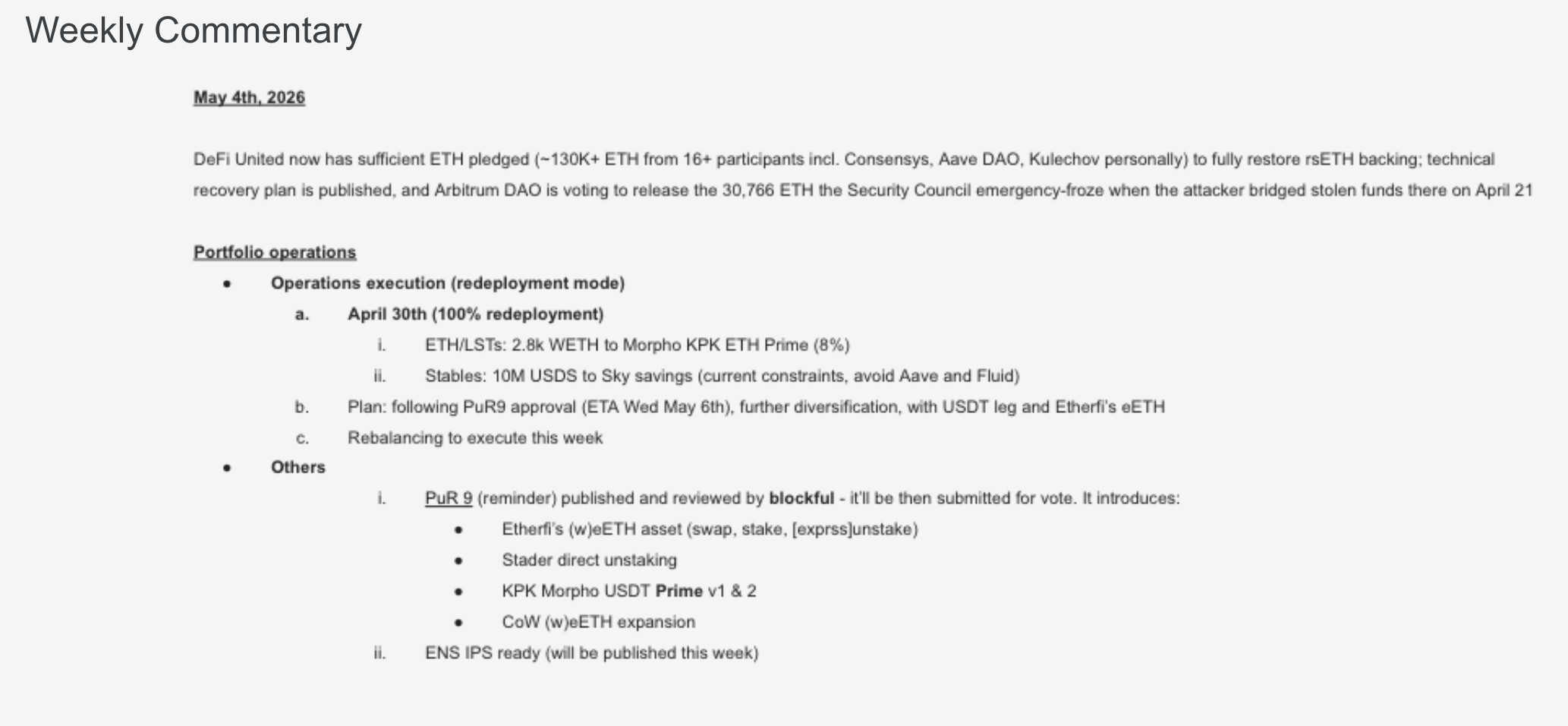
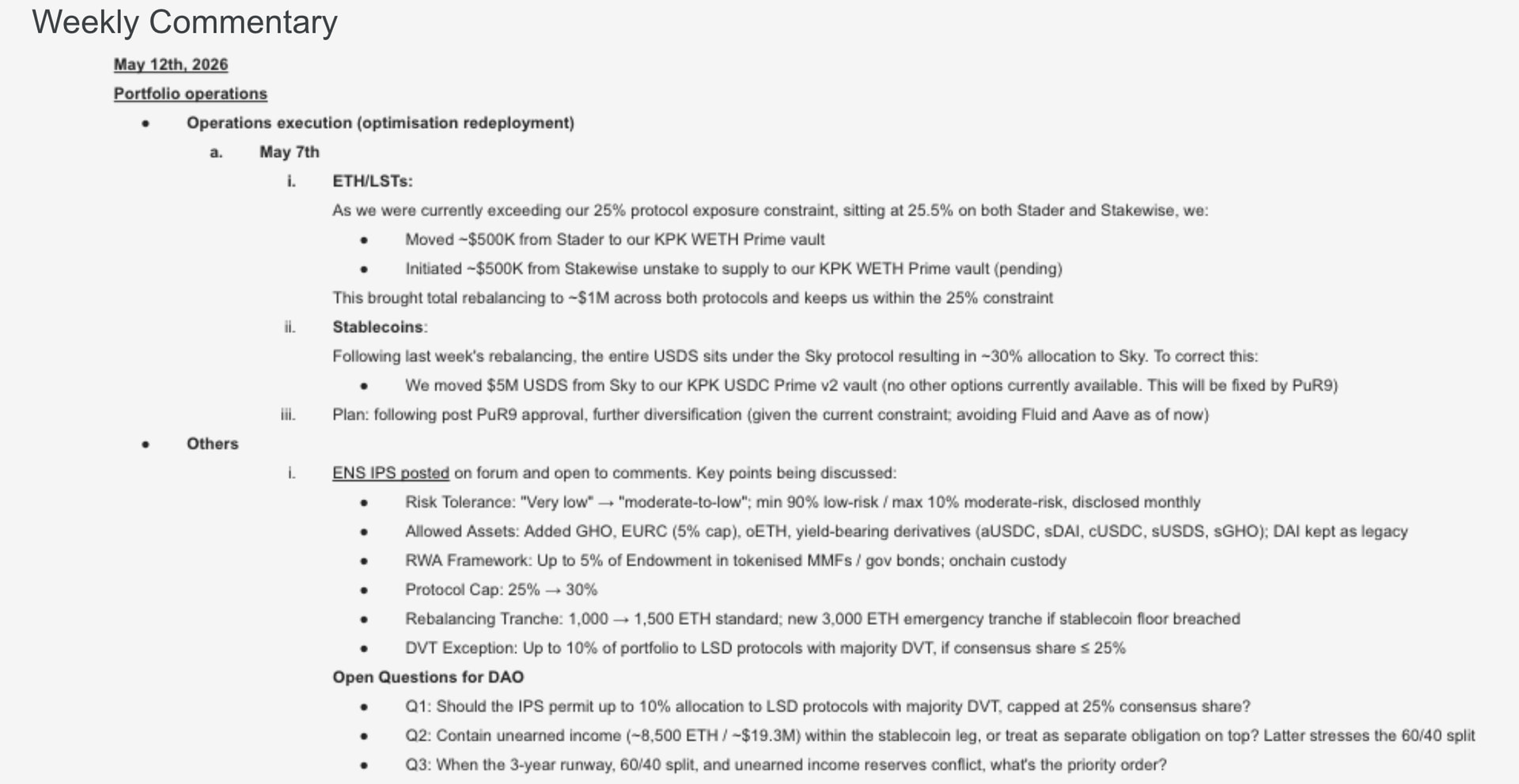
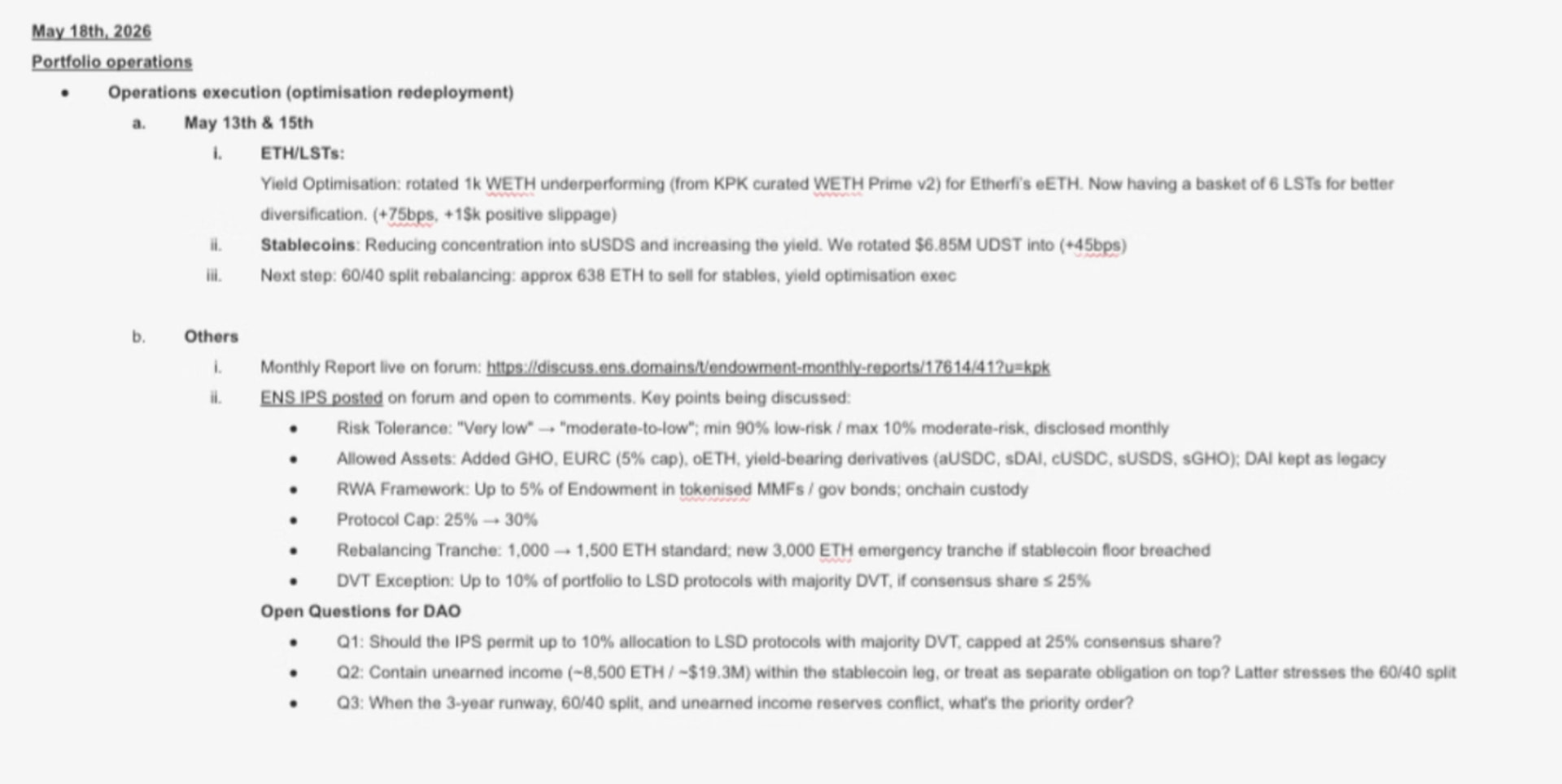
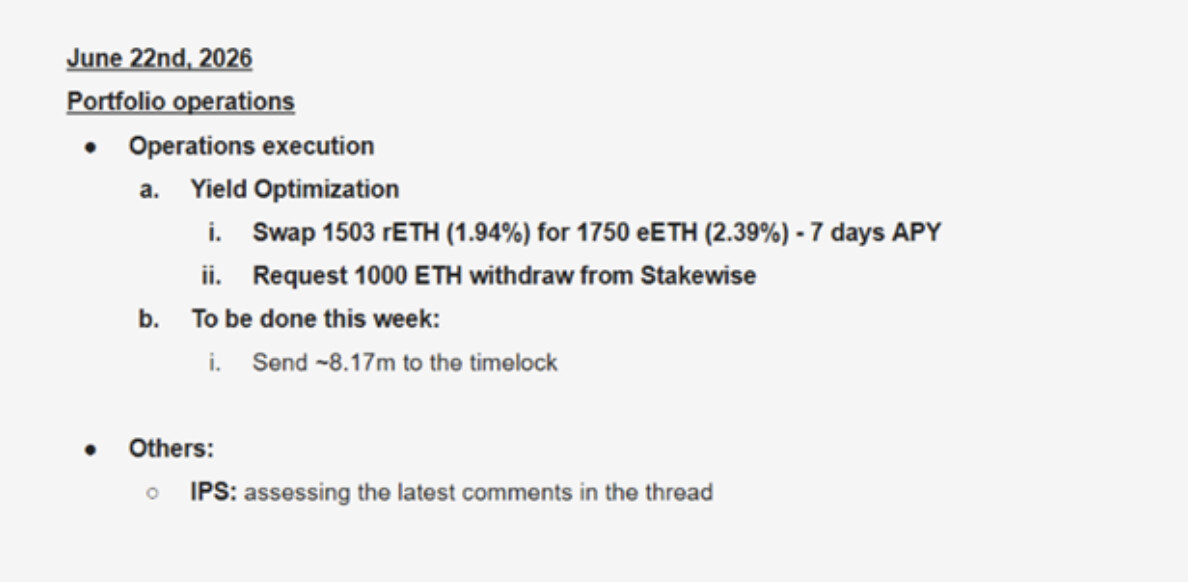
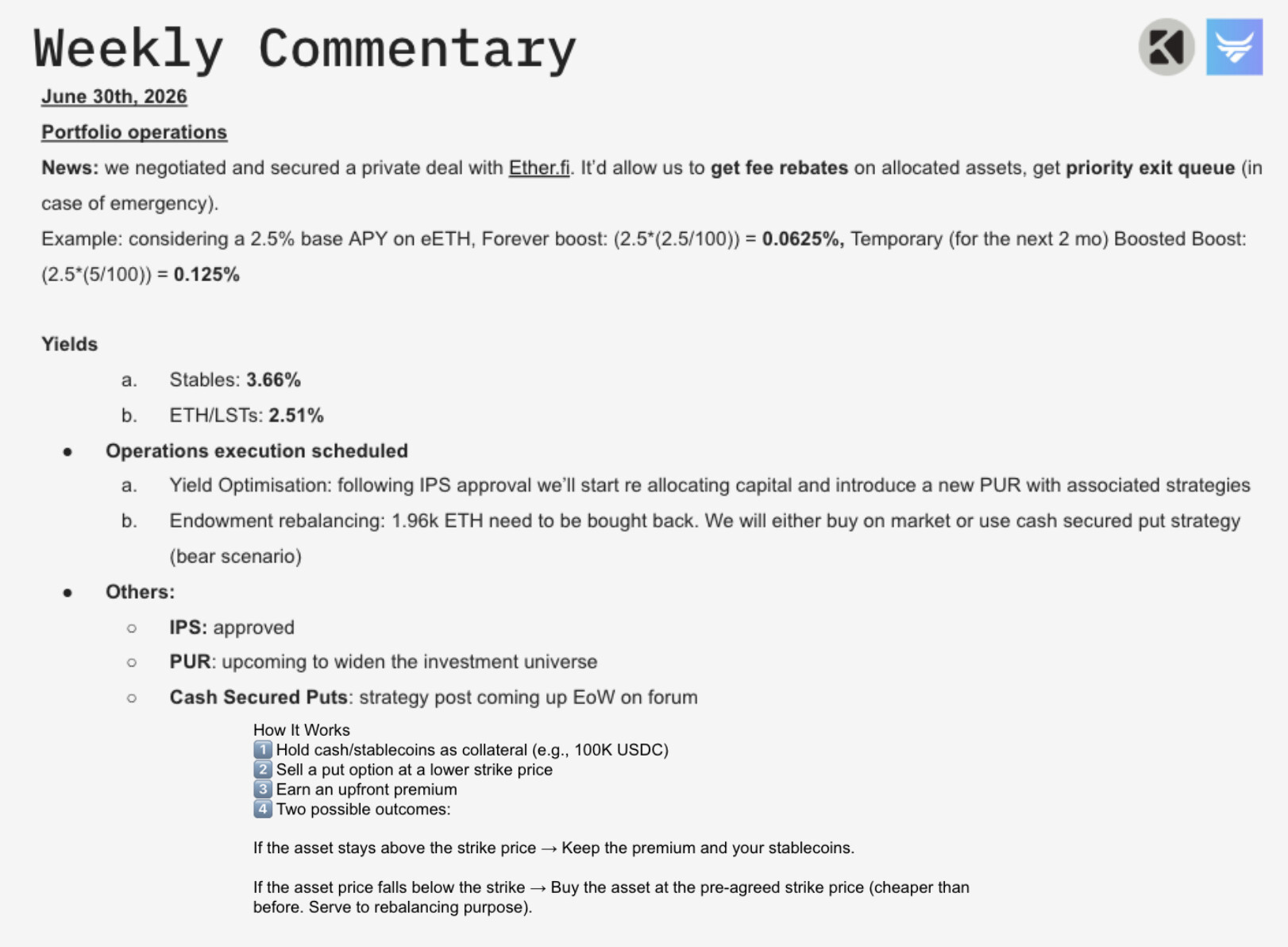
Proposed IPS updates include formalizing that 100% of protocol revenue goes to the endowment, updating the stablecoin runway to 3 years plus a 6-month buffer, and increasing protocol allocation thresholds from 25% to 30% of endowments.
Risk allocation changes are proposed to allow more room for new, low-to-moderate risk strategies, and Real World Assets (RWA) are being introduced for diversification
The application phase for SPP3 was extended to 23:59 UTC on Thursday, June 4th
2-week review phase after that, involving 45-minute calls with each applicant.
Applications are currently private to protect competitive details like requested amounts.
A list of all applicants, including reasons for selection or non-selection, will be published after the cohort has been presented, with applicants contacted beforehand to allow for redaction of sensitive information.
Blockful completed one year on SPP2, delivering on goals to improve ENS governance security, particularly Anti-capture, including “over-delivery” items without separate charges.
The ENS Security Council’s term expires in approximately 2 months, and a renewal process is underway to allow the DAO to renew and change the Council as needed without a whole full redeploy work.
Governor upgrades, involving a lot of technical complexity and significant surface area for smart contract risk, have been delayed for one more round of the final definitions to ensure community discussion and avoid redoing contract work.
The delegation incentive system platform is live for testing on the forum, aiming to increase cost of capture from a security perspective, with an onchain proposal expected soon for a target launch date of July 1st.
The new ENS native voting interface aims to establish DAO-owned infrastructure, avoiding reliance on external platforms.
The delegation incentive program’s pilot phase is calculated all offchain, with rewards from 5,000 ENS to 30,000 ENS per month, capped at 10% of growth for the total delegate pool and 1% for individual delegates.
Active delegate reward caps range from 50 ENS to 300 ENS, while holders can receive 250 ENS to 1500 ENS (five times the delegate amount), with no extra smart contract work for those already delegated.
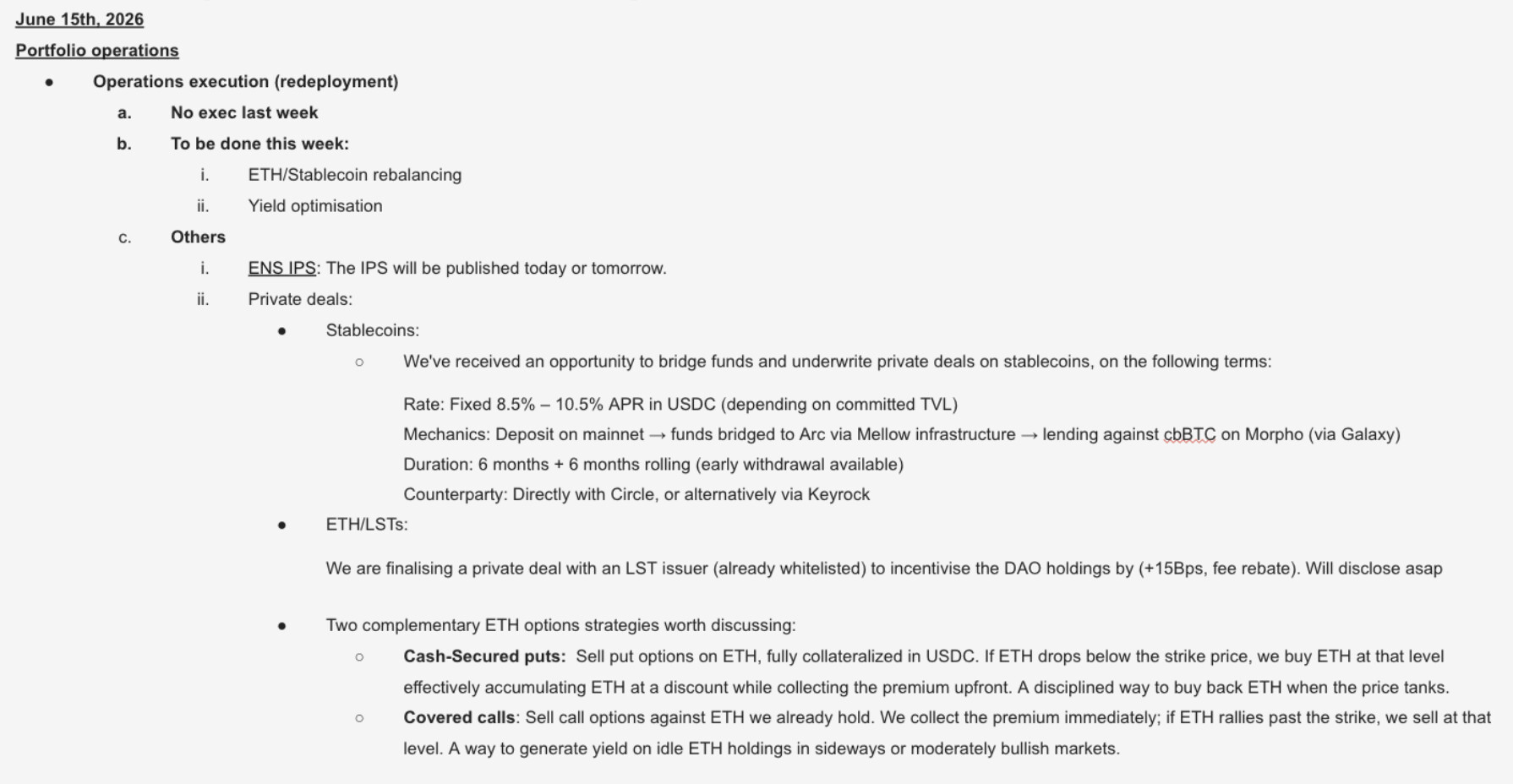
Discussion on moving funds to an alt L1 (like ARC) for private deals raised concerns about counterparty risk, asset management, and transparent ownership.
Karpatki manages 3 multi-sig setups for COW DAO on Mainnet, Gnosis Chain, and Arbitrum.
Attendees requested documentation to understand operational risks for L1 expansion.
The investment philosophy discussed giving Karpatki flexibility to invest in assets like real-world assets or alt L1s, with a desire to execute quickly and trust experts within high-level guidelines.
Delegates expressed concerns that the suggested risk profile is materially different from the endowment’s traditional low yield, low risk vehicle perception, raising fears of speculative yield gathering operations.
It was suggested that such activities should be very limited to a small percentage of the portfolio, and a snapshot vote during the IPS approval process could measure collective risk appetite.
The current IPS draft includes very minimal updates, like language clarifications, lacking sufficient feedback for material changes related to L1s, L2s, etc.
A proposal was made to test shielded voting for the upcoming Term 7 steward election to experiment with the primitive before deciding its future policy via a Snapshot Vote.
Concerns were raised about a potential lack of quorum.
On Arbitrum’s Snapshot, shielded voting allows visibility of who voted and with what tokens, but not how they voted until the end of the vote, as votes are submitted encrypted.
A concern was raised about a potential mismatch where shielded voting might not be enforceable for onchain executable votes, which are often more important than Snapshot votes.
Private voting neutralizes strategic voting by whales, making votes less political, and the ideal process involves Snapshot for consensus and onchain for ratification.
5. Open discussion
5.1. Working Group Budgeting
Working groups did not submit collective budget proposals for the current term, creating a budgeting gap.
The next set of stewards should propose and manage their budgets, as they will have a clearer understanding of their needs.
The MetaGov wallet currently holds $184k which is sufficient for near-term operations.
Twitter Space will be organized next week with steward nominees and delegates.
Security Council renewal proposal is up - vote here.
Renewing the Security Council is critical to prevent the DAO from being exposed to an attack.
The Security Council’s veto power and its role in blocking governance attacks were discussed, noting that such attacks can be subjective.
2.2. SPP3
SPP3 received 26 applications, with the review period concluding today.
The committee expects to contact candidates by the end of this week.
To protect the SPP process from the Foundation’s discretion, it was proposed that SPP3 continue and MetaGov transfer its streams to a multisig to avoid a “top-up situation” similar to SPP2.
2.3. Foundation proposal
Concerns were raised about the potential transfer of treasury control from the DAO to the foundation, which could be seen as the end of the DAO and a departure from its core values.
Strong support was expressed for experimenting with better accountability structures, as current key metrics are down despite increased spending.
Concerns were raised that ENS would become not decentralized at all.
The underlying protocol remains decentralized, but the ability to change it through voting is impacted by current centralization.
The process for the foundation proposal was criticized for not leaving “room for options,” especially after Nick delegated 3M token votes, leading to questions about the motivation for community engagement if one person holds all the power.
True accountability requires an independent foundation board, with members with significant prior accomplishments, leadership, and wisdom to hold all teams, including Labs, accountable.
ENS’s past growth and substantial revenue were driven by community engagement, but a perceived lack of accountability or a voting imbalance could drive people away from participating at all.
The narrative that “DAOs are dying” suggests a need for adaptation.
The campaign is going live tomorrow, distributing up to 90k ENS to delegates of active voters.
The campaign aims to increase the delegated total active supply and enhance technical governance security support.
Active voters will be provided with tools to share their participation on platforms like X, and a full PR campaign will be launched to spread awareness.
2.2. Metagov Stewards Election
The results for MetaGov working group stewards will be public tomorrow.
The current Medigov Stewards election and SPP3 program have been notably quiet compared to previous periods
Attributed to the committee-led SPP3 and the shielded voting for MetaGov elections.
Shielded voting is perceived to have prevented extensive politicking, making the voting process much cleaner and contributing to a peaceful atmosphere.
Reaching quorum for the ongoing election has become more challenging due to the absence of real-time voting visibility.
2.3. SPP3
The SPP3 cohort is finalizing selections
Also need to prepare legal documents and sort out stream mechanics.
SPP3 cohort selection will be released all at once on the forum.