Path forward on Working Groups for Term 7

Path forward on Working Group Elections

I’m posting this in personal capacity, several delegates on last week’s MetaGov call encouraged me to put a concrete proposal forward rather than continue waiting. Stewards and delegates, please push back in this thread if any of this misrepresents your view.

Status

In December 2025, the DAO voted to delay Working Group elections so stewards could support the DAO retrospective, with elections expected to resume by April 1 if the retro completed on time. The retro was published in early May, several weeks past that target.

Two structural proposals are now in discussion:

The result is that stewards are operating at reduced capacity with no clear mandate and no election timeline. This post is a proposal to break that inertia by setting a clear sequence: forum discussion this week, a Social Proposal to lock in the election timeline before May 31, a structural decision deadline of May 31, and elections in June with Term 7 starting July 1.

Proposed timeline

Phase 1: forum discussion (May 12 to May 19)

This post is open for community discussion for 7 days. Delegates, stewards, and proposers, please share views and pushback in this thread.

Phase 2: Social Proposal (around May 19 to May 24)

Around May 19, after this discussion period, I publish a Social Proposal that codifies two things:

  • The election fallback timeline (the dates in Phase 4 below).
  • The Term 7 Compensation Guidelines (the exact same structure we have now).

Phase 3: structural decision deadline (May 31)

May 31 is the deadline for the Working Group Restructure proposal to reach a concluded Snapshot vote.

  • If it concludes with a decision by May 31, Term 7 elections run under whatever structure that decision produces, still targeting July 1 as the start of Term 7.
  • If it does not, the Social Proposal’s fallback timeline activates and elections run under the current 3-WG structure.

Phase 4: elections and Term 7 start (June 1 to July 1)

Working backwards from a Term 7 start on July 1, 9am UTC, using the ENS DAO Working Group Rules:

  • June 1 to June 22: Nomination Window. Nominees self-nominate in the relevant working group category and gather the 10,000 signed votes required by WG Rule 4.4. Three weeks gives realistic time for off-cycle nominations, vs. the standard 72-hour window.
  • June 25, 9am UTC: Snapshot voting opens. Voting period is 120 hours per WG Rule 5.1.
  • June 30, 9am UTC: Voting closes.
  • July 1, 9am UTC: Term 7 begins. Outgoing Term 6 stewards step down. Newly elected stewards take their seats (WG Rule 6.2 and 6.3).
  • Within first 5 days of July: Each working group appoints its Lead Steward (WG Rule 8.1). Stewards across working groups collaborate to appoint a Secretary (WG Rule 9.1).
  • July (Funding Window): Term 7 stewards collaborate on the Collective Proposal to request working group funds for the new term.

In short: forum discussion this week. Social Proposal posted around May 19 and voting through by May 25. May 31 restructure deadline. Nominations open June 1. Voting opens June 25. Term 7 starts July 1.


Open question: working group operations until July 1

Between now and the start of Term 7 on July 1, what is the operating model for each working group?

Two options appeared in different moments of the conversation:

  1. All three working groups continue at minimum-viable activity through their current terms.
  2. Only MetaGov continues as is, with scribe and secretary. Ecosystem and Public Goods pause new commitments until the structural direction is clear.

My current understanding is that stewards are suggesting option 2 to be already valid on May. Appreciate delegate and steward input here.

What this means concretely

For current stewards. Be ready to support the nomination and election process from June 1. ENS token compensation also need to be disbursed, taking in consideration the 6 months TWAP.

For the Working Group Restructure proposal. The deadline to reach a concluded snapshot vote is May 31. I’m happy to help with drafting and feedback consolidation. If May 31 is not workable, please raise it in this thread.

For the Foundation Board proposal. The same May 31 deadline applies if its outcome should affect Term 7 elections under a different structure. If not, it can move on its own timeline post-elections.

For delegates. Please share views in this thread by May 19. Silence on the timeline will be read as soft consent. The Social Proposal will then formalize the path before the structural deadline.
3 Likes

Thanks for putting this forward.

As I mentioned on the call, a few points:

  1. The fallback in Phase 3, should contemplate the consensus that current WG structure doesn’t work and it seemed that MetaGov WG is the only WG that should continue, for now.
  2. The decision from this / or any current WG proposal shouldn’t be overwrite at least for the next term, in order for the DAO to decide its future.

Also, can be noted, maybe in light of the other proposals, that the times can be adjusted, so we don’t get caught in the “but the proposal said this date or that”.

2 Likes

For clarity, based on the discussions on the Metagov call I am working on a proposal that takes into consideration these points as well as the feedback highlighted in James’ post here: [Temp Check] Working Group Restructure

I will post this within the next 36 hours

Edit: Delaying posting until Tuesday to allow for additional feedback and to align discussion with Metagov call.

3 Likes

It seems the consensus from the last calls and discussions is that the fallback option should be Metagov WG only.

To make the decision-making process more open and collective, I’ll be submitting a ballot using ranked choice voting, with votes kept private during the voting period and revealed afterward.

This feels like a good proposal to test this mechanism, and it should help make the decision less political.

The ballot options will be:

  • As-is: 3 WGs + secretary + scribe
  • Metagov WG + secretary + scribe
  • Metagov WG only

The compensation terms would remain the same as Term 6:

  • Lead steward: $5.5k/month + ENS*
  • Steward: $4k/month + ENS*
  • Secretary: $5.5k/month
  • Scribe: $3k/month
*2-year vested ENS, calculated using the 6-month TWAP and distributed in the middle of the term, matching the USD value of the salaries.

I’m still figuring out a few details with the Snapshot team and will submit it as soon as possible.

5 Likes

Would like to contain the framework outlined here within MetaGov’s scope, should the DAO vote on MetaGov WG only.

Structured discussions re: architecting the DAO’s operational layer should come into focus next term.

Can you confirm this a six-month term?

I don’t believe scribe is a ballot-level decision - rather, it’s for the elected MetaGov stewards to fund at their discretion.

2 Likes

Given this, a snapshot for a social proposal must be submitted by 26th May to conclude by 31st May.

It seem pragmatic therefore to utilize next weeks Metagov call as a platform through which any outstanding questions about [Temp Check] ENS DAO Coordination Layer can be presented.

I would agree that a fallback is necessary, but I think the area of confusion on the last call was what proposal(s) would be going up. If this fallback goes up between now and the 24th, and then a social proposal for the Coordination Layer goes up on the 26th is it simply the case that if both pass then the proposal that passed later takes precedence?

Assuming so, it seems sensible to have a singular exhaustive proposal that just outlines the options on the table and allows delegates to make a singular selection as to their preference.

Agree, @netto.eth it’s simpler to have a binary ballot up. In this case:

  • As-is: 3WGs + secretary + scribe
  • MetaGov WG only

But I’ve been having second thoughts about the direction we’re heading in: we’re voting to elect a body with operational authority, but without an explicit mandate.

This creates a massive accountability gap, imo.

Why aren’t we first discussing what this new WG’s mandate will be? If the goal is to preserve the status quo, then I don’t agree that we should proceed with the vote without tying the new WG to an explicit ruleset.

If your answer is, “the new MG WG stewards will figure it out,” that’s a pretty weak stance. Without a mandate and clear expectations, it’s hard to hold stewards accountable for… anything at all.

Case in point: only one of the three MG WG stewards have been present during the retrospective (with little to no operational presence overall), yet all received a salary. Salaries are usually tied to clear scope, measurable participation, and accountable delivery — not just title occupancy.

Why is the DAO rewarding a Steward set, whose actions cannot be measured and cannot be held accountable? That is imprudent, financially and ethically speaking.

We’ve previously argued that the Foundation proposal as written lacked process legitimacy — we should therefore hold the WG restructuring proposal(s) to the same standard.

1 Like

Addressing some of the feedback here and on DMs:

Working group rule amendments for each option and details

1. As-is: 3 WGs + secretary

  • Lead steward: $5.5k/month + ENS*
  • Steward: $4k/month + ENS*
  • Secretary: $5.5k/month

2. Metagov WG + merged Ecosystem/Public Goods WG + secretary

  • Lead steward: $5.5k/month + ENS*
  • Steward: $4k/month + ENS*
  • Secretary: $2k/month
    • No need to attend calls
    • Signer for extra security
    • Support on operations by loading transactions on the multisig
    • Manages Calendar
  • Add rule to remove a steward from a WG if there is 2/3 consensus within the WG.
Required Working Group Rule amendments

Per Rule 12, the following amendments would be bundled into this Social Proposal. Additions in bold, removals in strikethrough.

Dissolve Public Goods WG and merge its mandate into the Ecosystem WG

Include a dissolution clause for the Public Goods WG under Rule 2.1, with unspent funds returned to the DAO treasury per Rule 2.3. The Social Proposal should explicitly state that the Ecosystem WG’s mandate is expanded to incorporate the Public Goods scope.

Amend Rule 7.1 to allow within-WG steward removal

7.1. Stewards may be removed at any time by:

  1. a Social Proposal passed by the DAO;
  2. a simple indicative majority vote among Stewards of all working groups, with the outcome of that vote communicated in the relevant working group category of the ENS governance forum; or
  3. a two-thirds vote among the elected Stewards of a single working group, with the outcome of that vote communicated in the relevant working group category of the ENS governance forum.

Amend Rule 9.8 to drop meeting-attendance and add multisig ops support

9.8. The responsibilities of the Secretary include, but are not limited to:

  1. Managing a DAO-wide calendar;
  2. Coordinating and attending working group meetings where possible and ensuring meeting summaries are posted in the ENS governance forum; Loading transactions on working group multi-sigs to support operations;
  3. Assisting Stewards with coordination challenges within working groups; and
  4. Acting as a multi-sig keyholder for each working group.

3. Metagov WG + merged Ecosystem/Public Goods WG (no secretary)

  • Lead steward: $5.5k/month + ENS*
  • Steward: $4k/month + ENS*
  • Multisig changes to 2/3, which is the decision structure within each group on the social layer.
  • Add rule to remove a steward from a WG if there is 2/3 consensus within the WG.
Required Working Group Rule amendments

Per Rule 12, the following amendments would be bundled into this Social Proposal. Additions in bold, removals in strikethrough.

Dissolve Public Goods WG and merge its mandate into the Ecosystem WG

Include a dissolution clause for the Public Goods WG under Rule 2.1, with unspent funds returned to the DAO treasury per Rule 2.3. The Social Proposal should explicitly state that the Ecosystem WG’s mandate is expanded to incorporate the Public Goods scope.

Amend Rule 7.1 to allow within-WG steward removal

7.1. Stewards may be removed at any time by:

  1. a Social Proposal passed by the DAO;
  2. a simple indicative majority vote among Stewards of all working groups, with the outcome of that vote communicated in the relevant working group category of the ENS governance forum; or
  3. a two-thirds vote among the elected Stewards of a single working group, with the outcome of that vote communicated in the relevant working group category of the ENS governance forum.

Amend Rule 9.1 to permit no Secretary appointment and disapply the rest of section 9

9.1. At the start of each Term, the current Stewards of each working group may shall collaborate to appoint an individual who will serve as the secretary of the DAO (hereafter ‘Secretary’ or ‘Secretaries’). If no Secretary is appointed for a Term, rules 9.2 through 9.8 shall not apply for that Term, and the administrative duties otherwise set out in rule 9.8 (other than multi-sig keyholding, which is governed by rule 10.3) shall be carried out collectively by the Stewards of each working group.

Amend Rule 10.3 to remove the Secretary from the multisig

10.3. Each working group multi-sig must have four keyholders, made up of three current elected Stewards for that working group and the Secretary of the DAO for that Term, with no other keyholders permitted. Where no Secretary has been appointed for a Term in accordance with rule 9.1 above, each working group multi-sig shall instead have three keyholders, made up of the three current elected Stewards for that working group, with no other keyholders permitted.

Amend Rule 10.4 to set 2-of-3 signing

10.4. Working group funds may be disbursed from working group multi-sigs with three-of-four keyholder signing**, or with two-of-three keyholder signing in the case of a three-keyholder multi-sig as defined in rule 10.3 above.**


4. Metagov WG only

  • Lead steward: $5.5k/month + ENS*
  • Steward: $4k/month + ENS*
  • Multisig changes to 2/3, which is the decision structure within the group on the social layer.
Required Working Group Rule amendments

Per Rule 12, the following amendments would be bundled into this Social Proposal. Additions in bold, removals in strikethrough.

Dissolve Public Goods WG and Ecosystem WG

Include a dissolution clause under Rule 2.1, with unspent funds returned to the DAO treasury per Rule 2.3.

Amend Rule 7.1 to allow within-WG steward removal

7.1. Stewards may be removed at any time by:

  1. a Social Proposal passed by the DAO;
  2. a simple indicative majority vote among Stewards of all working groups, with the outcome of that vote communicated in the relevant working group category of the ENS governance forum; or
  3. a two-thirds vote among the elected Stewards of a single working group, with the outcome of that vote communicated in the relevant working group category of the ENS governance forum.

Amend Rule 9.1 to permit no Secretary appointment and disapply the rest of section 9

9.1. At the start of each Term, the current Stewards of each working group may shall collaborate to appoint an individual who will serve as the secretary of the DAO (hereafter ‘Secretary’ or ‘Secretaries’). Where only a single working group exists, the Stewards of that working group may elect not to appoint a Secretary. If no Secretary is appointed for a Term, rules 9.2 through 9.8 shall not apply for that Term, and the administrative duties otherwise set out in rule 9.8 (other than multi-sig keyholding, which is governed by rule 10.3) shall be carried out collectively by the Stewards of the working group.

Amend Rule 10.3 to remove the Secretary from the multisig

10.3. Each working group multi-sig must have four keyholders, made up of three current elected Stewards for that working group and the Secretary of the DAO for that Term, with no other keyholders permitted. Where no Secretary has been appointed for a Term in accordance with rule 9.1 above, the multi-sig for the sole working group shall instead have three keyholders, made up of the three current elected Stewards for that working group, with no other keyholders permitted.

Amend Rule 10.4 to set 2-of-3 signing

10.4. Working group funds may be disbursed from working group multi-sigs with three-of-four keyholder signing**, or with two-of-three keyholder signing in the case of a three-keyholder multi-sig as defined in rule 10.3 above.**


5. DAO Coordination Layer

Replaces all three WGs with a single operational coordination body operating as a 12-month pilot. See [Temp Check] ENS DAO Coordination Layer for full details.

  • Lead-steward-equivalent compensation: $5.5k/month + ENS*
  • Initial composition of 2 stewards, with a 3rd elected through an open delegate process within the first 30 days
  • Up to $500k operational budget per 6 months, subject to transparency requirements, timelock constraints, and veto mechanisms
Required Working Group Rule amendments

Per Rule 12, the following amendments would be bundled into this Social Proposal. Additions in bold, removals in strikethrough.

Dissolve all three Working Groups

Include a dissolution clause under Rule 2.1 (Public Goods WG, Ecosystem WG, and Meta-Governance WG), with unspent funds returned to the DAO treasury per Rule 2.3.

The Coordination Layer would operate under its own ruleset rather than the Working Group Rules. With no Working Groups in existence during the pilot, sections 3 through 11 of the WG Rules would not be operative.


Additional considerations

  • Deleted scribe from the options, since it’s a Metagov decision.
  • The 2/3 within-WG steward removal rule would be useful to add regardless of which option wins. If more working groups are created again in the future, it’s a good safeguard to have in place.
  • I’d also be supportive of a working group focused on growth and revenue, which I’ll bring to discussion in the next opportunity. We need to discuss this subject more as a DAO and have initiatives pushing it forward.
  • Regarding the duration of the term, my understanding is the majority would prefer to continue having a 1 year term.
    • Some complaints about changing terms between holidays (Christmas and New Year’s Eve)
    • 6 months is a short period to make more meaningful contributions. Less elections is also better for delegates, reducing voting and political friction.
    • If the DAO decides to make the restructuring happen, we can always interrupt the term.

Due to some push back from different delegates, for this vote we’ll not be using private voting. Ranked choice is very gameable and can make delegates role harder and more political than it already is, plus needing to take in consideration strategic voting behavior. I’ll post another thread where we can discuss the use of private voting on the DAO and hopefully use it on the next votes.

2 Likes

Secretary

The secretary would be a steward nomination and not a ballot-level choice. It’s in the working group rules. If we decided to the position out, that vote should also include an amendment to remove it from the wg rules.

The added member to the multisigs has been a beneficial standard since we reduced the steward count to three.

Clarified already.

Private Voting

@netto.eth Regarding private or sheilded voting: is this something that will be turned on for every vote now?

It would remove politics/gamification and is a standard in most publicly held governmental elections, but it can’t me replicated with the on-chain votes (currently), which we should acknowledge.

I’m not against it, but I don’t think it’s a casual change, so looking for clarification.

@netto.eth If we do roll-up proposal with three options like:

  • Option A
  • Option B
  • Neither/Abstain

I would also strongly advise against anonymous voting combined with single choice or basic voting with more than two choices.


Possible Scenario

Say 100 voters turn out:

  • 34 vote A
  • 33 vote B,
  • 33 vote Neither.

Option A wins, but 66% of voters actively didn’t want A.

The “Neither” option doesn’t protect against A; it dilutes the opposition to A by splitting it across two buckets.

The shielded voting mechanic makes this worse in a specific way. In a transparent vote, a voter who prefers Neither but really doesn’t want A can watch the tally in real time and switch to B if A is pulling ahead. Anonymity eliminates that safety valve. Every voter casts their true preference in isolation, with no ability to coordinate against the leading option they oppose. The result is that sincere preferences produce an outcome the majority didn’t want.

A few ways to fix this:
Ranked choice / IRV: voters rank options. If no option hits a majority, the lowest finisher is eliminated and those votes redistribute. Neither would likely be eliminated first, its voters’ second choices flow to A or B, and you get a majority winner.

Approval voting: voters can approve multiple options. Someone can vote “I’m okay with B or Neither, but not A,” their vote counts for both without splitting.

Two-round runoff: Two voting rounds. First eliminates the weakest option, second round is a head-to-head. This lets voters consolidate without strategic voting pressure in round one.

@Coltron.eth Yes, ranked Choice with IRV solves this elegantly.
An argument could be made for Copeland again.

I think Snapshot implemented one of these, if not multiple, after Avsa asked for it. Hopefully that’s what Netto is connecting with them about.

2 Likes

Edited the previous post to add more details about working group rules and etc.

@Coltron.eth It would be a ranked choice vote, with the 4 options mentioned above, as @5pence.eth mentioned, using Copeland (which IMO is the best algorithm, given the Arrow’s theorem). 1M ENS quorum would be sufficient to make the vote valid. (I assumed I had added it on the proposal initially, thanks for asking)

Private/shielded voting is currently deactivated (that’s why I was in contact with the snapshot team and now waiting for admin access to the snapshot space cc @nick.eth @184.eth), It can be enforced to be used on all offchain proposals, for now I’d suggest we use the per proposal setting, and the proposer chooses what to use.

1 Like

I don’t think ‘we can interrupt the term later’ is sufficient as a governance plan. We should define a minimum mandate + accountability framework now, then elect against that.

Since we’re already discussing amendments to the Working Group rules, now is the right time.

2 Likes

This proposal is now live on snapshot.

Per request of delegates and discussions on today’s metagov call, I included @clowes.eth’ DAO coordination layer as an option and merged Ecosystem with Public Goods.


I’m just stating what can happen, like the ENS Admin proposal which was proposed while the term was happening. Unfortunately we don’t have time to include these discussions within this proposal, so we have more time for nominations and clarity for current stewards.

More accountability, goals and clear mandate is something very much needed to improve WGs. We can aim to discuss it on the coming weeks and get another proposal out to be included in Term 7.

Thanks @netto.eth !

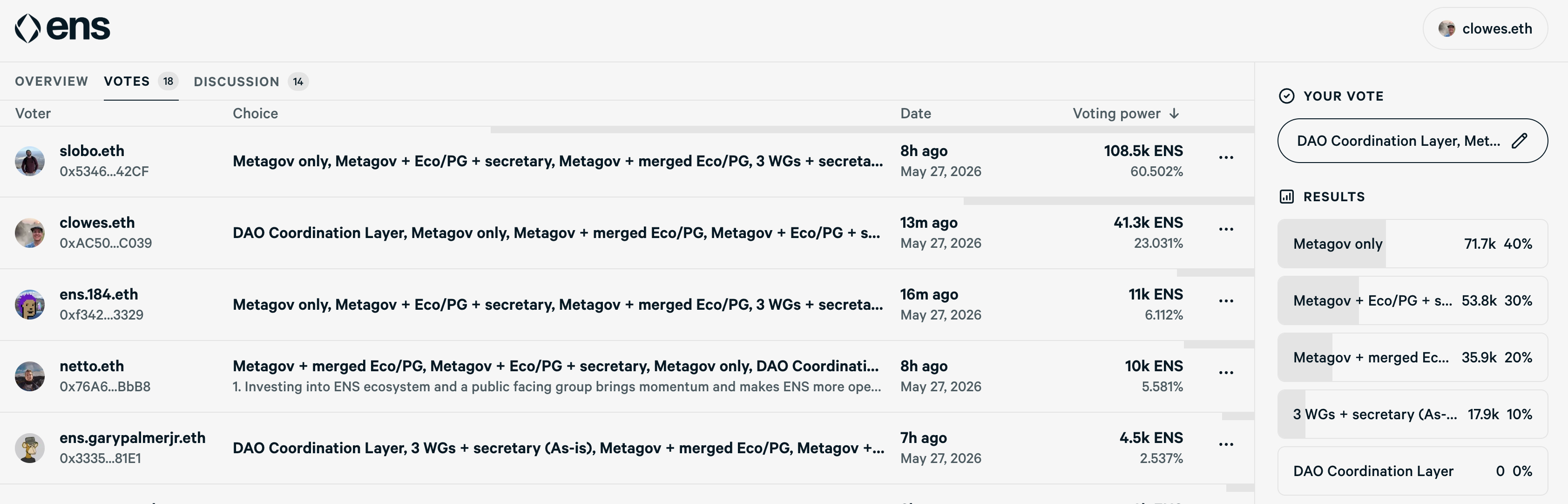
I’ve just submitted my vote and I unsurprisingly ranked the Coordination Layer in first place. The ‘Results’ as they stand state 0% next to the option, which doesn’t seem correct noting that I am the second largest delegate that has voted thus far. Is this a Snapshot issue, or a misunderstanding on my part as to how the voting mechanism works?

Additionally is it possible to edit the proposal body to add the high level summary of the Coordination Layer option, and a link to the thread? :folded_hands:

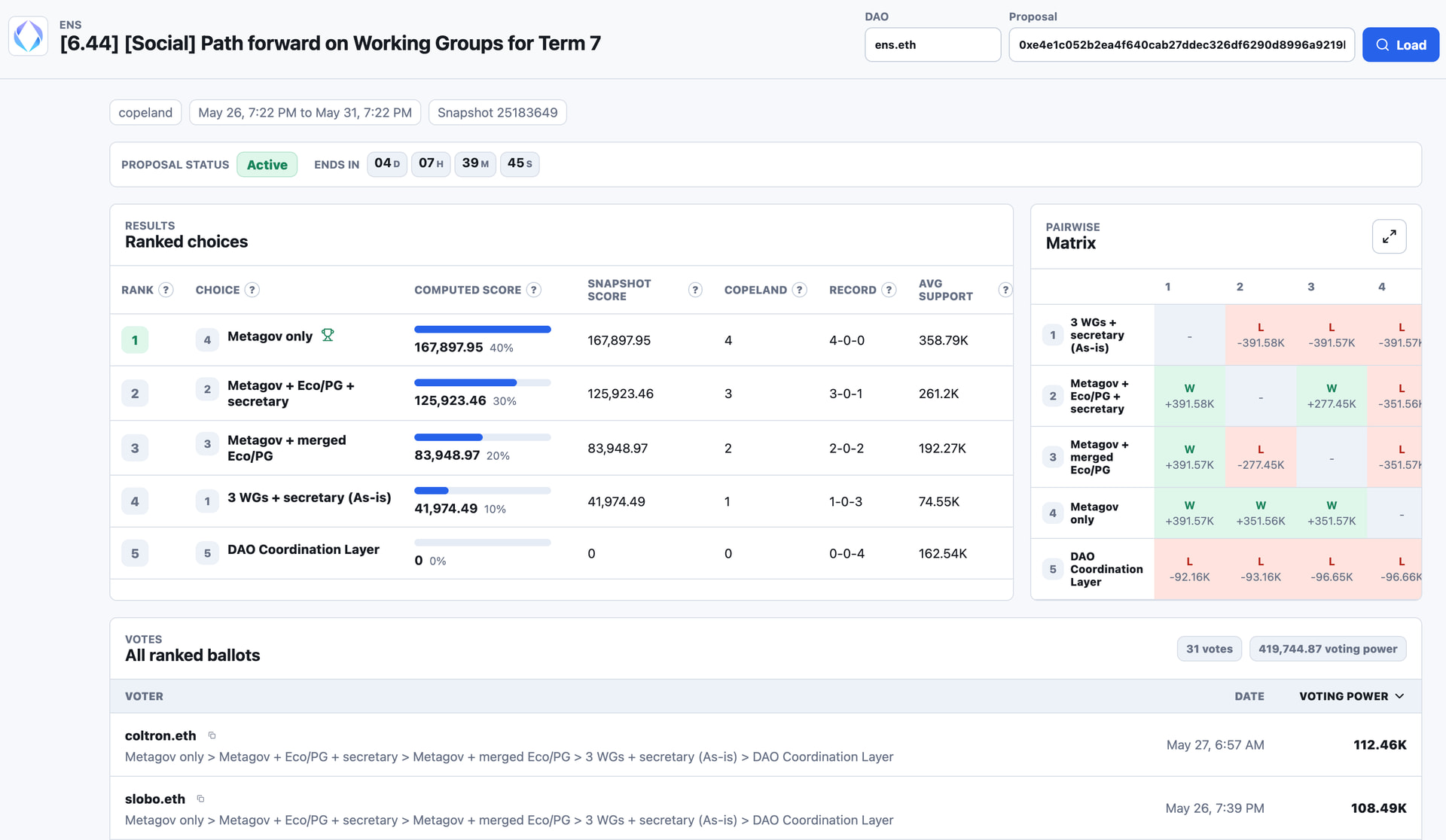
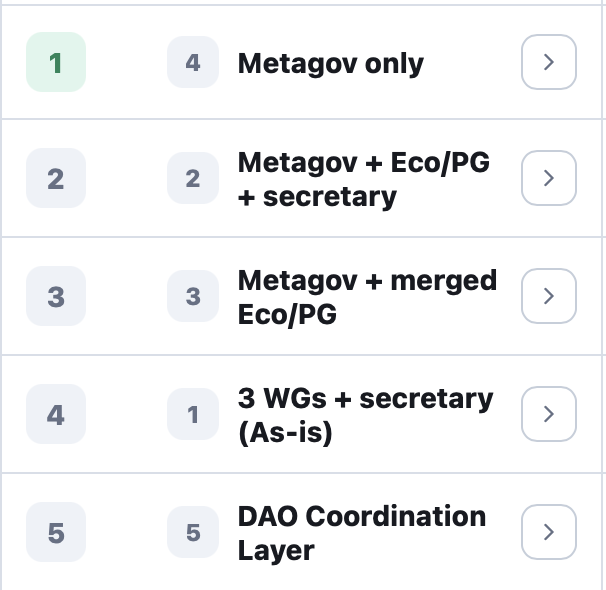
Shannon’s ghost made this. I encourage others to QA it, but I believe running this will give current standings.

Current winner: Metagov only. Condorcet winner: beats every other option.

Standings (Copeland)

Rank Option Pairwise W-L-T Copeland score Avg support (VP)
1 Metagov only 4-0-0 4 351,523
2 Metagov + Eco/PG + secretary 3-1-0 3 250,374
3 Metagov + merged Eco/PG 2-2-0 2 183,196
4 3 WGs + secretary (As-is) 1-3-0 1 71,920
5 DAO Coordination Layer 0-4-0 0 161,664

Data pulled: 2026-05-27 14:11:52 UTC. Latest vote: 2026-05-27 13:58 UTC

2 Likes

+1 on anti-failure guardrails.

Looking forward to discussing this in the coming weeks.

Inspired by @slobo.eth’ proactivity, I created a simple app to visualize copeland votes in realtime:

Hope it helps @clowes.eth. And not possible to change the proposal description, unfortunately.

2 Likes